
Bernard Arnault’s dilemma


familyandtrends a year ago, commenting on the fate of Armani, I had the opportunity to discuss the major French luxury groups, stating: “… we must bear in mind that the luxury sector is at a turning point; after twenty years of continuous growth, the number of consumers is no longer increasing and their ability to make choices without being guided solely by price has improved, even in emerging markets. The two groups that have defined the sector over the past twenty years, LVMH and Kering, are facing a generational transition that will put their founders to the test: Bernard Arnault has raised the age limit to 85 and, at 76, has five children working in the company; François Pinault is 89 years old and has, in recent days, played the ‘professionalisation’ card with Luca De Meo to steer the group out of a difficult period for some of its brands.”
On 27 July, Bernard Arnault responded to a journalistic investigation by *Le Monde* that examined in detail the succession tensions at LVMH with a masterful open letter on X. With impeccable style and masterful conciseness, the French entrepreneur addresses the relationship between family business and journalism when he states: “You have chosen to take stock of our wardrobes and scrutinise a family dinner. It is an editorial choice, and I respect it. In a free country, you have every right to prefer low-brow gossip to the reality of artisan workshops and business. It’s far more juicy, I’ll readily concede that… It’s all too clear to me that you have deliberately chosen to punish us for our transparency. Let this serve as a lesson to whoever you decide to target in the future.” For those who, like familyandtrends, believe it is possible to discuss family business, business strategy and capitalism without resorting to gossip, there is no better summary of how relations between journalists and entrepreneurs should not work.
Arnault also comments on his succession plan: “I would have appreciated at least a modicum of tact, perhaps a hint as to how five such ambitious personalities [his children] manage to work under the same roof without the whole enterprise turning into a tragic Italian soap opera. But apparently, in the Arnault household, there’s no discussion; there’s scheming. There’s no deliberation; there’s a struggle for the throne. Which makes for excellent storytelling. In the real world, my children run major brands, build incredible teams, make difficult decisions and – the ultimate sacrilege – ring each other on Sundays. What ordinary people call a family Sunday, your journalists call a corporate conspiracy. Clearly, it’s just a matter of vocabulary. We prefer Sundays… luxury is one of the very few sectors in the world that thinks in terms of generations, not financial quarters. A cognac is left to age for between 10 and 50 years before it is sold. The legacy of a vineyard is passed down over eighty years. The unrivalled savoir-faire of a master trunk-maker or a glassblower takes twenty years to build and only three to be completely destroyed. You do not manage this heritage like a Silicon Valley tech start-up: you nurture it, protect it and pass it on. It is a long-term endeavour and an immense responsibility, made all the more weighty by the fact that, in reality, it does not belong to me. It belongs to the hands and minds of our 220,000 employees worldwide – 40,000 of whom work right here in France – the families who depend on us, and the historic maisons of which we are merely temporary custodians.”
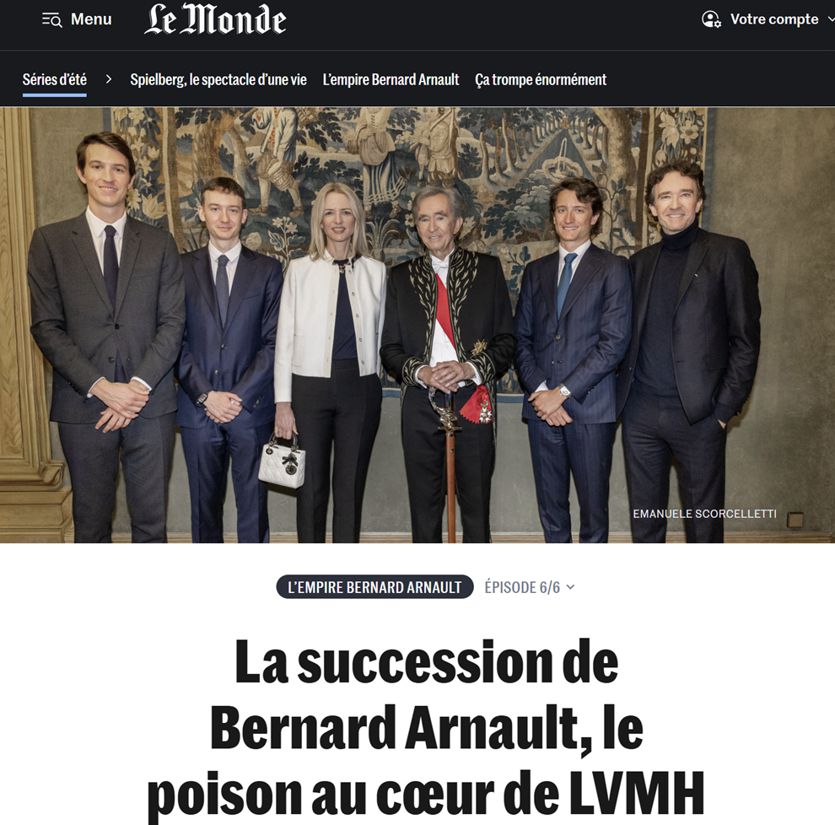
On the subject of his succession, Arnault’s response is straight out of a textbook, but if one is to give Le Monde at least a modicum of credibility, there do seem to be some issues: in 2025, the maximum age for the CEO of LVMH was raised to 85, having already been raised to 80 in 2022. The French magazine claims that the entrepreneur hates conflict and, by delaying decisions, is trying to hold together a system that would collapse without him. It seems, again according to Le Monde, that LVMH’s managers are pushing for external leadership, as happened with De Meo at Kering. Many of them have acted as mentors or been involved in the upbringing of his five children, and dangerous alliances are reportedly forming, which, without strong leadership, would quickly turn into factions.
The investigation also documents tensions between the children from his first marriage – Delphine (51) and Antoine (49) – and those from his second marriage – Alexandre (34), Frédéric (31) and Jean (27) – as well as between the children from his first marriage and his second wife, Hélène. In this regard too, Bernard has devised a solution, acting as godfather and godmother to the younger children. This may be a first step towards bringing the five of them together, but it seems there is still a great deal of work to be done.


