
The Boggiano tree cultivates freedom
Cristiano Berti reconstructed, between archives and artistic rendering, the story of African men and women who had acquired the name of the Italian master in Cuba in the 19th century and then redeemed themselves. In Turin installation, film and book

3' min read
3' min read
Memory and roots, oppression and freedom, passion and research: there is everything in this Cuban story (but not only) that recounts the journey made by dozens of men and women starting from a word. A surname, to be exact: Boggiano. The "passion" and the "research" are those of Cristiano Berti, professor at the Macerata Academy of Fine Arts and visual artist. The 'surname' is that of a merchant and landowner born in Savona in 1778 and died in Cuba in 1860, Antonio Boggiano. Berti followed in his footsteps, went to Trinidad, came across a proliferation of 'Boggiano's', studied and reconstructed the immense family tree that developed over time and became an installation on two walls in the Guido Costa Projects gallery in Turin. He wrote an essay (Eredi Boggiano, Quodlibet 2022) in which he condensed a work that lasted five years. He filmed the faces of some of the many Boggiano's he spoke to and the environment in which they live (this film is also available in the gallery). Why? What drove him to devote himself to this? This is where the other elements of this story come in.
Berti's excavation work - in historical archives, libraries, parish registers - leads to a time when the shame of slavery was not considered as such. Locked in slums, exhausted by exploitation, exposed to epidemics, African slaves had a very low average life expectancy. Rebellions were fiercely suppressed and when they attempted to escape they risked their lives, forced to hide in wild and treacherous territories. If caught, they knew their minutes were numbered. In the early 19th century, the enterprising and ambitious Antonio Boggiano was the owner of a coffee plantation, Nuestra Señora de la Misericordia, in the Polo Viejo area, in the mountains behind Trinidad. Two wives, nine children (two of whom died in infancy) and a wealthy life, his, accompanied, for fifty years, by the possession of slaves arrived from Africa. It was he who commissioned a marble altar for the city's most important church, the Iglesia Mayor, dedicated to the Santísima Trinidad.
According to the unwritten law in force in the Spanish colonies, slaves acquired their master's surname as a second surname: parish books show that in the Boggiano plantation, this happened to 51 Africans, 58 African women, 57 Creoles and 67 Creoles, whose relatives, marriages, baptisms, types of 'service', everything possible to restore their identity, were reconstructed by Berti. The custom was that slaves could recover their freedom upon payment of a sum of money, a public deed recorded in the ancient notary books of Trinidad. Thus slowly began the redemption of the Boggianos (those who had not been sold to other owners: sales were frequent), determined to change their destiny and live with dignity.
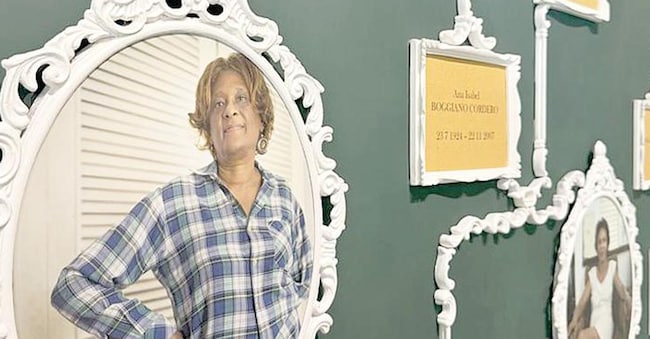
The first to apply, in 1822, was María de Jesús Boggiano: she shelled out five hundred pesos; she was followed by Felipe (650 pesos), Teresa, Esteban and others. From their new condition as free men, the descendants of Boggiano were born, who populated this territory and are still there today. This is well illustrated by Berti's installation in Turin, an extensive (17 metres) and spectacular latticework of handmade resin tiles bearing name, surname, date of birth and death (in some cases missing, where they could not be traced: in between there was the Cuban revolution and waves of migration). The most recent birth was in 2023. Below, alongside the most recent names, there are also photographs of some of the Boggiano people Berti spoke to.
Some of them appear in the 35-minute video entitled Pero está por ahí, ¿no? , filmed in Polo Viejo, where the village that once existed has been largely swallowed up by rampant vegetation. There are voices and faces of people living with little, conveying the experience of the ancestors of that coffee plantation that disappeared more than a century ago. Like the installation, they testify to the past of those who had the strength to emancipate themselves from slavery and the present of those who bear that surname: no longer a mark to be ashamed of, but a sign of freedom.


