
The story of the forest, families and children in society

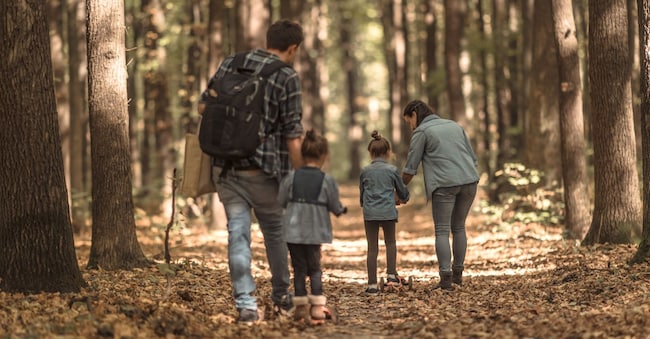
In recent times, we have been inundated with rivers of words about the now infamous family in the woods. Public opinion has taken sides either for or against it. We certainly do not want to get into the merits of this discussion. Instead, I would like to try to trace the underlying question that runs through this heated debate. Perhaps in the watermark we seem to read this question: are children of the family or are they of the social?
What we find on all sides is a radical opposition between family and social, as if they were two entities not only distinct but in total antithesis, one against the other.
We are used to thinking of children as something that is totally in the private sphere: they belong to the parental couple or even to the individual parent. That implicit in the parental role there is a social responsibility is something that is scarcely considered and tends to remain in the background. It only comes to the surface in situations of 'prejudice', in the face of neglect or mistreatment, in situations requiring intervention by the services. To put it simply, we could say that as long as everything goes well, they are parents, but when something goes wrong, then they are the object of intervention by the social services (possibly even the judiciary). The underlying logic is that of 'either' they belong to the private sphere ... or to the public sphere.
But the social is composed of families and families constitute the social: they are interdependent realities, and deeply intertwined. In reality, it is not possible to separate them, and considering them clearly separate produces misunderstandings, as is evident in the many words spent these days.
If bringing up children is a socially connoted task, parents cannot be left alone: it is indispensable for the social sphere to be at the side of families (and not against them), to accompany them in this increasingly arduous undertaking, and to prevent situations of overt distress. We commonly use this fine expression 'bringing a child into the world': the child is embedded in a broader horizon, in an interweaving of individual, couple, family and social dimensions. The child is not for oneself, it is not an extension of the adult, nor an object on which to project one's desires. Each child is the fruit of the meeting of the genetic heritage of many generations, therefore, linked not only to those who generated it, but through them to previous generations (as is clear when looking at the family tree). They are children of the family and at the same time citizens of tomorrow, embedded in a specific historical and cultural context. They constitute a social generation, they are the children of our future. And these are constitutive dimensions of their identity, i.e. they make that child a child.

