Formula 1

The economics of British motorsport: the Aston Martin case

The team led by Lawrence Stroll is undergoing a complete technical and economic restructuring to improve performance and compete in the Formula 1 championship. Investments, partnerships and future challenges outline the team's path

by Massimo Ruberti and Glenda Mecaj

9' min read

9' min read

The Austrian Grand Prix marked a point of no return for the 2025 World Championship drivers' standings. Kimi Antonelli's strike against Max Verstappen dropped the Dutch driver to 61 points from the top. Too many even for the talented Red Bull driver, who nonchalantly commented: 'I had stopped thinking about the drivers' championship for a while.

The competition will therefore remain at two, between Lando Norris and Oscar Piastri, the drivers of the McLaren spaceship. The team sympathetically called "papaya" because of the tropical colour of the cars, signs a one-two at Spielberg that recalls the McLaren one-two of 16 July 2000, when the colours were "silver" and the driver duo was formed by Finn Mika Häkkinen and Scotsman David Coulthard. The safety gap with the other rivals and the closeness in terms of performance between Lando and Oscar promise a close battle for the next grands prix and the famous (but also infamous) 'papaya rules' may well no longer be necessary.

Loading...

Ferrari updates are promising

In a weekend where McLaren was able to make the most of all its strengths (first and foremost its handling of high temperatures), Ferrari made important steps forward in terms of performance and race execution. In fact, the team from Maranello placed both drivers in the first two rows in qualifying for the first time this season and, with the same strategy, took over 30 seconds off George Russell, fresh winner in Montreal.

While it is true that Mercedes performance is negatively correlated to temperature, Ferrari also had its hands full with brake temperature management. The constant lift and coast required of the Red's drivers to keep the brakes from heating up created the early gap to McLaren. Without these brake difficulties, the Maranello team could have tried to put the Woking team, if not in trouble, at least in apprehension with an aggressive strategy. Ferrari's improvement in performance is due to the introduction of the first package of updates that will be completed at Silverstone. Confirming that the SF25 has made a performance leap, Lewis Hamilton finally appeared to be on the pace, coming in just behind Charles Leclerc.

LA CLASSIFICA

Loading...

The British DNA of Formula 1

.

The British Grand Prix has been a fixture on the calendar since 1950 and Formula 1 has its roots in this land of tradition and passion for many sports, including motorsport. Britain, but in particular the English Midlands, is literally the cradle of Formula 1, hosting no less than seven of the ten teams currently involved in the world championship. In addition to the English engineering tradition, the role of drivers from these lands is evident in the history of the Circus.

Of the twenty drivers racing on the track in 2025, four are British: veteran Lewis Hamilton, former teammate George Russell, Papaya driver Lando Norris and, finally, Haas rookie Oliver Bearman. This brood of talent is just the latest in a long generation that has seen more than 150 British drivers make their Formula 1 debut, ten of whom have gone on to become world champions. Among them are true motorsport legends: Lewis Hamilton, seven-time world champion first with McLaren and then Mercedes; Jackie Stewart, who won three titles racing with Tyrrell and then Mantra powered by Ford; and Graham Hill (British Racing Motors and Lotus) and Jim Clark with Lotus.

Even on the team side the British presence is not diminished, in fact ten British constructors have won the relevant title. Notable for the nine titles won were Williams and McLaren, who are still active in the championship. The former is going through a disappointing period in history but has a promising project and the latter is dominating both the constructors' and drivers' championships. Between the 1960s and 1970s Lotus excelled, with seven constructors' titles won. Brabham and Cooper followed in number of victories, with two wins each.

Today, no fewer than seven racing teams have chosen to have their headquarters in the UK: McLaren in Woking, the Austrian Red Bull team in Milton Keynes, Mercedes in Brackley, Aston Martin right in Silverstone, French Alpine in Enstone, Williams in Groove and Haas in Banbury (although it partly maintains operations in the US). But why did seven out of ten racing teams choose the UK as their business location?

I CAMPIONI DEL MONDO BRITANNICI

Loading...

SCUDERIE BRITANNICHE CON VITTORIA DEL TITOLO COSTRUTTORI

Loading...

The development of the Motorsport Valley since the Second World War

.

It may seem strange that companies so proud of their nationality, such as Mercedes and Renault for example, have for decades chosen to plant the technological foundations of Formula 1 car development in England. Yet, as previously mentioned, the choice is driven by a need in terms of human and technological capital that are rooted in the Midlands.

Following the end of the Second World War, the Thames Valley area became fertile ground for the development of cutting-edge motorsport technologies: these areas had been selected as ideal for airstrips, and as a result, at the end of the conflict, many aerospace engineers who had formed the core of the technological development of the RAF, the Royal Air Force, found themselves 'unemployed'. These skills in building light, fast and easy-to-repair aircraft were transferred to motorsport. In addition, former airfields could be converted into racetracks. One example of this was the Silverstone circuit, site of the first ever Formula One race on 13 May 1950.

Supporting the ecosystem of the so-called Motorsport Valley, there is also a large number of companies specialising in advanced automotive technology: a BBC article from 2013 shows that there are as many as 3500 companies associated with the motorsport sector in the region, employing around 40,000 people. It is not hard to imagine how the numbers could have increased further in the last twelve years. Certainly, contributing to the system is the British educational network, with over 15 universities offering bachelor's and master's degrees in motorsport engineering and more than 200 colleges with programmes dedicated to practical motorsport training. This ensures a continuous generation turnover and meets the needs of Formula 1 teams, suppliers and companies in the industry.

The re-launch of the stable to grow the Aston Martin group

.

Silverstone is home to one of the most ambitious racing teams in Formula 1 today, Aston Martin Racing. The project to relaunch the British car manufacturer is the work of Lawrence Stroll, a Canadian entrepreneur and founder of the company Sportswear Holdings Ltd, with which he contributed to the global success of brands such as Tommy Hilfiger and Michael Kors. Lawrence Stroll's entry into Formula 1 is in fact not due to a sporting fun to give his son Lance a seat, but to a much broader vision of relaunching the manufacturer of the cars made famous worldwide by agent 007, Bond. James Bond.

The 'Aston Martin Lagonda Global Holdings PLC' group listed on the London Stock Exchange in 2018 is currently undergoing a restructuring attempt led by Stroll himself, but with other players in the sports capital market, such as Ernesto Bertarelli, Toto Wolff and the Saudi Pif fund, as cash providers. One of the greatest tools for relaunching the group is the return in image that Formula 1 can give to Aston Martin: from this perspective one can understand the great investments that Aston Martin has made and is making to become competitive in the Circus.

The first steps of the Aston Martin F1 Team

.

The Aston Martin team relies on the structure formerly known as Force India. The first step towards the sporting revival is the transformation of the team into Racing Point, which debuts with drivers Sergio Pérez, already part of the previous management, and Lance Stroll, former Williams driver and son of the owner. Following Lawrence Stroll's entry into the Aston Martin Lagonda automotive group in 2020 for around $235 million, the racing team takes over the name of the British car brand under the name Aston Martin F1 Team.

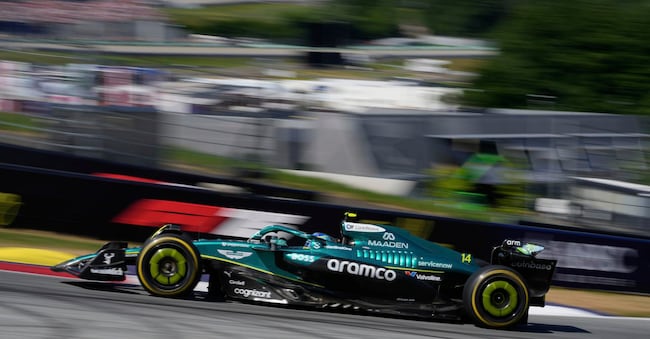
From 2022, with the signing of the partnership with Aramco, one of the world's largest oil producers, the team takes on its current name: Aston Martin Aramco F1 Team. In sporting terms, the strategy is clear: to pair Lance Stroll with high-profile drivers to accelerate the team's growth. After Pérez's farewell, four-time world champion Sebastian Vettel arrives in 2021, followed in 2023 by Fernando Alonso, who has won the drivers' championship title twice.

Initially the strategy seems to be a winner, the 2023 season getting off to a surprising start with four podiums by Alonso in the first five races. However, the single-seater's loss of performance in the second half of the year results in the championship finishing fifth in the Constructors' standings (280 points), with Alonso fourth in the Drivers' standings and Stroll tenth. The negative trend continued into 2024, with the team again finishing fifth in the Constructors' Championship, while Alonso and Stroll finished ninth and twelfth respectively in the Drivers' Championship. As things stand, Aston finds itself eighth in the 2025 Constructors' Championship.

Aston Martin's development under Stroll

.

In order to relaunch the team, Stroll has planned a complete technical restructuring, one example of which is the hiring of aerodynamics legend Adrian Newey from Red Bull, who joins in 2025 as Managing Technical Partner, and Enrico Cardile, who is leaving Ferrari, who will take on the role of Chief Technical Officer. Newey is mainly working on the design of the 2026 car, in view of the new FIA technical regulations.

Also playing a key role in Stroll's project are the team's sponsors, especially Aramco, with whom the Aston Martin team signed a five-year agreement in 2022, becoming title sponsor with the aim of providing the team with an important technical contribution (think of the sustainable fuels produced by Aramco) as well as a political one. Lawrence Stroll said of the agreement: 'We are in this sport to win; therefore, I am thrilled to welcome an extraordinary partner of the stature of Aramco, who I have got to know during this process and who possesses an enormous amount of intellectual property and technical expertise. I am certain that this will greatly help our team achieve its goal of winning the Formula 1 World Championships. Our historic partnership demonstrates the scope of our ambition: to make our team a pioneering and winning force in Formula 1, highlighting the sustainability and performance of Aramco's products'.

In addition to maintaining business relationships with sponsors, Lawrence Stroll is also investing in the creation of a location for the team that will allow it to have the best technology available to create a single-seater capable of winning a title. In fact, from September 2021, the project to refurbish the Silverstone headquarters began, which also includes the creation of a wind tunnel on which to do aerodynamic tests on the single-seater. The team's headquarters had undergone few changes compared to what it was like in the days of Jaguar and then Force India, moreover, the Mercedes wind tunnel was used to do the aerodynamic tests, a tool that was certainly of high quality, but the ambitious project to create its own certainly makes the work at the Silverstone team more efficient. With an investment of between £150 and £200 million, the campus now covers an area of 37,000 m² spread over three main buildings. The first, completed in July 2023, houses the offices for design, production and marketing. The second, opened in summer 2024, includes the simulator, a wellness area, an auditorium and a history room. The third, completed in November 2024 and operational in early 2025, contains a state-of-the-art wind tunnel designed for autonomous aerodynamic testing.

Are the investments paying off?

On the economic revival front, given the team's critical financial situation, Stroll seems to be adopting a new model to deal with the huge costs of paying the team's drivers, engineers and top players. For example, Sebastian Vettel has confirmed that he owns shares in the company in the wake of signing his contract in 2021. Similarly, Adrian Newey was hired in 2024 with a record salary of between 20 and 30 million pounds per year, but also with a shareholding of around 2.5 per cent of the team. Newey himself described the deal as 'not just a contract, but a partnership of action'. However, the criticality of the overall economic situation of the Aston Martin group, and not only of the racing stable, is also evident from the trend of the stock market shares, which have seen a gradual decline over the last five years.

IL GRUPPO ASTON MARTIN LAGONDA

Loading...

On the goal of winning in Formula 1 Lawrence said in July 2021: 'We are not really compromising on anything. In Formula 1, as in any other business, I think realistically you can't plan to win before four or five years. I think that is, realistically, the time frame.' Five years after entering the championship, the team still seems far from achieving this ambitious goal: will the results be seen in 2026 thanks to Adrian Newey? Or, in addition to changing engineers, refurbishing the headquarters, and investing in the best possible technology, is a re-evaluation of its driver line-up also necessary?

An overview of the financial situation of the Aston Martin stable

In the five years analysed (2019-2023), it can be observed that the economic and financial situation of the Silverstone stable is growing, but unstable in the face of the large investments made. The growth in revenues was clear and higher than the costs, although not yet reaching their level and consequently generating negative profitability, throughout the five-year period. The large investments we have described above can be seen in the increase in assets (i.e. fixed assets), which grew to be worth £191m by 2023. A really important and necessary growth, when you consider that the value of fixed assets (and thus the technological strength of the company) was only 31 million in 2019.

RISULTATI FINANZIARI ASTON MARTIN

Loading...

On the other hand, it should be noted that the lack of corporate profitability does not allow the stable to self-finance these investments and, on the contrary, it has to resort heavily to debt. While the newly acquired company had no debts on its balance sheet in 2019, at the end of 2023 it was worth over £170 million. Three times as much as in the previous year.

Copyright reserved ©
Loading...

Brand connect

Loading...

Newsletter

Notizie e approfondimenti sugli avvenimenti politici, economici e finanziari.

Iscriviti

Tutto mercato WEB