Venice Film Festival

'The Brutalist', great audiovisual power and rhythm for an extraordinary film

Brady Corbet's third feature film is in the running for the Golden Lion: the story of a brilliant Hungarian architect, played by Adrien Brody, is at the centre.
by Andrea Chimento

3' min read

3' min read

A vision impossible to forget: in competition at the Venice Film Festival was 'The Brutalist', one of those films that cannot leave one indifferent and will be discussed at length on the Lido in the coming days.

Behind the camera is Brady Corbet, a talented actor - we remember him, for example, in Gregg Araki's "Mysterious Skin" and Michael Haneke's "Funny Games" - who in 2015 made the transition to directing with "The Childhood of a Boss", already showing skill and ambition and winning the De Laurentiis Prize for Best First Feature and Best Director in the Orizzonti section in Venice. In 2018, he arrived in competition with his second feature 'Vox Lux', a discontinuous feature starring Natalie Portman as a rock star.

Loading...

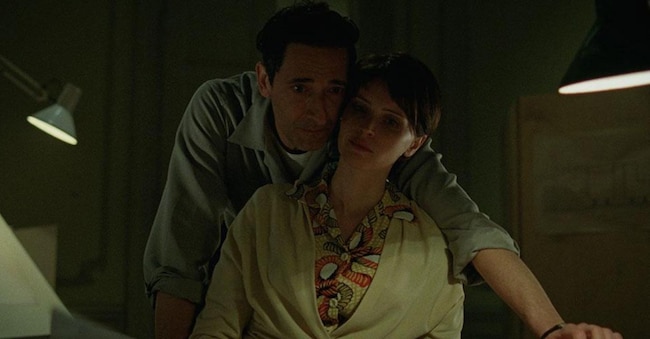
"The Brutalist" is the film that brings its author to full maturity: at the centre is the story of Jewish architect László Tóth, who emigrated from Hungary to the United States in 1947. Forced at first to work hard and live in poverty, he soon obtains a contract that will change the course of his life.

Co-written by Corbet with his partner Mona Fastvold (director of the successful 'The World to Come' in 2020), 'The Brutalist' is a product that has been a long time in the making, as its author recounted: "almost a decade spent trying to get this project off the ground, I would like to take the opportunity here to thank each and every one of the collaborators who made the 'impossible film' possible".

Filmed and screened in Venice on 70mm film, 'The Brutalist' is a fascinating experience also because of the way the film is structured: after an overture, there are two acts divided by a 15-minute interval that take the audience to an old-fashioned projection, recalling great films of the past and with a logic that may remind them of the cinema of Quentin Tarantino and Paul Thomas Anderson.

References to cinema of the past

.

Anderson, in particular, seems to be a name Corbet looks up to a lot, especially in the way the editing choices are married to a pounding soundtrack, so much so that it manages to evoke the great films of the director of 'The Master' and 'The Oilman'.

The main inspiration, however, is King Vidor's magnificent 'The Marvelous Spring', a 1949 film based on the novel by Ayn Rand and starring Gary Cooper.

In great growth as the minutes go by (with the exception of a rather questionable weak epilogue), 'The Brutalist' is a product with a powerful audiovisual force and a very high pace, so much so that the 215-minute duration flies by in a flash.

The relationship between two characters is simply memorable: that between Tóth and the mysterious tycoon Harrison Lee Van Buren is an extraordinary duet, played on a continuous exchange of roles and enhanced by the remarkable performances of the two actors Adrien Brody (Tóth) and Guy Pearce (Van Buren).

A part set amidst the marble quarries of Carrara is especially splendid, but there are many moments to remember, and already from the first sequence one can see the director's inspiration in constructing one of the most interesting works of the entire season.

Cloud

Out of competition was the presentation of 'Cloud', a new feature film by the great Japanese director Kiyoshi Kurosawa.

The author of 'Cure' and 'Pulse' returns to talk about the - often dangerous - relationship between human beings and technology: the protagonist is a guy who works in a small factory and earns some extra money as an online retailer, buying low and selling high. Increasingly strong on this business, he decides to quit his job to devote himself fully to this second occupation. His business is going well, until disturbing incidents begin to occur around him, one after the other.

Elegantly shot by Kurosawa, this film delves into a series of deep existential anxieties, yet fails to entertain as it should.

The pace is erratic, but picks up again with a good final part in which genres are mixed and it is noticeable how effective the author's hand is when the narrative development becomes more dynamic.

Copyright reserved ©
Loading...

Brand connect

Loading...

Newsletter

Notizie e approfondimenti sugli avvenimenti politici, economici e finanziari.

Iscriviti