
The capital of uncertainty. This is why finance is quantum
Value arises from loss of control: markets react to expectations, physics has demolished the illusion of a predictable world

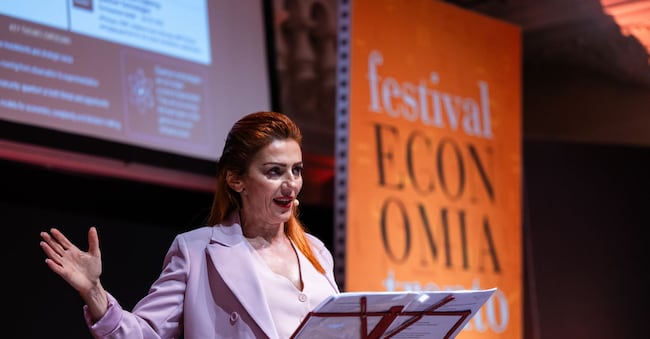
Uncertainty is not an accident. It is an asset. Invisible, unstable, even uncomfortable, but indispensable for understanding the contemporary world. 'Everything that really matters, from financial markets to geopolitics, right up to the great scientific revolutions,' observes Gabriella Greison, a quantum physicist, 'stems from a fluctuation, from an equilibrium that breaks down, from something that is beyond control.
Doubts are an asset
The turns of history and thought born of discontinuity are the thread running through the monologue "The Capital of Uncertainty" written by Greison for the Trento Festival of Economics. The story unfolds on the link between quantum physics and finance and starts with a provocation: for years, economics has tried to imitate classical physics and imagined a linear, predictable, ordered universe.
Everything flows
Then came reality, which behaved more like quantum mechanics than a Swiss watch. At the microscopic level, in fact, everything oscillates: there are probabilities, interferences, variables that change as they are observed. And this is where physics meets finance, because markets also move on expectations as well as facts: a forecast can alter investor behaviour and change outcomes, as happens in a quantum experiment.
The world rests on probability
In Greison's monologue, electrons converse with algorithms, Heisenberg's equations intersect with economic crises, and the uncertainty principle ceases to be an abstract theory and is transformed into a concrete question: why do we continue to demand absolute certainties in a world built on probability? The answer overturns an ingrained conviction: uncertainty is not weakness. It is space for possibility. It is the place where intuitions and new trajectories are born. A predictable system creates nothing, but only repeats itself.The real capital of our time is not control, but the ability to inhabit doubt without ceasing to move.
Greison, also the author of the Radio 24 podcast Fundamentals - The minds that turn on the light, takes us with her on journeys where physics is not used to simplify the world, but to look at it better.


