The Bookseller's Trade

The challenge of selling books in Italy between passion and (difficult) reality

Little is read in Italy and book sales are falling. Bookseller Vittorio Graziani explains how selling books is a complex business that requires competence, passion and concrete strategies to resist in a difficult market

6' min read

Translated by AI
Versione italiana

6' min read

Translated by AI
Versione italiana

Everyone says they love books. Even those who don't read them. Or those who no longer read them. Ah, if I had the time for it.... say many with smug regret.

Everyone says they love them, even those who buy one a year, the one most publicised on TV and in the media. You know the names. And then maybe they give it as a Christmas present, thinking they are doing something nice, or at least not making a bad impression.

Loading...

Then there are those who really love books. They keep them on their bedside table, they have a house full of them, some even have two copies because, by dint of buying them, they forget they have them. And then one writes dedications, one underlines them, one associates them with pieces of one's own life, with a beautiful friendship, with a love that ended well or ended badly. We like to go and see and hear the most famous authors at literature festivals, get our copies signed, patiently queuing up like at the supermarket checkout.

All very nice, though....

But despite this pretty picture, very little is read in Italy. In 2025, sales dropped by 4 per cent, while in 2024 (WIPO/Nielsen data), they were close to 104 million copies. The highest growth (109.3) was in 2021, with large fluctuations due to external events, such as the pandemic and targeted market policies. Ahead of us in Europe are Germany (around 700 million copies), the United Kingdom (670), and France (426). We are instead ahead of countries like Australia (71), Spain (66.5), Brazil (58.6). In the world, the lion's share is held by the United States (3.1 billion copies sold, 24.7% of the global market), then China (19.4%) and Japan (8.4%). It is true that not all that glitters abroad is gold. Many are also commercial books, however they are printed and sold.

A lazy and listless readership

In short, despite being a country of saints, poets and navigators, and despite being the birthplace of many writers, we Italians are lazy and listless readers. Especially as adults, when school is over, we lose the habit of reading. Too busy. Better are the women, who are the biggest purchasers of books, but despite their push in Europe, we are in a bad way. As if that were not enough, digitalisation has given the latest blow with smartphones and computers always connected. As a result, many bookshops, especially neighbourhood ones, cannot cope and have to close amidst tears and melancholic appeals not to give in. The large chains resist, but they too are suffering.

Yet all is not lost. Something can still be done. This is said by someone who knows it and who won the prize awarded by the Mauri booksellers' school in 2025. His name is Vittorio Graziani, he was born in Naples in 1974 but lives in Milan where he is the owner of the Libreria 'Centofiori' in Piazza Dateo 5, a historic location that has been in the building for over half a century.

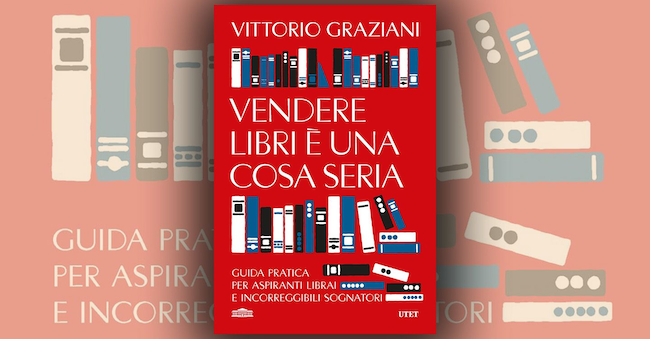
Graziani, you can tell on the fly, has an infectious passion. You can tell he loves books and above all his profession. After graduating in law, he has spent more than 20 years in the field learning how beautiful but also complicated this job is. And he doesn't like rhetoric or the usual romantic clichés that run in bookshops. So he decided to write an essay - 'Selling books is a serious business, a practical guide for aspiring booksellers and incorrigible dreamers' - that succeeds well in summarising the two cornerstones of his thinking: the first, that selling books is a wonderful thing, and that it is fine; the second that, being a serious business, it must be done by those who know how to do it or are painstakingly learning how to do it. Passion, he says, is important, but not enough. Of incorrigible dreamers, without art or part, who have had to close down due to superficiality or inexperience, there are already too many.

The bookseller, a tiring profession

"Many unfortunately believe that doing this job is like a romantic retreat where everything magically works. But it doesn't. Those who think this way and are not prepared, who have no serious training, are inevitably doomed to failure. In Italy unfortunately anyone can open a bookshop. There is no school that teaches you how to do this job. Which is tiring, you have to be on your feet all the time, dealing with customers who come in once to buy a certain title and you have to win them over so that they come back. You have to know how to do the accounts, how to understand whether opening a bookstore in that neighbourhood is feasible, how to have a certain investment budget, how to organise an opening well. I learned these things little by little, going from one bookshop to another and perfecting myself at Feltrinelli, which is a kind of university in the sector. It was only later that I took the plunge, acquiring a bookshop that already had a name, had been established for some time, in a suitable neighbourhood. I don't want to be a contrarian, or discourage those who love books. But selling them is another thing; improvisers, they must know, are lost....'.

There is much to learn from reading this essay. Which is not only addressed to aspiring booksellers, but to anyone who is attracted to the world of books. Between anecdotes, practical tips and reflections on the secrets of the trade, Graziani guides us to the threshold of a fragile and complex community. He shows us, for example, where to go and where not to go. He suggests non-trivial titles, the passwords to books that have a why. "I have to constantly update myself. That's the only way I understand if a title can work. You have to not be a snob, and therefore have the best-selling books found, but at the same time understand if a new author has an edge".

The choice of a title

There is an alchemy, a subtle balance, says Graziani, even in the choice of titles. You cannot favour only one genre, for example fiction, at the expense of non-fiction. "A customer must understand that with you he can broaden his knowledge, get out of the bubble of his usual books. When they tell me about Amazon, I tell them just that: that in my bookshop they will find something more, something they had not thought of or had not researched on the internet because they did not know it'.

There is also the controversial topic of social. Some people play hard to get. If he doesn't despise them, let's say he looks down on them. 'Another mistake to avoid. We have entrusted our Instagram profile to a professional, Silvia Rubino, who is part of our staff in all respects. We don't do marketing, we don't self-celebrate, we just recommend the best titles or those we find most interesting'.

Those who read a lot, apart from women, are children. Graziani knows this, and in fact there is a cosy space in his bookshop for the little ones. "Children's books are the only ones that go against the trend in sales. We host families, they stay with us as long as they want leafing through the books and enjoying some activities. You sow an important seed, if they have been well, you will see that they will come back".

Before saying goodbye to Graziani, we cannot help but ask him for a couple of titles to suggest for our readers. 'I have no doubts,' he replies, smiling: 'The first that comes to mind is Albert Speer, his battle with the truth by Gitta Sereny, the disturbing story of the architect and later Reich armaments minister. The second is a great classic: Fratelli di Italia by Alberto Arbasino, an ever timely journey through the follies of the economic boom'.

Vittorio Graziani

Selling books is serious business
Practical guide for aspiring booksellers and incorrigible dreamers

Utet, 18 euro, p. 180

Copyright reserved ©
Loading...

Brand connect

Loading...

Newsletter

Notizie e approfondimenti sugli avvenimenti politici, economici e finanziari.

Iscriviti