The book

Champion Coppi and his wife Bruna, the story of an uphill love affair

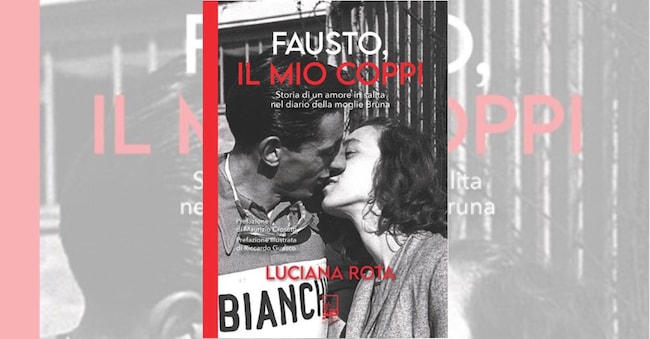
Luciana Rota tells the story of a great and troubled love affair through the diaries and stories of Fausto's wife, who was later left by the champion in favour of Giulia Occhini, the famous 'Dama Bianca'

by Dario Ceccarelli

5' min read

Translated by AI
Versione italiana

5' min read

Translated by AI
Versione italiana

It is one of those stories that doesn't end, that takes us back to the way we were, and that makes us understand better than a thousand essays how Italy - even that of customs and prejudices - has changed. Probably for the better, although every era, we know, has its hypocrisies and taboos.

This story is about a great racer, Fausto Coppi, the "Campionissimo", who died at the age of 40 from a banal malaria that was not diagnosed by doctors who were too presumptuous. But it is above all about his wife, Bruna Ciampolini, who died in 1979, after being left alone for more than 25 years, since Fausto left her in June 1954 to go and live with another woman, Giulia Occhini, the famous Dama Bianca who caused a scandal throughout Italy because, at the time, she was already married to a doctor (a Coppi supporter) and the mother of two children.

Loading...

Giulia was an elegant woman, very beautiful, with an aggressive beauty that one could not help but admire, especially when one began to notice her at the race arrivals with that white duffle coat that did not escape the mischievous eye of a photographer and the French journalist Pierre Chany, who first wrote about it in Equipe.

It was a big scandal that divided Italy, not only the sporting world, because Fausto Coppi was so famous. Not only as the great rival of Gino Bartali, but also because he was a champion with a legendary aura, winner of five Giro d'Italia and two Tour de France, at a time, the post-war period, when cycling was the most popular and deep-rooted sport in the country.

A scandal that exploded in newspapers and magazines in a very bigoted and hypocritical Italy, where these things, if they were done, had to remain in the shadows with many whispers and little shouting. At the time there was no divorce and adultery was still a crime, so much so that Giulia Occhini in Locatelli not only ended up in prison in Alessandria and Ancona, but had to face a trial in court on charges of abandoning the marital home. Even Pope Pius XII intervened against the Dama Bianca with a reprimand. And Giulia, when she gave birth to Angelo Fausto Coppi, known as 'Faustino', preferred to go to Buenos Aires, Argentina, where it was possible to give him the surname of the 'Campionissimo'.

The wife left in the shadows

The one who remained in the shadows in that storm, paralysed by grief but also by her reserved nature, was Bruna, his lawful wife, who remained silent, as if she did not want to further disfigure the image of Fausto, by whom she had had a daughter, Marina, in 1947, who would later grow up alone, without ever complaining.

Bruna was like that, for her 'simple and bourgeois' upbringing, everything about Fausto remained a private matter. Even when things were going well.

"I always held back the outbursts of affection, I wanted to be the perfect wife of a perfect champion. Only I knew how fragile and sweet the champion the world thought of as steel was.

This time, however, Bruna makes her voice heard, her feelings, (her unbreakable love for) that shy but determined boy she had met in 1941 already in the middle of the war. He was already somebody, he had already won a Giro d'Italia the year before, but he did not put on airs.

"I saw him for the first time on the provincial road that goes from Villavernia to Cassano Spinola, in the Alessandria area, at kerbside lane 57 of State Road 35. He was returning from a training session and I was also on a bicycle. He was 22 years old and I was 19. I asked him for a photograph. Crossing the road to reach him I almost got run over by a lorry...'.

For once, after always being in a corner, Bruna came out of the closet, but again in her own way, by telling a journalist friend, very close to Coppi, about all his travails and pain. That journalist was Franco Rota, an illustrious colleague of La Notte and many other things, whom Bruna knew well not only because he was Coppi's spokesman, but also because he was a trusted friend, a friend who knew when to write about something and when to keep it to himself, which is not easy for a journalist.

An intimate diary turned into a book

But as in a legend, that diary, collected amid tears and sighs in Bruna's house, has become a book (Fausto, il mio Coppi, Lab Dfg Editore) thanks to the intervention of Luciana Rota, the daughter of the art who at the time accompanied her father on those long afternoons where the interviewer, sometimes abandoning the role of reporter, took on that of a fine psychologist while listening.

"Returning to those pages,' Luciana recounts, 'was not only a way of repaying Bruna, but also a way of finding my father, a great man before being a great journalist. As a child, when I accompanied him, I didn't understand and asked: 'but daddy, why do you always make Mrs Bruna cry?"

Inside that diary were a lot of curiosities, some even concerning Bartali, his lifelong rival: 'It's not true that they hated each other. In racing they were adversaries, but Fausto had a deep admiration for Gino.

Fausto used to say to Bruna: "If I weren't Coppi, I'd be the most fervent of the Bartalians". The diary also reveals a joking Fausto who teased Bartali, who was always on edge when there was an important race: "Sometimes Gino would go to Fausto's room in the hotel and rummage through the basket, looking for boxes of medicines. Fausto, who only used tonics and detoxifiers, knew this and took advantage of it: in front of Gino he would swallow mysterious pills that were actually just bicarbonate. And Gino would try hard to read the name...".

A mine of anecdotes

This book by Luciana Rota, with a historical note by Paolo Mieli and a preface by Maurizio Crosetti, is a small mine of anecdotes about Coppi and that unrepeatable period of post-war Italian cycling. There is also a lot of love and that discretion that seems to have had its day in this day and age - not only in love -. Now everything is shared, Bruna instead cradles her memories, good or bad, even if they do not make her sleep.

She was sure that Fausto would return, even though the Campionissimo's love for the Dama Bianca was certainly a great love. Someone, such as the writer and journalist Gianni Brera in 'Coppi e il Diavolo', wrote of a Coppi who towards the end of his existence 'couldn't take it any more', thrown from a life that was too calm to a life that was too tense. That even his early end, no longer knowing how to come out of that torment, was almost wished for by the champion.

Bruna, in a way, corroborates this thesis: 'I'm sure we could have met again. He was fed up with that life. He was tired. His dream was to stop being a runner and become a farmer like his father.

We won't anticipate anything else, because it is a book that must be read from beginning to end. As a precious testimony of a world that no longer exists but never ceases to fascinate us. As a precious gift from an affectionate father to a much-loved daughter who had the merit, just like in a fairy tale, of telling it to us all.

Luciana Rota

FAUSTO, MY COUPLE
History of an uphill love affair in the diary of his wife Bruna

LabDfg publisher, 18 euro

Copyright reserved ©
Loading...

Brand connect

Loading...

Newsletter

Notizie e approfondimenti sugli avvenimenti politici, economici e finanziari.

Iscriviti

Tutto mercato WEB