
The appeal of ‘do-it-yourself’ is back, along with the latest inventions created using Arduino
From robotics to AI and retro gaming: the number of projects on the open-source platform has doubled. The maker community is evolving from a consumer of technology to a developer of it.

A robot dog that answers questions and a screen that creates images by rotating coloured tiles: these are just some of the projects created in recent months by people using Arduino to turn ideas into objects. Founded in Italia in 2005, Arduino is an open-source electronics and programming platform that allows users to connect sensors, lights, motors and other components to a programmable board, thereby enabling them to build devices at home that can receive information, process it and carry out actions. The various online communities and available tutorials have also contributed to the rise in the number of makers and enthusiasts who create and share their inventions: according to figures released by Arduino, the number of projects published on Project Hub has almost doubled over the past year, whilst library downloads have increased by around 50 per cent, reaching over 244 million downloads in the last 12 months.
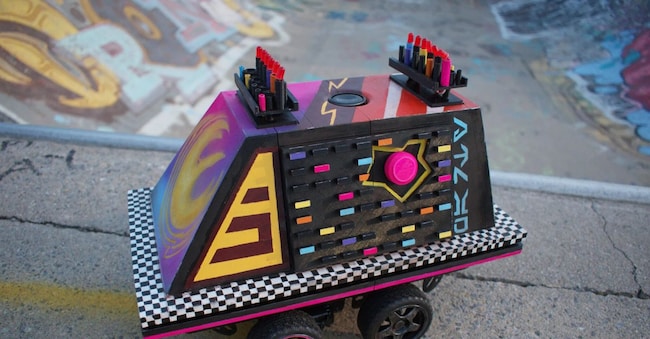
Among the most intriguing creations is the ‘mouse droid’ made by Cass, creator of the YouTube channel @heychaostheory: it is a customised version of the MSE-6, the box-shaped robot that appears in the Star Wars universe. The shell, which is 3D-printed and decorated, incorporates wheels, a battery, a pair of motors, an ultrasonic sensor and an Arduino UNO Rev 3 board. It can move autonomously whilst avoiding obstacles, although its most interesting feature is ‘party’ mode: the robot spins round, plays music and lights up its LEDs, just like a miniature nightclub.
Nuvi is even more sophisticated: the desktop companion unveiled last September by Luca Di Lorenzo, known in the platform’s community as LucaDilo. Standing less than 30 centimetres tall and featuring a display that shows its mood through animated eyes, this AI-powered robot moves its ears, arms and head and reacts when touched; Nuvi can also sense when someone is approaching, is able to respond vocally and dance. Inside, it features an Arduino Uno Q, alongside a microcontroller for movement and a system capable of handling more complex programmes. Its ability to converse relies on Gemini and an internet connection; text-to-speech, on the other hand, can run directly on the device. An interesting fact: the project was inspired by Kaito, a Shiba Inu belonging to an employee who works at Arduino’s offices in Turin.
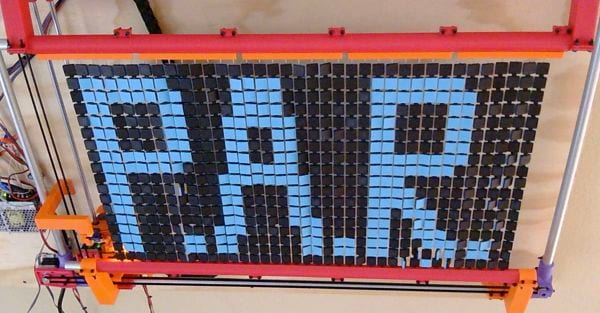
Not all inventions look like robots. P.A.R. (which stands for Pixel Art Robot), for example, is a sort of mechanical screen capable of displaying text and images without using a conventional display. Designed by the maker Zimm, the device consists of 666 small square tiles, black on one side and light blue on the other, arranged in a grid of 37 columns and 18 rows. The way it works is easy to explain: like the pixels on a screen, each tile helps to form an image, but instead of lighting up, it changes colour by rotating on its own axis, thanks to a mechanism that slides behind the panel and, via a pin, flips the tiles one at a time in accordance with the design to be reproduced. An Arduino Nano ESP32 coordinates the movements, whilst a sensor detects the colour of the tile already visible to avoid unnecessary operations; naturally, the process takes longer than a digital screen but allows you to watch a design take shape.
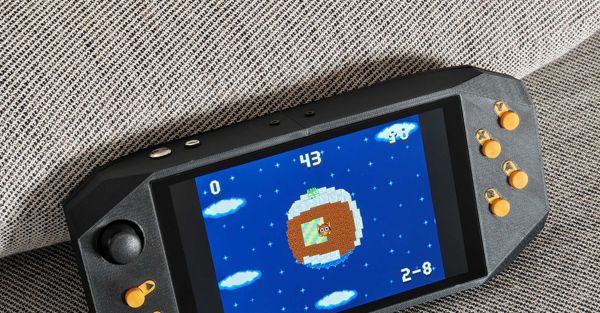
Another interesting invention takes its cue from the video games of the past. The Zalmotek team has built a handheld console based on the Arduino Uno Q and fitted with a display, buttons, a joystick and a 3D-printed casing. The project uses RetroArch for emulation and requires neither custom circuit design nor soldering; in fact, the various modules are connected via pre-made cables. The result is a console that is less compact than commercially available models, but the real appeal of the project lies in the opportunity to build it from scratch, understand how it works and customise it by modifying the components to suit your own needs.

