
AI: Air Force Chief of Staff Conserva says: ‘It may have an impact on professional skills, but the human element will not be replaced’
Conference in Rome. Mariani (Leonardo): ‘There is a vital issue concerning technology. I brought it up whilst talking about satellite networks rather than radar sensors or data processing, but that’s just to say that it’s not just about artificial intelligence. We are certainly talking about technologies relating to sensors, infrared, materials, networks, quantum computing and lasers.”

Key points
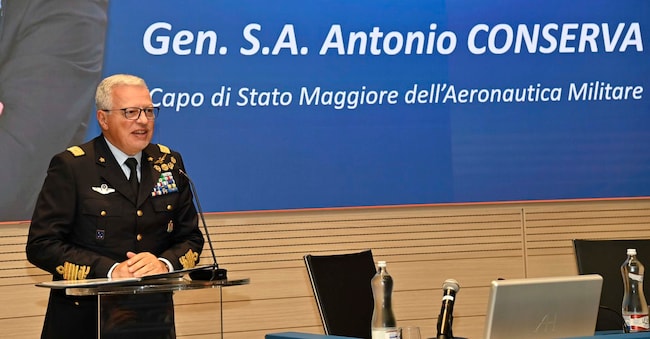
AI also poses a challenge for the defence sector. What is increasingly taking the form of a revolution could have an impact on professional roles, but human beings will remain at the heart of the process, even in this scenario. This view was expressed by the Chief of Staff of the Italian Air Force, Antonio Conserva. The Air Force General spoke at the conference “Facciamo Sistema – Defend the Present, Plan for the Future: Together, Higher”, which took place on Monday 12 October in Rome at the Adriano Visconti Auditorium in Palazzo Aeronautica. ‘Technological development will certainly bring about innovations,’ he stated, ‘but both the ethical considerations and the complexity of military operations will not allow us to rely entirely on drones and artificial intelligence. Therefore, even the systems we are designing for the future, such as the GCAP (the sixth-generation fighter, ed.), are based on a combination of new technologies and the human element; consequently, I believe – not least to ensure greater resilience in these systems – that human involvement in the decision-making loop is fundamental. ‘So,’ added Conserva, ‘for the time being, it may well be that the professional roles required will be affected, and so there may be a reorientation of these roles, but artificial intelligence will not replace the human element.’
The Rome-based initiative, which paves the way for the Air & Space Power Conference 2027, scheduled to take place in Milan on 7 and 8 April, brought together representatives from government, the defence sector, industry, academia and research to examine the main current and future challenges in the defence and aerospace sectors, with particular reference to capability development, technological innovation and the development of a shared vision for the future. The aim is to present the Italian Air Force’s development strategy from a long-term perspective up to 2044 and to facilitate the establishment of strategic partnerships, promoting collaboration between the key players in the national defence system from the very outset. Speakers will include academics, senior executives and representatives from institutions and industrial organisations in the aerospace sector, such as the European Space Agency, ENEA, Leonardo, MBDA, ELT Group, Avio Aero, Argotec, D-Orbit, Rheinmetall, Almaviva Group, Almawave Labs, Quantum Ket and Nuclitalia. ‘We live in a world where the international balance of power has changed and continues to change rapidly,’ noted the Minister of Defence, Guido Crosetto, in a video message. ‘This requires us to change our approach. We can no longer think in terms of separate sectors. National security,” emphasised the Defence Minister, “is a single entity, and to guarantee it, we must pool all the resources at the country’s disposal.”
The conference, organised by the Italian Air Force in scientific collaboration with the Institute of International Affairs (IAI) and the Centre for Aerospace Military Studies (CESMA) of the Air Force Association, was structured around two themes: ‘Protecting the Present’, dedicated to short- and medium-term needs, and ‘Planning for the Future’, focused on the major long-term strategic and technological challenges. The first session highlighted the need to ensure the full operational capability of weapon systems, support personnel training, strengthen the protection of bases and develop effective capabilities to counter remotely piloted systems. The second session focused on the capabilities required to address the 2035–2044 timeframe, with particular reference to deterrence, IAMD (Integrated Air and Missile Defence), space dominance, technological innovation, energy autonomy and operational sustainability, as well as the use of artificial intelligence.
Mariani (Leonardo): ‘Technology is a vital issue’
Today, the line between so-called ‘high-end’ threats and low-cost challenges is becoming increasingly difficult to define. Lorenzo Mariani, CEO and General Manager of Leonardo, has “debunked” a certain notion. “Today,” he stated, “there seems to be a dichotomy, at a political and media level, between old systems and drone-based systems. What I am simply saying is that, in my view, new, modern systems will have to be able to manage drones, and ‘manage’ unfortunately means both using them and defending against drone attacks. This is quite different from saying that we no longer need a tank, we no longer need a ship, or we no longer need an aerial platform. And examples – which I won’t go into now – would show that this is indeed the direction in which we are all rightly moving. I’m thinking of the GCAP, I’m also thinking of the latest ships, and I’m also thinking of the tank we’ve just configured.’ “There is a vital issue concerning technology,” added Mariani. “I brought it up whilst talking about satellite networks rather than radar sensors or data processing, but that’s just to say that it’s not just about artificial intelligence. We’re certainly talking about technologies relating to sensors, infrared, materials, networks, quantum computing and lasers – there are many of them – and progress in any of these technologies isn’t achieved through good will alone; it’s achieved through planning and investment. So we’re certainly calling for this on behalf of companies that need to understand this properly – we’re certainly among them – and we’re also trying to help the supply chain identify where investment is needed. But it also concerns planning – let’s call it government planning – because without a bit of money, you can’t even get into a church, let alone attend mass. ‘Not even my dog wags his tail without a bit of money on the table.’
Benigni (Elt Group): ‘Sophisticated, high-cost threats and low-cost threats coexist’
‘It is not just the technological change we have witnessed in recent years, but above all the way in which it is made available, integrated and deployed in the field. ‘High-end’ capabilities remain absolutely indispensable for our deterrence, as well as for our intelligence and operational superiority. Today, however, this ‘high-end’ capability must coexist with unmanned systems (remotely piloted aircraft, such as drones), alongside commercial and dual-use technologies. ‘Superiority in the 21st century will no longer depend solely on platforms, but on the ability to integrate data, sensors, networks and operational capabilities into a shared understanding of the situation,’ noted Domitilla Benigni, CEO and COO of Elt Group. In a context where sophisticated, high-cost threats coexist and combine with low-cost threats, competitive advantage hinges on the ability to understand, protect and control information, cyberspace and the electromagnetic spectrum. “This is why we have invested and continue to invest in distinctive capabilities, with the aim of integrating electronic defence and cyber capabilities with the aid of Artificial Intelligence to transform the complexity of the battlefield into useful information for achieving and maintaining superiority in today’s conflicts,” concluded Benigni.


