
The advance of Chinese cars: here is the alternative in fleets
Models of brands such as Byd, Omoda & Jaecoo, Leapmotor, Geely or Mg are now attractive in the Nlt sector due to their value for money and the availability of hybrid or electric powertrains

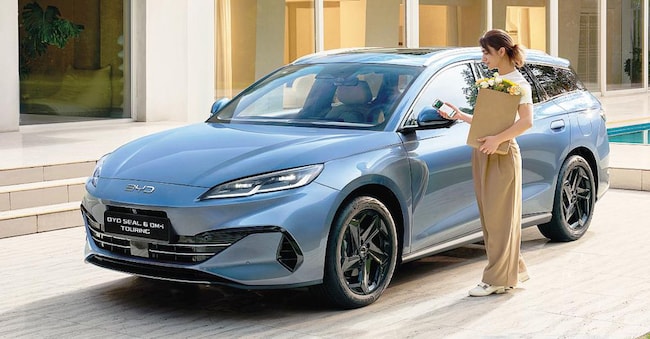
Chinese-made cars are growing in the fleet world, thanks to an ever-increasing range of electrification. Because while 100% electric remains the best choice from a fiscal point of view, but complex in many cases in everyday use, plug-in hybrid cars combine 20% fringe benefits and ease of use thanks to the presence of a fuel tank. Just from China, the offer of 'super hybrid' models is growing steadily. These are models with plug-in hybrid technology, i.e. they can also be refuelled via a power socket, powered by large batteries with about 20 kWh at their disposal and more than 100 kilometres of autonomy in fully electric mode.
Browsing through the list of models available to fleet managers, we find the Omoda 7 phev, equipped with an 18.3 kWh lithium-ion battery that can be recharged up to 40 kW in current, allowing it to go from 30% to 80% in just 20 minutes. The heat engine is a 1.5-litre 143 hp petrol engine combined with the 204 hp electric component. The total power of the system produced by Geely reaches 347 hp. Autonomy? 100 km with all-electric drive and over 1,200 km relying on the petrol tank. Same group but higher power for the Jaecoo 8. In this case, the Shs-P 8 system sees the combination of a 143 hp 1.5-litre Miller cycle heat engine combined with two electric motors at the front and one at the rear to provide all-wheel drive. The system output is 428 horsepower with 580 Nm of torque, a 0-100 km/h sprint covered in 5.8 seconds and a top speed of 180 km/h. The 34.46 kW battery (among the largest among plug-in SUVs) guarantees an electric range of 134 km and over 1,100 km thanks to the 70-litre petrol tank. The battery can be recharged in alternating current up to 6.6 kWh and up to 70 kWh in direct current.
Geely has also arrived in Italy under its own brand name, marketing the electric EX5 but above all the Starray Em-I with its 1.5 plug-in hybrid powertrain with a total 218 horsepower, 18.4 kWh battery, 83 kilometres in pure electric and recharging at 22 kW in alternating current and 50 kWh in direct current.
Moving on to Byd, the offer ranges from SUVs, sedans and even station wagons thanks to the Seal 6 Dm-i Touring. Equipped with Byd's Super Hybrid with Dm (Dual Mode) technology, it integrates several innovations including dual high-speed electric motors with integrated controller, the Blade Battery and a 1.5-litre petrol engine with 98 hp matched by a 197 hp electric unit plus a 19 kWh battery, which accepts up to 6.6 kW AC and 26 kW DC. The result is a propulsion system that functions most of the time as an EV, with up to 105 km of purely electric range, and intelligent control brings efficiency to a weighted combined consumption of 1.5 l/100 km and a combined range of 1350 km.
Among the Chinese plug-in hybrid models with generous autonomy is the MG HS, a D-segment suv with 272 horsepower and a zero-emission range of around 100 kilometres thanks to its 21.4 kWh battery that can only be recharged at 6.6 Kwh.

