
The concluding message from the catwalks: men without ambiguity
From Hermes to Kolor to Craig Green returning to the catwalk after an absence of a few seasons

3' min read
3' min read
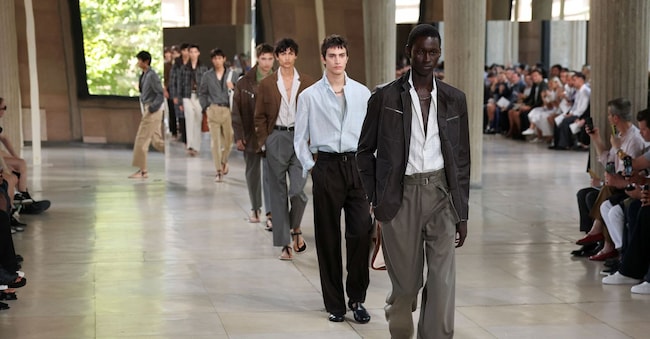
The busy men's fashion week closed with a certainty, even in the uncertainty of the general crisis: men are once again represented through widely shared and unambiguous dress codes, but this time round fragility is an accepted and introjected quality, which, to the sound of impalpable materials and humid melancholies, even breaks up the stale classics. At Hermes, Veronique Nichanian confirms that she is the only designer capable of giving male luxury a modern and acceptable form: au curant but not forced, precious but not garrulous, snappy without youthfulness. She has been there in her niche for years, concentrated and resistant to meaningless trends but not clinging to rigid positions. This season he works on large, weightless volumes that barely touch the body and reveal their beauty in movement, and on cuts and details with graphic precision, made reverberant by the superfine materials. It is a serene and reassuring vision, elegant in the most essential and ineffable way.
Taro Horiuchi's debut at the helm of Kolor has the appearance of an organic handover with the founder, Junichi Abe. Abe's sense of colour and humour remains, to which Horiuchi adds a stimulating taste for sporty technicality combined with a fashion drama solemnity. It is an unexpected contrast, resolved with great skill. At LGN, Louis Gabriel Nouchi chooses the form of an animated film populated by androids and very sensual replicants to present perhaps his most successful collection, in which superhumanism and carnality meet in silhouettes with decisive volumes. Always lyrical and equally squinty, at Doublet Masayuki Ino chooses a neighbourhood vegetable garden to present a collection that revolves around food as a human connector and a link to nature. Between ties like mackerel and hats like fried eggs, it is, in terms of clothes, the most normal test in recent seasons for Ino. Everything is fluid and with an organic feel, with the surrealities concentrated on details that give character. The search for materials and craftsmanship carried out by Kartik Kumra and declined through the brand Kartik Research is fascinating for its non-obvious link to the Indian territory. Making its debut on the Parisian calendar, Kumra questions the concept of sobriety as good taste, celebrating spontaneity and personality with authentic freshness, and producing finely woven or embroidered garments with surprising naturalness.
After an absence of a few seasons, Craig Green is back on the catwalk, and it's a good thing: personal and imaginative, his proposal is one of the best of a season that has been stalled - yet! Green ventures into a territory all his own, in which clerical clothes, quadrupedal coats repurposed into human bodies, infantile forms, ectoplasms leaving their bodies from their mouths, and sartorial abstractions composed of consuming sheets intertwine in a tale in loose verse revolving around The Beatles. As derailing and psychedelic as it is, the journey condenses into a vibrant vision of colour as form and form as sound, which is a joy to behold but also a magnificent look. By comparison, Jacquemus' couture fantasy at the Orangerie in Versailles has something pompous and self-aggrandising about it. The business lies elsewhere - handbags and other basic pieces - but on the catwalk Jacquemus portrays himself as a supreme creator, with a sentimentality that oscillates between the spontaneous and the manufactured. The garments look better made than last time but the brand vision is far from clear at the moment: it mixes anachronistic imagery and Instagram virality in what looks like a mere exercise in style.

