The Monaco Grand Prix

The convergence of motorsport and luxury: how Monte Carlo consolidates its industry

Monaco opens the European F1 season with a unique model that fuses competition, high-end marketing and an exclusive sporting and commercial ecosystem

by Massimo Ruberti and Glenda Mecaj

6' min read

Translated by AI
Versione italiana

6' min read

Translated by AI
Versione italiana

The logistical rationalisation of the Formula 1 calendar inaugurates the European season with the Monaco Grand Prix: nine consecutive races on the Old Continent until mid-September, with the debut of Madring, the new circuit in the Spanish capital. The last race weekend in Montreal saw Andrea Kimi Antonelli score his fourth consecutive success; on the podium, the tandem of Italian and German anthems evoked in nostalgic fans the triumphs of Michael Schumacher, with the roles reversed. The talented Bolognese now leads the world championship standings by a clear margin (+43) over team-mate George Russell.

Despite the hierarchies of the world championship, Ferrari arrives on the French Riviera with favourable odds. According to the bookmakers, in fact, the Rossa's drivers are the main candidates for success, with host Charles Leclerc (around 30% chance of victory) favoured over Lewis Hamilton (15%). The SF-26 is proving to be a single-seater with remarkable mechanical qualities, capable of partially masking the power unit's marked power deficit. At Monaco, an anomalous track where speeds do not exceed 300 km/h, the difference will be made by traction on the exit and the driver's instinct.

Loading...

CLASSIFICA F1 2026

Primi 10 piloti e classifica costruttori

Loading...

Formula 1 as a meeting point for the luxury market

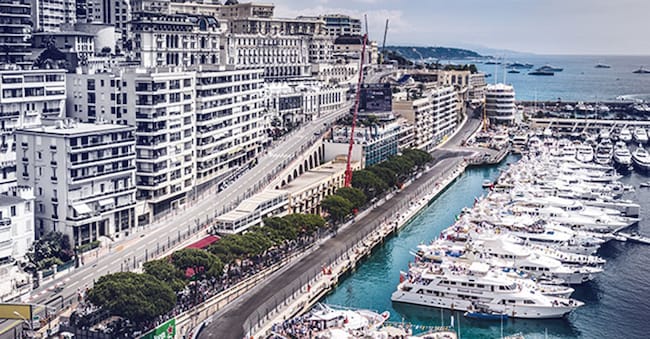
The anomaly of the Principality, however, does not end with track dynamics. The Monaco Grand Prix is historically distinguished by a very peculiar spectator ecosystem, different from other circuits. Over the decades, Monte Carlo has built an identity deeply rooted in luxury, transforming the race into a closed relational perimeter where yachts, private terraces and high-end hospitality replace traditional ticketing logics.

If for a long time this elitist soul was unique in the world championship, today the 'Monaco model' is progressively contaminating the whole of Formula 1. Under the commercial impetus of Liberty Media, the management has initiated a strategic repositioning aimed at the constant 'premiumisation' of the global offer. Recently introduced events such as Miami and Las Vegas, together with the imminent debut of the Madrid street circuit, have been conceived precisely to replicate the exclusivity of the Principality on different scales, maximising revenues from the corporate segment and high-margin entertainment.

This structural metamorphosis has inevitably catalysed the interest of global luxury giants. Today's Formula 1 has surpassed its original nature as a mere technological showcase for automotive manufacturers, transforming itself into a strategic positioning and experiential marketing tool of the highest order. The great conglomerates of fashion, haute horlogerie and the hospitality sector no longer limit themselves to classic visual sponsorship contracts, but exploit the fabric of the paddock to directly intercept and retain a target of Ultra-High Net Worth Individuals (UHNWI). The race weekend thus becomes an exclusive relational ecosystem for the management of top clients, certifying the definitive fusion between the motorsport business and the global luxury industry.

It is in this logic of strategic repositioning that the recent commercial partnerships are framed. Since the beginning of 2025, the LVMH group has operated as Global Partner of Formula 1 through a ten-year agreement actively involving the brands Louis Vuitton, Moët Hennessy (champagne on the podium) and TAG Heuer (timekeeper in place of the historic Rolex). The convergence between motorsport and haute couture was further consolidated a few days ago: the Renault group announced that from 2027 Gucci will become the title sponsor of the Alpine racing team . The agreement will see the French team officially compete under the name 'Gucci Racing Alpine Formula One Team'. The deal, facilitated by the role of Luca de Meo, the current CEO of Kering with a recent history as CEO at Renault, highlights a clear paradigm shift. Luxury holding companies no longer limit themselves to the purchase of peripheral advertising space, but integrate themselves directly into the visual and nominal identity of car manufacturers.

It is no coincidence that the executive advisor of the Alpine team is Flavio Briatore, one of the architects of the great history of Benetton Formula. These are his official statements following the unveiling of the business deal: "Having a brand of the calibre of Gucci as Title Partner of Alpine Formula One Team is something I am enormously proud of. But that's not all: I'm equally excited about the possibilities this partnership brings and the great things we can achieve together globally. The Enstone team has a history of going out of the box, and has already proven that fashion can come first in Formula One".

The diversification of the motoring offer

However, the economic architecture of the Principality does not rest solely on the display of luxury. For premium positioning to translate into structural revenues and continue to attract major investors, glamour needs a solid base: competitive substance. Monte Carlo consolidates its commercial status precisely because, apart from its worldliness, it boasts an authentic and deep-rooted sporting credibility. A vocation that goes far beyond the motoring weekend, transforming the entire area into an ecosystem in which professional sport acts as a perimeter to financial dynamics.

The core of this sporting architecture is presided over by the Automobile Club de Monaco (ACM), the institution that manages a triad of events on the street circuit, capable of intercepting complementary market niches. If the Formula 1 Grand Prix remains the unattainable spearhead in terms of volume of business and corporate activations, the Historic Grand Prix is aimed directly at the small circle of elite collectors. This appointment sees the parade of vintage single-seaters that are not mere relics, but alternative assets of very high commercial value for enthusiasts and wealthy investors. Completing the picture on the urban track is the Monaco E-Prix: the Formula E stage responds to the automotive industry's need for green positioning and technological innovation, demonstrating the Principality's ability to interpret motorsport in terms of sustainability and energy transition.

Monaco's motorsport diversification extends beyond the city's kerbs with the Monte Carlo Rally. First held in 1911, the event traditionally inaugurates the World Rally Championship (WRC) calendar in January, projecting the Monegasque brand's media exposure along the Alpine roads of south-eastern France. This competition not only represents a pillar of sporting tradition, but generates a strategic economic spin-off at a time of low tourist season for the Côte d'Azur.

The residential hub and multi-sports ecosystem

The economic weight of sport in Monte Carlo, however, is not limited to the media exposure of major events. The Principality operates as a true district of the industry: it consolidates its status as a global hub by serving as the residence of choice for elite athletes, attracted by a unique combination of tax optimisation, privacy and state-of-the-art infrastructure capable of directly driving the luxury real estate market.

This same logic of positioning governs the rest of the competitive calendar, structured to preside over the disciplines with the greatest image return. The Rolex Monte-Carlo Masters is the spring pillar of this strategy: the first ATP Masters 1000 clay-court tournament of the season, it combines sporting prestige with outstanding commercial figures, with more than 140,000 spectators, a global audience of more than 40 million viewers and a prize pool that for the 2026 edition exceeds 6 million euros. In parallel, the Principality maintains a constant presence in European championships through its teams. In football, AS Monaco competes steadily in the French Ligue 1, exploiting the showcase of the Louis II stadium; in basketball, AS Monaco Basket is at the top of the LNB Élite and the Euroleague, welcoming the public inside the Salle Gaston Médecin arena.

The summer season enhances the maritime vocation through the activities of the Monaco Yacht Club, with events such as the Monaco Classic Week for vintage sailing and the Monaco Energy Boat Challenge for experimentation on energy transition. Completing the multi-sports ecosystem are global profile events such as the Jumping International de Monte-Carlo, a prestigious stage of the Longines Global Champions Tour equestrian circuit staged in the Port Hercule area, and the Herculis Meeting, the central event of the Diamond League in athletics. The end result is a model of planned diversification in which each event meets strict exclusivity requirements, ensuring the Principality's saturation of its accommodation capacity and constant media visibility all year round.

The real impact of this planning can be measured in the budget figures for 2025, which show an economy in strong health. Within this macroeconomic scenario, the sector dedicated to art, sport and recreation registered a clear expansion: the sector generated an increase in revenues of EUR 86.6 million compared to 2024, marking an increase of 8.5% (Source: IMSEE). This dynamism is directly reflected in the private labour market, with the sector now employing 2,787 people at the end of the year, representing an employment growth of 7.2%. Numbers that certify how the sports system, while not representing the main financial engine in terms of absolute volumes, fully confirms its strategic and driving role for the entire Principality.

The Monaco GP

The weekend in the Principality will feature the traditional format, with the usual European afternoon schedule. On Friday, the first two free practice sessions are scheduled at 13.30 and 17.00 respectively. On Saturday, following the third free practice session scheduled at 12.30 p.m., qualifying will be staged at 4.00 p.m. and will determine the starting grid, fundamental for this appointment, usually devoid of overtaking. The traffic lights for Sunday's race will go out at 3pm.

Copyright reserved ©
Loading...

Brand connect

Loading...

Newsletter

Notizie e approfondimenti sugli avvenimenti politici, economici e finanziari.

Iscriviti

Tutto mercato WEB