The case

The Court of Auditors rejects Agrigento Italian Capital of Culture 2025

It gives one pause for thought as to how the winning cities were awarded and their evaluation criteria: two months after the end of the programme, only 4 out of 44 projects are completed


by Roberta Capozucca

4' min read

Translated by AI
Versione italiana

4' min read

Translated by AI
Versione italiana

A year that should have marked the revival of Agrigento, especially in terms of culture, risks turning into the symbol of missed opportunities. With the approval of the report on the management of the 'Agrigento Italian Capital of Culture 2025' investigation, the Court of Auditors has in fact turned a spotlight on the Sicilian project's organisational machinery, confirming the many critical profiles already highlighted in the September report. Delays and accounting uncertainties that, according to the magistrates, risk compromising the full implementation of a programme supported by some 6 million in public funds, which is now close to completion.

The file of the Court of Auditors

In their lengthy report filed in September 2025, the accounting magistrates of the Auditing Section of the Court of Auditors for the Sicilian Region identified 11 major critical issues: from the lack of correspondence between the projects actually implemented and those indicated in the application file, to the lack of cost controls, to the dubious mixing of actions and resources from state funds and the regional budget.

Loading...

Among the most problematic aspects is the delay in project implementation. The Court's judgement is severe: out of the 44 interventions envisaged in the application file, only four have actually been concluded, while several construction sites are still in the process of being entrusted or set up. The expenditure progress for the 18 projects started is also critical: as of July 2025, the expenses reported by the Municipality of Agrigento amounted to 610,521.57 euro, less than 80% of the 984,000 euro disbursed by the Ministry of Culture, a threshold that had led to the blocking of the disbursement of the next 246,000 euro funding tranche. With regard to the other actors involved in the planning, the Archaeological Park of the Valley of the Temples, in the statement sent on 5 August 2025, reported expenses paid to suppliers amounting to €2,020,918.78, against a total reported amount of €2,420,918.78. The Court also noted that the Municipality of Agrigento transferred an advance of €422,665.42 to the Agrigento 2025 Foundation for the activation of an event, but suspended a further €77,902.98 pending clarification.
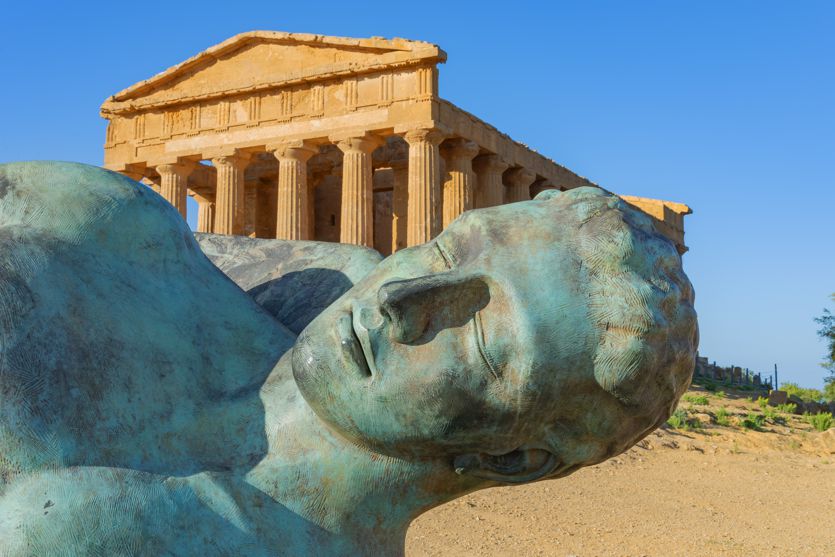
Tempio della Concordia, Valle dei Templi, Agrigento, UNESCO, Sicilia, Italia

The Resolution

Despite some critical aspects, the new resolution of the Court of Auditors shows positive signs on the front of administrative efficiency and accounting transparency, improvements also attributed to the entry of new high-profile figures from the state management. At least for now, the Agrigento 2025 Foundation can breathe a sigh of relief: the magistrates' checks did not reveal any accounting irregularities.

However, the resolution sinks the blow on the absence of useful elements to demonstrate the achievement of the objectives set out in the candidacy dossier, including social cohesion, economic development, individual and collective wellbeing, and greater attractiveness of the territory. In short, according to the magistrates, the title of Italian Capital of Culture would have passed over Agrigento without producing tangible effects, leaving in the field more promises than results. The appointment is now set for 31 December 2025, when Agrigento will officially close its year as Capital of Culture and the Court will be able to draw its final conclusions.

Scala dei Turchi, Agrigento, Sicilia, Italia

A programme for transforming

Beyond the Foundation's administrative and managerial difficulties, the Agrigento 2025 case invites us to reflect on the structural limits of one of the Ministry of Culture's most consolidated funding programmes, that of the Italian Capitals of Culture, which is still too often perceived as the mere organisation of a major annual event. On the contrary, the programme, which has its roots in the European model of the same name, was created with the aim of transforming cultural initiatives into levers of territorial development, capable of generating lasting benefits for the entire territory, as demonstrated by the European experience, where the Capitals of Culture have been able to generate long-term social, economic and cultural impact, building a true legacy that goes well beyond the single annual event.

But what is missing, then, from the Italian experience to really make a difference? We asked Professor Isabella Mozzoni, Professor of Economics and Organisation of Cultural Enterprises at the University of Parma: 'The experience of the Italian Capital of Culture is, so far, a promising laboratory: in ten years it has helped many administrations understand how the title can be a planning lever, not just an annual showcase. Now a quantum leap is needed. The Ministry of Culture should launch a national multi-year planning, monitoring and evaluation framework, with shared deadlines and indicators covering before, during and after the title year. So far, due to the 'attractiveness' approach, the focus has been on tourist flows, visibility and economic estimates without consolidating tools that guarantee continuity and comparability beyond 12 months. There is a need to shift the focus to structural effects: cultural enterprises activated and still operational at 3-5 years, infrastructure projects completed with cost-benefit analyses, growth of creative entrepreneurship, quality of cultural services and levels of community participation. This last point is particularly relevant and goes hand in hand with the need to start a social impact assessment, knowing that in these contexts it is difficult to set standard KPIs valid everywhere. The solution could be a two-level system: a national core of minimum indicators (cultural access and participation, inclusion, employment and skills in the sector, social cohesion, perception of well-being, civic activation) and a local module adapted to the city's objectives. The measurement could combine quantitative and qualitative by providing time series and a common 'data dictionary' to ensure replicability and comparability. This should be flanked by a model of true collaborative governance: a public-private steering cabin, thematic committees and formalised operational tables, with clear roles, decisions by consensus and permanent mechanisms of participation and not mere consultative moments, in line with the 'Inclusion and Participation' dimension of the Unesco framework. The results of this approach are already evident: cities that have adopted mixed bodies and inter-institutional tables have shown a greater capacity for co-planning and coordination, especially when the purpose committee has functioned as a stable bridge between administration, cultural enterprises, the third sector and citizens. Examples of this are Parma 2020+21, Bergamo and Brescia 2023, Procida 2022 united by public-private steering cabins and stable inter-institutional tables. Only with flexible national standards for monitoring, participatory governance with independent evaluation, and systematic comparison with the best international experiences can the Capital of Culture become public policy, not just a calendar appointment."

Copyright reserved ©
Loading...

Brand connect

Loading...

Newsletter

Notizie e approfondimenti sugli avvenimenti politici, economici e finanziari.

Iscriviti