
The trade without a workshop
If artificial intelligence takes over entry-level jobs, young people will lose the place where they learn what school does not teach. Businesses and the education system will have to rebuild it.

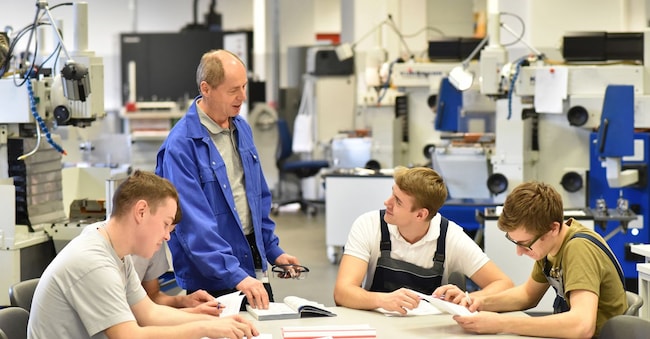
For centuries, a trade was learnt in a workshop. The apprentice would watch the master, repeat the simplest movements, make mistakes under an expert eye and, step by step, become independent. Today’s workshops go by other names: the law firm where the trainee researches case law and drafts their first documents, the consultancy firm where the junior analyst prepares tables and slides, the office where the new recruit handles administrative tasks alongside a senior colleague. These tasks are often repetitive, but they were the first step on the career ladder and, above all, a learning experience.
These are precisely the tasks that artificial intelligence performs best, and the data is beginning to show this. A study by the Stanford Digital Economy Lab (Brynjolfsson, Chandar and Chen, 2025), based on the payslips of millions of American workers, finds that in occupations most exposed to AI, employment among 22–25-year-olds has fallen by around 13 per cent compared with other sectors, whilst that of their more experienced colleagues has remained stable or increased. In the UK, the major audit and consultancy firms have reduced the number of new graduates they take on, and in American law firms there is open talk of a ‘broken ladder’, because the work carried out by junior associates served both to generate revenue and to provide training; if machines do this work, there is no longer any material left on which to practise.
The phenomenon is portrayed as a threat to employment. Yet one question remains in the background: what is lost in the passing on of a trade when the first rungs of the career ladder disappear?
Young people mainly possess codified knowledge – the sort found in manuals – which AI has learnt from those very texts. Experts, on the other hand, possess tacit knowledge, which helps them to understand that a customer is worried even if they do not say so, to sense that a figure does not add up, and to know who to ask. This knowledge is not found in books, which is why machines do not possess it. It is learnt through practice, alongside those who know.
AI does not replace tacit knowledge, but it risks erasing the very places where it is formed. A company that uses it to do without young people saves money today but finds itself without experts tomorrow. In ten years’ time, who will be able to check the machine’s work if no one has learnt how to do so?

