
Rebirthing culture: L'Aquila becomes Multiverse
As Italian Capital of Culture 2026, it presents itself with a rich programme of initiatives that enhance and extend to the entire territory

Key points
- The Narrating Countries of the Gran Sasso
- Taste stages
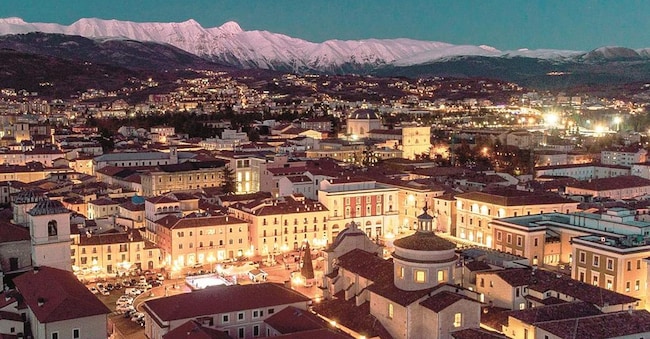
The ice and snow at Campo Imperatore, the great plateau of the Gran Sasso, give way to crocus flowers, giving the little Tibet of Abruzzo a picture worthy of a postcard. It is not yet transhumance time when it returns to the realm of sheep. Now silence is the real master. But the echo of fervour in nearby L'Aquila reaches here. In the ancient city, a crossroads for centuries of trade and exchange, the heart of Abruzzo, the wounds of the terrible 2009 earthquake now give way to the vibrant energy generated by being chosen as the Italian Capital of Culture 2026. And like the wind that descends from the Gran Sasso and caresses reborn squares and places, it spreads through monuments (the Castle, the San Filippo Theatre, the Churches of San Bernardino and San Silvestro, the Oratorio dei Cavalieri de Nardis), streets and Renaissance and Baroque palaces (Palazzo Margherita, Palazzo Pica Alfieri, Palazzo Dragonetti and many others) that reopen old doors (next event on 29 March), leaving room for new stimuli. Such as Palazzo Ardinghelli, home of MAXXI L'Aquila, dedicated to contemporary art. The 'Multiverse' dossier, with which the city has presented its candidacy, aims at a lasting legacy with infrastructural, artistic and social projects (university courses, perfomative art, seminars, workshops), transforming these 12 months into a model of permanent rebirth that with its 'doing' goes beyond the urban event and creates a cultural ecosystem involving natural landscapes, villages, as far as Rieti and the areas hit by the 2009 and 2016 earthquakes.
Unmissable events
If art will take pride of place with the return home to the MuNDa (National Museum of Abruzzo at the Spanish Fortress) of Raphael's Visitation, music and theatre will not be outdone. The celebrated altarpiece, created in 1517 and left the city in 1655, now at the Prado Museum in Madrid, will dialogue with Pontormo's Visitation (from 27 June to 27 September). Alongside the rooms where the work of Maurits Cornelis Escher, the artist of impossible worlds, is exhibited, others will host Antonello Da Messina's Ecce Homo. Exciting notes will spread through the city with the world premiere performance of Nicola Piovani's 'Bonaventura Barattelli', created for the 80th anniversary of the Società Aquilana dei Concerti 'Bonaventura Barattelli'. The Istituzione Sinfonica Abruzzese, the words of Davide Rondoni, the music of Roberto Molinelli and the singing of Simona Molinari give life to an unprecedented project for the eighth centenary of the death of Saint Francis. The first edition of the 'Vittorio Antonellini' International Conducting Competition of the Solisti Aquilani for young conductors, chaired by Salvatore Accardo, will also leave its mark.
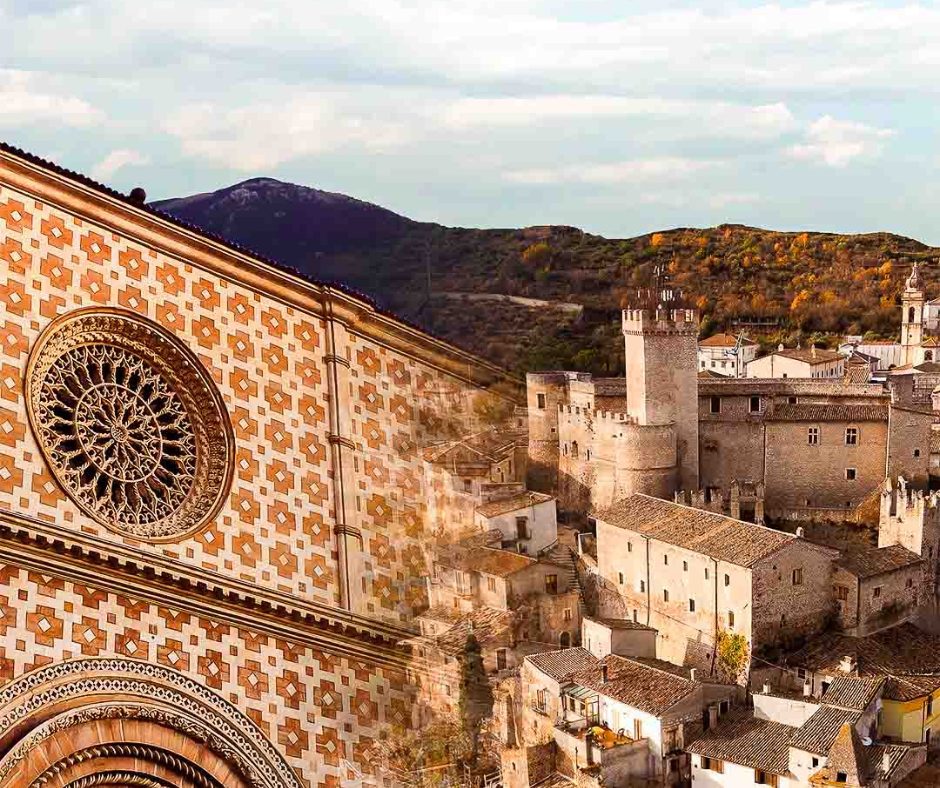
During the summer, the city's identity events - the Cantieri dell'Immaginario, Jazz Italiano per le Terre del Sisma, Festival delle Città del Medioevo, and that great religious and popular festival that is the Perdonanza celestiniana, hosted in the beautiful basilica of Santa Maria di Collemaggio - will have an enhanced programme. Liu Bolin, the Chinese artist known as 'the invisible man', has also chosen it for one of his public performances with body painting, in which he will merge with the landscape. Two other performances will take place in the ancient forests of the Abruzzo, Lazio and Molise National Park and Rocca Calascio.
The Narrating Countries of the Gran Sasso
At an altitude of almost 1,500 metres and where the gaze wanders from the Maiella to the Sirente, Rocca Calascio is precisely the highest castle in Italia, one of the most evocative jewels of the Bel Paese, chosen as a set for films such as The Name of the Rose and Ladyhawke. It offers an invitation to contemplation and silence, but also to endurance, typical of the people and pastures at high altitude. After years of neglect, with the 'Luce d'Abruzzo' project, launched with PnRR funds, Calascio is a concrete example of how sustainable development of inland areas is possible. There are many activities: archaeological excavations, schools for perfecting sheep farming, weaving, tourism and music, and then cultural and sporting activities (the Festival of Innovation, cinema, street bouldering, or urban climbing), a wellness centre with gastronomy and sport, and an experiential museum. L'Aquila Capital of Culture is stopping there with its university's International School of Archaeology for young Italian and foreign scholars. The long wave of Capital of Culture leads to the other villages of the ancient Baronia of Carapelle, which made the fortune of the Medici, namely Capestrano, Castel del Monte, Santo Stefano di Sessanio, Carapelle Calvisio and Navelli, where ancient treasures and unspoilt landscapes come together. Capestrano Castle dominates the Tirino valley, among the cleanest and clearest watercourses in Europe. Not far away, in 1934, the Capestrano Warrior was found, a stone statue from the 6th century B.C., a symbol of the region and a key find for the study of the Italic peoples (now in the Chieti Museum). Other treasures include the convent of Franciscan St. John of Capestrano and the church of San Pietro ad Oratorium with the 'magic square', five Latin words whose juxtaposition creates the palindrome 'Sator, Arepo, Tenet, Opera, Rotas', whose symbolic meaning is still obscure. If the scent of saffron leads to Navelli, that of cheese to Castel del Monte, the village of transhumance, a place of great fascination, rich in beliefs and mysteries to be discovered, such as the Night of the Witches. A tradition not to be missed is 'ru rite de' re sette sporte' (the rite of the seven arches carved into the rock, ed.), a theatrical performance by the inhabitants of the village, which has been repeated every year since 1996 on the nights of 17 and 18 August, attracting thousands of people. Both villages are part of the newly-established destination i Paesi Narranti, a new player in sustainable tourism that enhances the territory with tinspirational tours, itineraries designed to create connections, encounters and awareness with quality and never trivial proposals such as those devised by Il Bosso (www.paesinarranti.it) . A must on this tour is a stop in the village of Bominaco, where within the walls of an oratory is the Sistine Chapel of Abruzzo, so nicknamed for its beauty. This is the Oratory of San Pellegrino, declared a World Heritage Site by Unesco, a small chapel that holds unexpected images inside with wonders of the calibre of the Scrovegni Chapel.
Taste Tables
The Abruzzo region of L'Aquila is also a land of great food and wine traditions. And from this point of view it is also worth a trip. In the capital among the 99 squares, 99 churches and 99 spouts, a national monument, the number symbolising the city as legend has it, a tasteful stop is the historic Elodia, a temple of Abruzzo cuisine, with a super cellar now housed in the fascinating Palazzo Cipollone. Further on in Palazzo Pica Alfieri, which conquered Queen Govanna D'Aragona who lived there, is Yoichi where local and oriental cuisine meet. And if another period palace (Palazzo Fibbioni) hosts Connubio, FØRMA Contemporary is also interesting, offering creative cuisine with local ingredients, awarded the Bib Gourmand by the Michelin Guide. The concept, conceived by chef Simone Ciuffetelli, has also extended to 'FØRMA Bakery' in Via Fortebraccio, offering high-quality baked goods. On the outskirts of the city is 'Il baco da seta' in the 'Dimora del baco', while the history of the city is in the old Nurzia bar, famous for its ancient Christmas nougat. To taste Abruzzo's red gold in its hometown of Navelli, you should stop at the 'Antica tavena' or at La Cabina in San Pio. Taste and tradition also in Capestrano at Il Castello and decidedly more rustic but certainly zero-kilometre is the proposal of Risto-Macelleria Tirino, while in the town centre you can sleep at the Dimora Storica Casa Senatore. In Castel Del Monte, an excellent proposal is Hotel Parco Gran Sasso (both as a restaurant and as hospitality) and Santo Stefano di Sessanio, famous for its Sextantio Albergo Diffuso, opened Sextantio Cucina a few months ago, led by Dino Como, former right-hand man of the three-starred Niko Romito at Casa Donna in the village of Castel di Sangro.


