
The AI and data centre boom brings gas back into the spotlight
The sharp rise in demand for electricity, particularly in the US, cannot be met by either renewables or next-generation nuclear power, which is still in the planning stage. Consequently, plans for new gas-fired power stations are flourishing

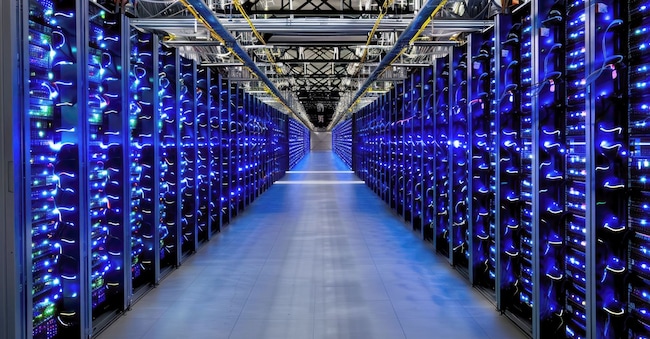
AI and cloud computing are not only reshaping the digital economy, business operations and many of our daily activities, but also the global landscape of energy consumption. This is particularly evident in the United States, where the rapid expansion of data centres required for Big Tech’s supercomputers has led to a structural increase in electricity demand (a trend set to continue in the coming years) which renewable energy and nuclear power are unable to meet. Renewables, in fact, are by their very nature intermittent; as for nuclear power, the mini-reactors (known as SMRs, or Small Modular Reactors), considered the perfect solution for data centres, are still a long way from a final, market-ready version. Consequently, this scenario is bringing gas-fired power stations and manufacturers of combined-cycle turbines back into favour – and in a big way – with their order books already ‘full’ for several years ahead, given that demand now far exceeds supply.
Data centres and electricity consumption on the rise in the US
The figures speak for themselves. According to S&P Global Energy, the electricity consumption of US data centres has almost tripled since 2020, reaching 64.4 GW. Projections indicate a steep upward trajectory that will see demand reach 183 GW by 2030. What’s more, some experts estimate that by 2028, servers alone will account for up to 12 per cent of all electricity generated in the United States. A veritable avalanche of energy consumption, which is fuelling itself and growing month by month, yet at the same time comes up against two significant operational constraints linked to renewables. The first is intermittency: AI chips and cooling systems operate continuously (24 hours a day, 7 days a week) and require a stable, continuous base load that is therefore unaffected by weather conditions. The second is delays in the electricity grids: connection times to public infrastructure in the US are at full capacity; between red tape and connection times, more than five years are often lost. This has prompted a counter-move by the tech giants, who – whilst awaiting next-generation nuclear power – are focusing on natural gas-fired plants built directly within the perimeter of data centre campuses or in close proximity to them. A report by Global Energy Monitor highlights how projects relating to new gas-fired power infrastructure in the United States have increased almost 25-fold over the last two years, driven by the needs of Silicon Valley’s servers.
Cases in the US
There is no shortage of concrete examples across the United States. The utility Entergy Louisiana is developing nearly 10 GW of new gas-fired capacity, ten of whose power stations will be dedicated exclusively to supplying new industrial data centre complexes. States such as Virginia and Texas alone account for 40 per cent of projects currently operational or under construction, but the gas rush is rapidly spreading to secondary hubs in Ohio, Pennsylvania, Georgia and Arizona. According to a recent report in the Financial Times, three-quarters of the utilities serving the 60 major data centre projects run by Amazon, Microsoft, Google and Meta are planning or building new gas-fired power stations. This is one of the reasons why experts at RBC Capital Markets estimate that demand for natural gas from US data centres alone will reach 6.1 billion cubic feet per day by 2030, an increase of almost 20 per cent compared with the average consumption of the US electricity sector in recent years. This could, in the medium term, also reduce the US supply of liquefied natural gas available for export to Europe and the rest of the world, with obvious global repercussions.


