
The 1970s, a turning point decade for Italian women
Through Paola Agosti's photos and Benedetta Tobagi's texts, we retrace an unrepeatable season of battles, unity and also contrasts within feminism
by Eliana di Caro
4' min read
4' min read
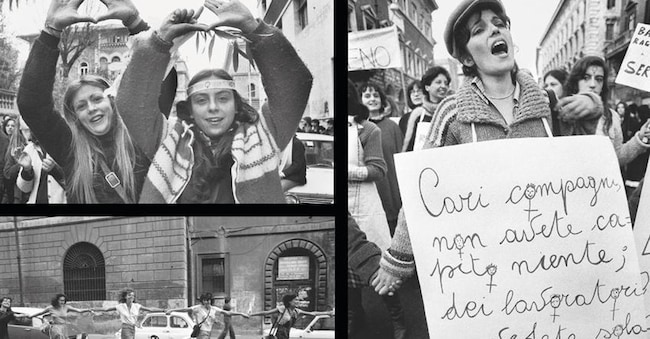
The beret pulled down over the forehead, the big wool sweater, the face of a soap and water girl with a huge placard hanging from her neck and the words 'Dear comrades, you have understood nothing, you only see half of the workers': the women of the 1970s are all in images like this, in addition to the roundabouts, the hands alluding to vaginas, the flood of slogans, each one more effective than the last. The people who 'haven't understood anything' are the men, starting with those active in the trade union or in a party in which women recognise themselves but which does not consider them. Which is even more unacceptable.
They are images of a decade of battles that helped change society and about which much has been written, which here flow like a black and white film, powerful and elegant, accompanied by words that are the precise script of that film: Covando un mondo nuovo. Viaggio tra le donne degli Anni Settanta is a book to keep, to consult, to leaf through. The size is right (the strength of the photos complemented by the clarity of the words), suitable for adults who know - and want to immerse themselves in that season - and for those who do not know, because the story takes nothing for granted. Above all, it is perfect for girls and boys: they will realise that they are sitting on the shoulders of those who fought for them by filling the squares.
Hunting for a new world contains the gaze of those who were there and captured those moments: Paola Agosti, born in 1947, who intercepted in her shots the faces, the slogans, the streets, the masses of women organising themselves, uniting, shouting moved by a single feeling that held all the others together. What are they rebelling against? Against patriarchy, that's all too easy. Against confinement within four walls, they who are angels of the hearth do not feel or, at most, want to freely decide whether and to what extent to be so. Against laws that prohibit: the sale of contraceptives, divorce, abortion ('The womb is mine and I manage it'). Against a sexuality they do not live freely, rather, they suffer it, worse, they do not know how to express it because women have not always been asked to express it. Against economic inequities: underpaid jobs, immediate dismissal when they get pregnant, housework and family care by which they are crushed. In a word, they rebel against the certainty of an unequal condition that is no longer tolerable.
Benedetta Tobagi, thirty years Agosti's junior, reconstructs the scenario, takes us to places (Via del Governo Vecchio in Rome, the Magdalena Theatre, the Women's Bookshop in Milan, the self-managed counselling centres), recalls the newspapers that were a point of reference ("Noi donne", "Effe"), gives visibility to the names, evokes the legislative processes that laboriously - and at the price of inevitable compromises - changed things. There is a pivotal word from which convictions and actions derive: it is 'feminism', with all the vocabulary it carries with it (self-consciousness, emancipation, liberation, difference, the personal is political, self-determination, etc.) and the contrasts generated by it: from separatism yes/separatism no to the fight for the decriminalisation of abortion carried out by radicals in opposition to the conquest of the law that was later approved (the 194).
A battle, the latter, waged not only on a regulatory but also on a medical level. This is well explained by Tullia Todros from Turin, a gynaecology registrar at the beginning of the decade, when 'gynaecologists were practically all male, at the time of specialisation we were 4 women out of 80 men'. A young mother, militant in Avanguardia operaia and feminist, then head of gynaecology and obstetrics at the Sant'Anna hospital, she told Benedetta Tobagi how important it was to share experiences and information: "We doctors also learn, from other women, together with them", interpreting the public service as a service to the person and in the furrow of rights (what the Italians expected, demanded, and did not happen, as denounced by the banner 'gynaecologists, refuse therapeutic abortion for free in order to do clandestine abortion for 800,000 lire').

