
The desk takes centre stage once again and regains its role as a personal space
Through new interpretations and reissues of works by the great masters, fine materials and memory engage in a dialogue with the demands of today’s workplace

Key points
Among the many objects that, with the advent of digital technology and the increasing mobility of work, seemed to have had their day was the desk: that classic, spacious, imposing piece of furniture which, since the post-war period, has come to symbolise, in the collective imagination, prestige, authority, the very essence of study and intellectual work. Fortunately, this is not the case: although work is becoming increasingly dematerialised, mobile and informal, the desk still represents – or is once again powerfully coming to represent – a necessity and a pleasure, a physical island of personal space to which one can anchor all the stimuli, materials and thoughts that pass through the frenetic hours of work or the rarer, quieter moments of study.
Ceccotti’s desk
The message is clear from a number of Italian design firms that feature this piece of furniture in their collections: crafted from fine materials using refined techniques, it is a piece worth investing in, to be cherished and passed down to future generations. The nod to the 1950s is very much felt: it was then that, in Italia, tradition and modernity merged masterfully in experimental designs by the great masters, now reissued as a tribute to an unrepeatable era whose creative energy has not yet been exhausted. It is in this context that Ceccotti Collezioni, a refined Tuscan cabinetmaker, has included the 604 Desk executive desk in its 2026 collection, a design by the Venetian architect Mario Gottardi dating back to 1954, initially conceived (as evidenced by a sketch) for the captain’s cabin of the turbo-ship Leonardo Da Vinci, and subsequently realised two years later for a company in Verona. Gottardi, a man of many talents, had been commissioned to design several large ships (including the Cristoforo Colombo, the Michelangelo and the Raffaello); in the same spirit of grandeur and efficiency, he designed the 604 desk, the essence of which has been preserved intact in the current version by Ceccotti Collezioni: the geometric and modernist lines of the body convey a certain classicism thanks to the leather upholstery and the perimeter edging in solid American walnut, whilst the large suspended top, supported by brass spacers, is accentuated by back-painted glass or by wood upholstered in Poltrona Frau leather.
The Cavour desk by Zanotta
Carlo Mollino’s experimental Cavour desk dates back a few years earlier (1950); a piece of furniture that defies every rule and convention, occupying a timeless realm: during those years, Mollino – in his quest for the perfect structure, in furniture as well as in large-scale architecture – had experimented with compositions combining fluid lines and parallelepipeds: he did the same for the Cavour desk, designed for Casa Orengo in Turin and never put into mass production. Zanotta has taken on this task; just this year, the company announced that it had secured, through a successful bid in a public tender, an exclusive licence from the Italian State to produce thirty works by the great Turin-based architect. The company already had around ten pieces by Mollino in its catalogue, including the Cavour desk, which still surprises with its structural design centred on the slender wooden spine, created using the cold-bending technique (developed and patented by Mollino himself), which rests on the drawer unit at one end and supports a side storage unit at the other, as well as the top shelf made of clear glass.
The Cavalletto writing desk by Cassina
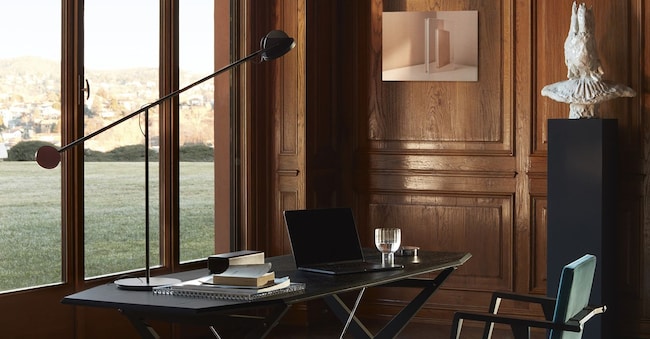
Balance and simplicity also characterise Franco Albini’s ‘Cavalletto’, featured in Cassina’s iMaestri catalogue: the architect, another of the great pioneers of Italian design, who was always in pursuit of structural lightness, conceived this table in 1950; it is skilfully crafted from wood and inspired by the workbench of the same name found in workshops and laboratories. The tabletop and legs are slender in thickness and volume, stabilised by a system of burnished brass tension rods that act as bracing: a solution that is both functional and elegant, offering stability whilst suggesting lightness, and showcasing the technical excellence of Cassina’s joinery.
Carpanese Home designs Tachi
Giorgio Bonaguro has clearly taken the masters’ lessons to heart; this year, for Carpanese Home – a Venetian contemporary cabinet-making firm – he has designed the Tachi desk, available in an L version, which is more compact, and an XL version, which is larger and features a drawer unit. Beneath the top – which has an organic, irregular shape (like a boomerang) – sits a metal or leather-upholstered base shelf, set back from the top and not exactly the same size, providing a place to store everything that needn’t be on display but should be within easy reach. Spacious, functional and visually light, the name ‘Tachi’ evokes a long, curved Japanese sword, whose precision and strength it aims to embody.
Brand connect


Newsletter RealEstate+
La newsletter premium dedicata al mondo del mercato immobiliare con inchieste esclusive, notizie, analisi ed approfondimenti
Abbonati