
The Devil Wears Almost Everything Except Prada
The decline of the traditional press is the pretext for the return of the team of twenty years ago but makes the film boring in a Milan all to spend
by Cristina Battocletti
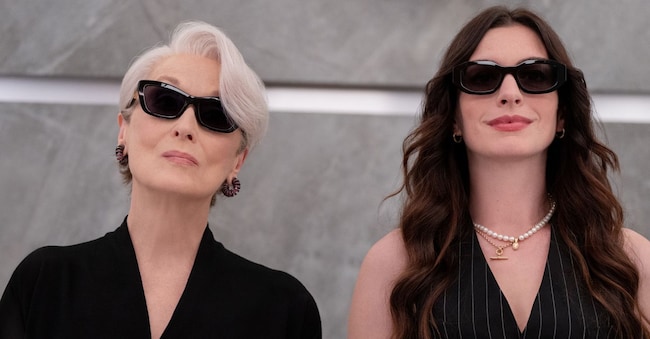
After becoming an excellent aeroplane film, The Devil Wears Prada is back on the screens twenty years later in a morose and boring version with the same team, from the actors - Meryl Streep, Anne Hathaway, Emily Blunt and Stanley Tucci - to the director, David Frankel. The editorial staff of 'Runaway' returns with the wicked and cynical editor Miranda (Meryl Streep) and her right-hand man Nigel (Stanley Tucci) facing the crisis in the print media. The first to be affected is Andy (Anne Hathaway), a former 'Runway' intern who, since the first version of The Devil Wears Prada, has made her way into investigative journalism. But just as she receives an important award, she loses her job.
The return to 'Runway'
Fate extends her hand and she is called back to 'Runway' with the task of bringing the 'Inquiry' to the temple of Fashion. She rediscovers the same conditions of vassalage from subordinates that she had experienced in her time and, in a world dominated by likes, savours lukewarm victories, all the way to revenge in the Italian capital of Fashion. The film is tedious not because it starts from a more than sacrosanct and welcome reflection, namely that of the demise - or at least the disruption - of traditional media, but because it does so in a hasty and superficial manner. And again, not because it uses comedy to portray a dramatic situation, which works even better at times, as in Gennarino Carunchio-Giannini's class struggle against the 'industrial booty' Melato or Albertone Sordi running through hospital corridors to score the highest number of patients on the health insurance scheme.
The overwhelming power of fashion brands
But here, while the film challenges the overpowering power of fashion brands and tycoons over journalism on its knees, it reaffirms it by giving contentions to all brands. In fact, the she-devil and her surroundings wear highly visible brands, sometimes associated with the faces of their patrons. Certainly not Prada, which, ironically, appears very timidly. If the viewer, then, had the slightest urge to react and run to the newsagent's to reclaim the paper in cellulose and ink, he certainly would not do so for Andy. If in the first version she got suckered into being a cog in a conspiracy out of youth and naivety, after twenty years she cannot be forgiven for falling into a similar trap, especially after winning the Pulitzer-like prize for journalism. It is the same for her race colleagues whom she tries to help: one merely opens her laptop several times, while the other acts as a bridge for a publisher to get Andy to write Miranda's unauthorised biography. But what moves the latter is not the unveiling of the unfair conditions of the new generation of journalists (one of the reasons for the category's strikes, in addition to the non-renewal of the contract for ten years), or the grotesque proto-slavery for which urination is forbidden at "Runway" (see Esselunga employees), or for the inappropriate tasks with respect to the contract or the title of study.
Fashion World Changes
The fired colleague-friend only dreams of getting a percentage of the amount with several zeros with which Andy would be rewarded. Another mistake: Andy accepts the job at 'Runway' with reluctance, because for her, fashion is not journalism. Instead, it was also through that door that changes in customs and progress were accepted. Donyale Luna in '66 became the first African-American model to appear on the cover of 'British Vogue', changing mindsets and the industry. As well as the shoots with over models to counteract the culture of bodyshaming or the campaigns with wrinkle-wearing testimonials, white hair and imperfections of ageing, facilitating the acceptance of the body in ageing. To stay at home, Oliviero Toscani's famous inclusive photos for a textile brand helped promote integration.
Milan to spend
Then there is the chapter on Milan, no longer for drinking, but for spending: five-star luxury, a starched city, everything to buy. Of course, one could not expect the Devil to end up in Corvetto, but one hopes that the film, since it will ensure an avalanche of tourists, will not only serve to feed the narrative of the singular and rough beauty of the city that wins the Covid and soars towards the Olympics, leaving even more behind the last, the penultimate and all the travets, or their descendants, who have made the city of laurà, laurà great and who cannot keep up with the cost of living. It is always bad to speak ill of a film that will help the theatres and in which Meryl Streep's statuesque performance in the birignao of cultural figures remains. It's not that The Devil Wears Prada is supposed to save the world and, in particular, the world of journalism, but don't even pretend to. And, in any case, on the assumption of the film, this review won't move anything and, fortunately for exhibitors, it is mostly sold out for weeks.

