
The Devil Wears Prada 2, a faithful and cruel mirror of fashion (and other) journalism
Reflections - at times enthusiastic - of a reluctant spectator

Key points
I went to see The Devil Wears Prada 2. Foreword: I did it more out of duty than pleasure. Or rather: I did it out of duty and curiosity. There is a lot of talk about it, the theatres are full, and I wanted the pleasure - in this case really - of being able to talk about it with good reason. I would add that it is a film that, right from its title, speaks of my work and my passion.
Twenty Years of Revolution
Twenty years have passed since the first Devil Wears Prada and everything, or almost everything, has changed in journalism. Perhaps even more, fashion journalism has changed - in theory and practice - and fashion has changed. Changes that I have observed - and largely undergone, as I was born in 1969, definitely not a digital native - as far as journalism is concerned. I thought, sure, in these 20 years of digital acceleration, every type of journalism has changed and every consumer goods sector has changed. But fashion journalism and fashion, I repeat, trumps all. Let me explain: cultural journalism and books have changed, sure. But book reviews or interviews with their authors, for example, still exist, cultural events do, and so do those who report on them. And speaking of books: in the year 2000, great managers of American publishing (one among all, the ceo of Random House), gave them up for near extinction or irrelevance and we know that this did not happen.
Fashion, alas, has many more problems than books and the same goes for publishing - here, again, it is a cross-industry problem and it is a global problem - and for fashion journalism. This exceptionality of fashion, I thought, could be related to the fact that it has been the sector most affected by the advent of influencers. A term, influencer, that fortunately no one has dared to translate from English into Italian, risking cacophonous obfuscations such as the translation of expertise into experience, heard, I am told, in the Italian version of D 2. Simplifying, influencers for many years have erased the role of fashion journalism as knowledge, observation, reflection and storytelling (to readers/users of sites). They have also attracted small or large parts of brands' marketing and communication budgets, taking away one lung from fashion publishing, advertising revenue. The other lung, newsstand sales and print subscriptions, has almost collapsed due not to influencers, but to digital as a whole. Pay wall construction, subscriptions to online versions and online advertising are a kind of out-of-body breathing that can keep fashion journalism and publishing alive, but it is not known or predicted for how long.
Scepticism 'disproved'
I might not have made these reflections - or at least I would not have lined them up - if I had not seen D 2. I had refused to see it dubbed (by now I even see films in Turkish or Japanese in the original with subtitles) and had booked it for 30 April, then found an excuse not to go but forced myself to rebook. I saw it on Saturday 2 May at 10am at the Anteo and I am very glad I did.
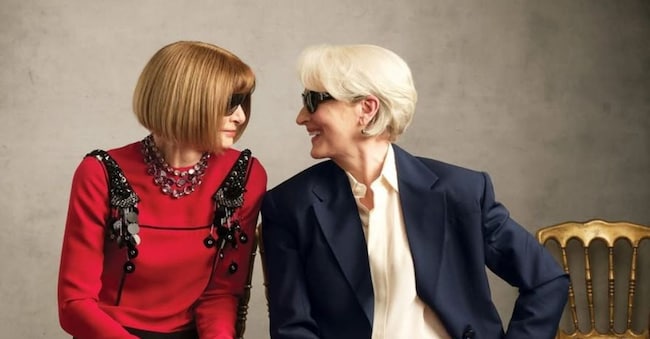
One of the reasons for my scepticism was the promotion circus we had been witnessing for months. Red carpets everywhere for previews, very short trailers anticipated on social media and invasive, product placement announcements of clothes and accessories by every known press office and, last but not least, the commitment, at this stage of promotion, I would say 'immersive and totalising', of Meryl Streep. But after having seen the film, this last aspect almost makes her more sympathetic to me: I believe that her commitment is certainly linked to contractual obligations, but also to healthy fun, the fun that fashion gives you, that fashion can give you, that fashion should give you. Meryl Streep discovered this (with the help perhaps of her daughter, who catalysed attention as Caroline Bessette in Love Story) and must have thought: but yes, let's have fun with fashion as I have never done in my life and certainly as I had not done in D 1 (where the costumes were a sort of caricature imitation, for me, of what we had seen in Sex and the City, which got even worse in And just like that).


