
The drama of Schiaparelli, the life-giving grace of Giambattista Valli
The Paris days opened with a new course for the historic maison led by Daniel Roseberry. Highest and well-deserved honour from the French Republic for Valli

2' min read
2' min read
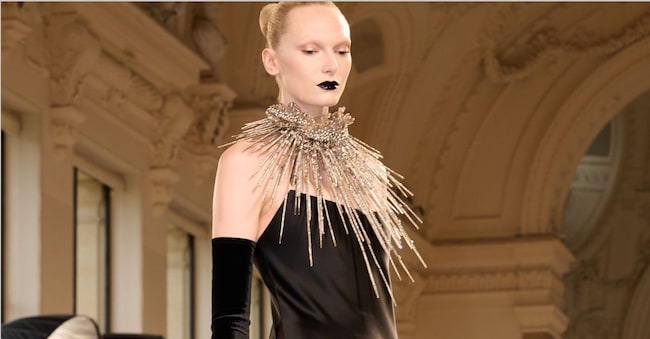
It may be the pouring rain after days of heatwave, the not particularly auspicious world climate and the ensuing gripping uncertainty, combined with an undoubted moment of crisis and system fatigue, but the start of the brief Parisian period dedicated to haute couture would be underwhelming - the fireworks, namely Glenn Martens' debut at Maison Margiela and Demna's farewell at Balenciaga, are in any case reserved for the finale. The change of atmosphere is immediately evident at Schiaparelli: if the audience is flamboyant as expected - Cardi B, Dua Lipa and then a whole parterre of high-end women who like to appear exuberantly, attract the gaze of an entire room, stir up comments - the proposal on the catwalk is severe, dramatic, at times almost mournful, and not only because the protagonist is almost absolutely black.
It has been a few seasons now that Daniel Roseberry, the creative director of the media hits, has put aside the sensational baroquesque triggering virtual viralities - with the exception this time of a perturbing red dress, admittedly ghostly, with breasts and bust realistically rendered and worn on the back together with a mechanical heart-shaped beating necklace - to concentrate on form and construction. This fashion show, tending to connect through an imaginary bridge archive and future - it is perhaps more the former that stands out, amidst sculpted silhouettes, Spanish echoes and solemn curves - represents the closing of the circle. Roseberry looks at the Paris of the late 1930s, before the capital was invaded by the Germans in June 1940, and speaks of the 'twilight of glamour', the same that runs through the fashion photographs of the time. Hints of a robotic future, populated by centaur women, are not lacking, but it is the anterior future of that wartime imagery, also consigned to history. In other words, one appreciates the gravitas of the ordeal, but one cannot help but feel its nostalgic afflatus.
Always a supporter of women, a herald of an aesthetic in which, in his own words, 'legs and brains go together', Giambattista Valli does not let himself be overwhelmed by gloom. 'In this,' he adds, 'I am Roman: even in the darkest horror I manage to attach myself to a glimmer of light, and go from there'. He is radiant: as a prodrome of the presentation, the Minister of Culture, Rachida Dati, awards him, for merits acquired in the field, the title of Officer of the Order of Arts and Letters. It is a recognition of the highest weight, sanctioning Valli's tireless dedication to the reasons of beauty and craftsmanship. For the occasion, he does not parade: the dresses, graceful and frothy flourishes that pay homage to the French 18th century from afar, are exhibited in the white rooms of Maison Valli. It is a vision full of lightness, which reaches straight to the heart and thoughts without lambasting, with ineffable grace.

