
The Oriental dream of a flamboyant Bayadère at the Opéra
Rudolf Nureyev’s magnificent swan song returns to the Paris theatre for the eleventh time

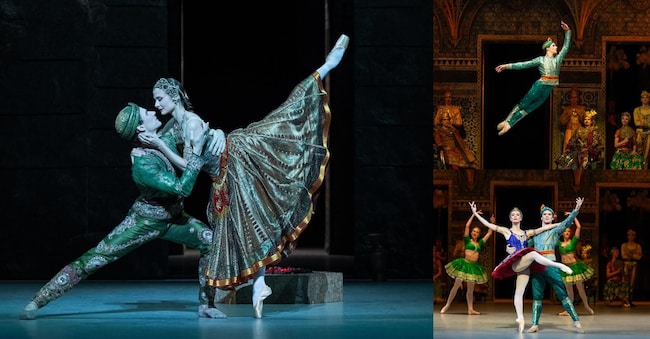
The last choreographic work by the star of late 20th-century dance dates back to a few months before his death. It was October 1992 when Rudolf Nureyev presented his final work at the Palais Garnier – both an artistic testament and a swan song to a long-standing reflection on that nineteenth-century repertoire, which he reinterpreted in an unrivalled manner. With *La Bayadère*, in fact, the unforgettable star reached the pinnacle of his articulate, complex and magnificent choreographic vision in this sumptuous ‘dream of the Orient’, conceived in collaboration with Franca Squarciapino and Ezio Frigerio. The greatest temple of French dance is once again staging Ludwig Minkus’s ballet for its eleventh revival, quite rightly retaining this version, which is one of the many flagship titles in its repertoire.
The stars of the Opéra and the appointment of Thomas Docquir
At the first of the nineteen scheduled performances, the dancer portraying the temple’s sacred fire is the étoile Léonore Baulac, who displays exquisitely refined lines and technical precision; her movements, as smooth as velvet in the snow-white realm of shadows, make one forget the slight stiffness observed in some of the ballet’s most treacherous final sections. The valiant warrior Solor is played by Paul Marque: one of the Opéra’s most highly regarded étoiles, he displays ease, conviction and an unshakeable technique that allows him to pay homage to the variation in the second act with brilliantly executed jumps. Gamzatti’s malice and performance are intense, linear and consistent, entrusted to the excellent skills of the étoile Bleuenn Battistoni.
We see yet another display of the French company’s leading lights in one of the afternoon performances, thanks to the proverbial and ever-excellent poise of Dorothée Gilbert, a Bayadère with crisp, decisive lines, who is equally persuasive in her quarrel with the Rajah’s daughter, played by Roxane Stojanov, an étoile who enriches the role with solid turns and a verve capable of alternating between light-heartedness and ruthlessness. The twenty-eight-year-old Thomas Docquir, who as early as 2022 was already grappling with the fascinating nuances of the Idol d, appears here for the first time in the role of the Indian warrior, in a performance so effective that it earned him the title of danseur étoile through the customary and indispensable ceremony announced by Alexander Neef, Director General of the Opéra, on the recommendation of José Martinez, Director of the dance company.
Koen Kessels’ direction is particularly noteworthy, as it is perfectly attuned to the demanding requirements of the choreography. Whilst *The Kingdom of Shadows* seems to call for a greater sense of mystery, such as to render the atmosphere even more ethereal and intangible, the extremely slow procession of the thirty-two Shadows remains pure poetry, confirming the state of grace of an impeccable company in a repertoire that embodies identity, memory, tradition and pride.

