
Drought: the phenomenon is also affecting snowfall
This is the finding of a new scientific study, “The 2022–2023 snow drought in the Italian Alps doubled glacier contribution to summer streamflow”, published in the journal *Hydrology and Earth System Sciences*

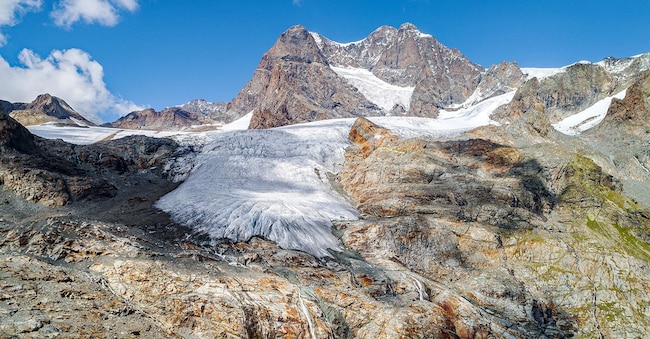
It is not just a matter of the countryside and rain. Drought is also affecting high-altitude mountain areas, where there has been a decline in snowfall. This is an increasingly frequent trend that has repercussions on water availability downstream, though in some cases this is offset by glaciers. This is the picture that emerges from a new scientific study, ‘The 2022–2023 snow drought in the Italian Alps doubled glacier contribution to summer streamflow’, the result of a collaboration between Fondazione Cima, Arpa Valle d’Aosta, the University of Genoa, the University of Milan-Bicocca and the Lombardy Glaciological Service, and published in the journal *Hydrology and Earth System Sciences*.
The dossier
The report analysed the role of Alpine glaciers during the extreme weather event of 2022–2023, with a specific focus on the Dora Baltea catchment area in the Aosta Valley and the Adda catchment area in Lombardy.
One of the findings to emerge from the study concerns the overall picture: above-average temperatures and low rainfall in recent years have led to a sharp reduction in winter snow cover. ‘In this scenario,’ the study’s conclusions state, ‘the research highlights how Alpine glaciers have played a decisive role: glacial melt has, in fact, increased very significantly, even doubling or tripling its contribution to runoff compared with normal conditions.’
The figures
So, the figures behind exponential growth
The study compared the snowmelt droughts of 2022 and 2023, and found ‘an increase in glacial melt of up to +148 per cent compared with the 2011–2021 reference period’. ‘This increase, combined with the reduction in river flows,’ the study states, ‘meant that the contribution of glaciers to summer runoff reached peak values of 83 per cent in Lombardy and 75 per cent in the Aosta Valley in 2022, before settling at 61 per cent and 65 per cent respectively in 2023.”

