
The ghosts of Elektra take to the stage: Maestro Enrico Calesso conducts
Hugo von Hofmannsthal and Richard Strauss’s masterpiece at the Teatro Verdi in Trieste, featuring eighty-six musicians on stage

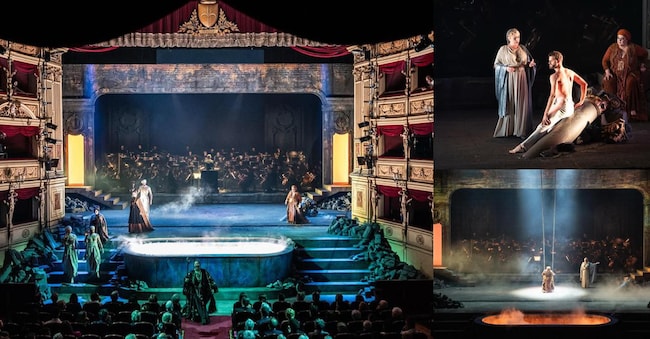
There are three women, each different from the others, yet similar in their strength and determination; each, in her own way, has inspired artists from ancient Greece and 20th-century Europe. The tragedy of *Elektra* captivated Hugo von Hofmannsthal and Richard Strauss, marking the beginning of their collaboration. Richard Strauss and von Hofmannsthal’s masterpiece was staged at the Teatro Verdi in Trieste; conducting was Maestro Enrico Calesso, with Marco Filiberti making his opera-directing debut; set design by Benito Leonori, costumes by Daniele Gelsi and lighting by Alessandro Carletti. An excellent cast featuring Okka von der Damerau / Sanja Anastasia, Elena Batoukova-Kerl / Diana Lamar, Simone Schneider / Regina Riel; Alexander Schulz; Michail Petrenko / Lars Fosser; Andrea Pellegrini; Saverio Fiore, Valentina Bilancione, Sophie Haagen, Benedetta Marchesi; Marta Lotti; Veronica Prando, Mandy Fredrich; the Orchestra and Chorus of the Teatro Verdi in Trieste. *Elektra* is a majestic and complex opera that demands a powerful orchestral performance; Calesso, in collaboration with Filiberti, has chosen to position the orchestra at the back of the stage, as if it were a Greek chorus. On stage are Clytemnestra, the mother, consumed by the murder she has committed; and Chrysothemis, one of her daughters, who longs only to live in the sunlight, far from the darkness to which her mother’s crime has condemned her.
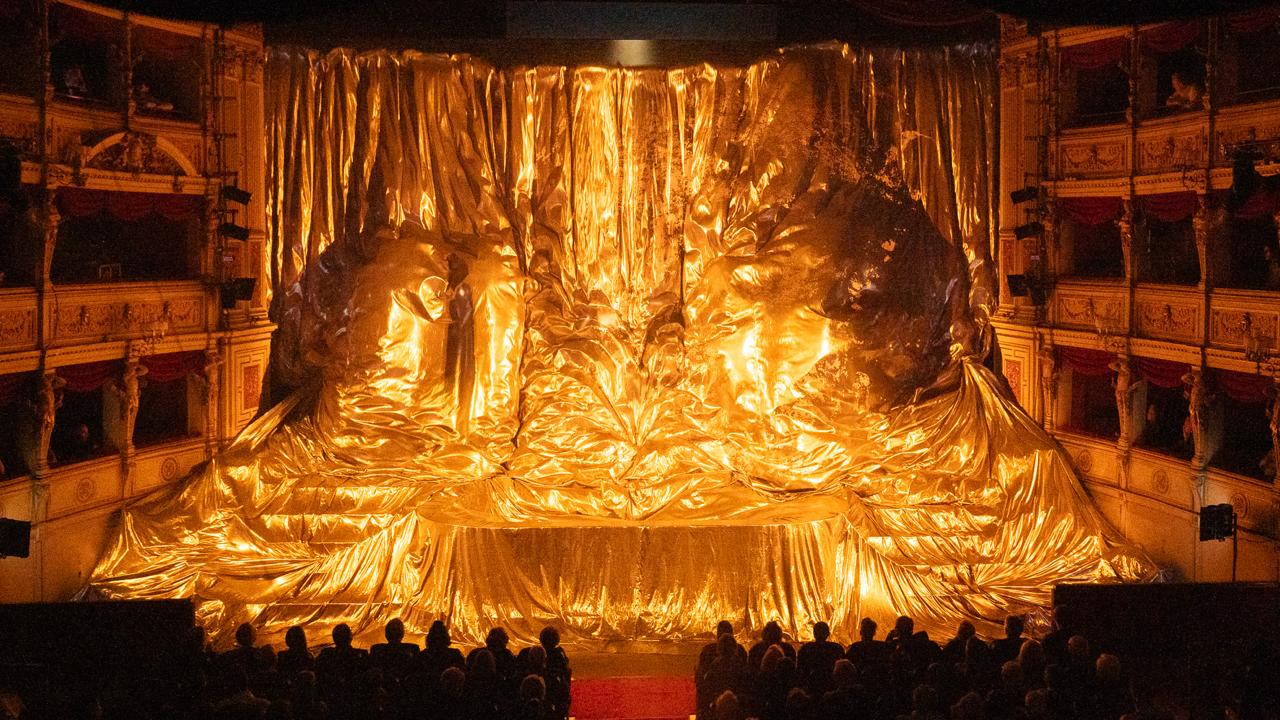
Elektra and the musical revolution of the 20th century
She is the outcast daughter who lives in the palace courtyard with the dogs; her wretched state serves as a constant reminder to her mother and her lover of the murder of Agamemnon, her father and the husband of the incestuous woman. The music conveys the anticipation of her brother Orestes’ return: only he can avenge Agamemnon. Hofmannsthal’s *Elektra* draws inspiration from Aeschylus, Sophocles, *Hamlet* and *Macbeth*; Richard Strauss is well aware of this – it is the age of Freud – and in the music he gives voice to the unconscious of every character. Enrico Calesso is truly a conductor to follow, listen to and get to know; his surprising approach to the score and his interpretation confirm his talent. It is a pity that the Maestro is only appearing in the German and Austrian seasons, and in Italia, at the Teatro Verdi in Trieste. And at the Verdi, unable to bring the original large ensemble – nor even the reduced version devised by Otto Singer and approved by Richard Strauss – because, as he writes in the programme, it would have weakened the timbre of the score, the Maestro, by reducing the strings and woodwinds, has assembled an ensemble of eighty-six musicians without sacrificing ‘the bass trumpet, the contrabass trombone, the Wagnerian tubas or the basset horns’. The conductor knows the score perfectly, presenting it almost in its entirety; he analyses it thoroughly, breaking it down and reassembling it; he navigates the two casts with a keen sense of the drama of the phrasing, which varies according to the performers, all of whom are outstanding in their own right.
A significant debut
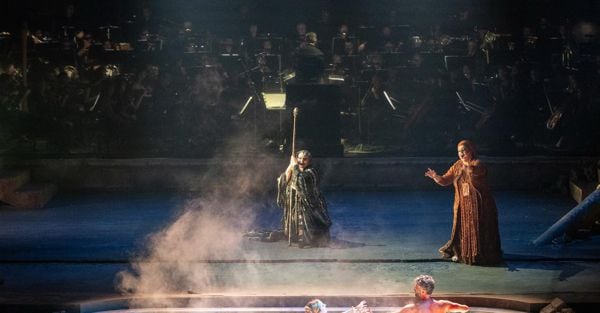
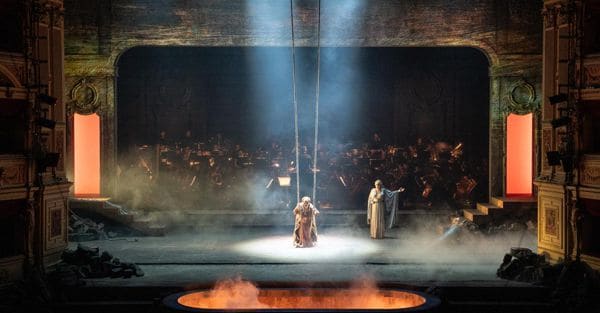
Marco Filiberti’s talent as a theatre and film artist, essayist and writer is well known but, as with Enrico Calesso, more so abroad than here at home. In a game of doubles, he has the actors of his theatre company, Le Vie del Teatro in Terra di Siena, portray the ghosts of the protagonists’ unconscious; disaster is bound to strike again. The narrative unfolds on three levels – the orchestra, the singers and remorse – which is why the actors move offstage; just as in Aeschylus and Sophocles, the director revives the presence of the ‘vasca’; the audience senses it but is never quite certain, for it appears and vanishes like an obsession in a deranged mind. In his debut as an opera director, the artist draws on the ideas of a brilliant Trieste-born figure, Giorgio Strehler, who believed that an understanding of music – and the importance of reading the score, phrase by phrase, not just the libretto – must form the basis of a collaborative production. The high quality of the production lies precisely in the fact that it was conceived and developed through a collective effort in which the conductor, the director, the set designer, the lighting designer and the choreographer reached their goal in harmony, The stage space is heightened by Alessandro Carletti’s lighting, whilst the stage movements, coordinated by choreographer Emanuele Burrafato, emphasise the protagonists’ bewilderment and the impossibility of finding a way out. Filiberti draws on the archetypes of pre-classical Greek culture—a wellspring of Dionysian and barbaric elements, much like Strauss and Hofmannsthal—whilst incorporating the Christ-centred interpretation of Simone Weil, of whom he is a fervent admirer: and in his *Elektra*, art redeems a psychotic mythology steeped in violence, transforming it into pure lyricism.

