
The End of History and the Loss of the Possible
It is a morning in October 1980. Adriano Alessandria arrives at the gates of the Fiat factory in Turin.

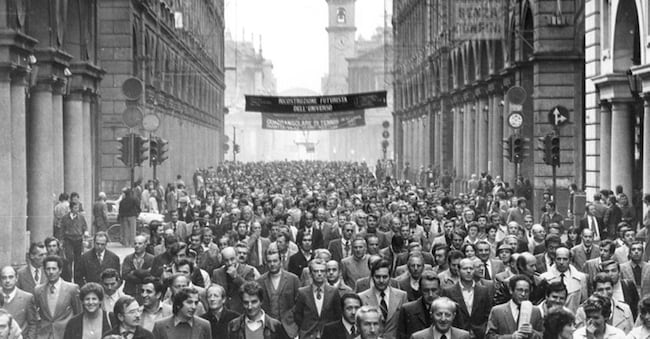
It is a morning in October 1980. Adriano Alessandria arrives at the gates of the Fiat factory in Turin. He is due to start his morning shift. He is twenty-three years old. Before him, the rain has brought down the banners and large posters that had accompanied the workers’ protest for weeks. They lie on the ground like the remnants of a party that ended badly. For thirty-five days, thousands of workers had picketed the gates of the Fiat factories. Now the dispute has ended with an agreement that, for many of them, represents a defeat. Alessandria looks at the fallen banners and feels the tears welling up. He forces himself to hold them back. He must enter the factory with his head held high. Forty years later, interviewed by the *Corriere della Sera*, he still remembers that scene. The rain, the banners, the need to maintain a certain sense of pride. But to understand the significance of that moment, we need to go back a few months. When Alessandria was taken on at Fiat, in February of that same year, a FIOM representative approached him to suggest he join the union. The young man turned him down, rather brusquely in fact. He didn’t seem interested. Twelve days later, once his probationary period was over, it was he who sought out the representative. This time, he wanted his membership card.
It is a minor, almost insignificant episode in the history of Italian industrial relations. Yet it reveals something important. A young worker joins a factory and realises almost immediately that his situation is not merely a personal matter. Wages, working hours, health and safety, and career prospects all depend on decisions over which, on his own, he has very little influence. Together with others, however, he can try to make a difference. It is one of the fundamental experiences through which people can develop a political consciousness: discovering that certain problems which seem private actually have a collective dimension, and that this can become the basis for joint action. A few months later, Alessandria took part in one of the most significant workers’ protests in post-war Italian history. Fiat announced thousands of redundancies. The dispute spread to the Turin factories and involved the workers, their families, the neighbourhoods, political and trade union organisations, and a significant part of the city. On 14 October, the demonstration by Fiat managers, white-collar workers and other employees – which went down in history as ‘the march of the forty thousand’ – shifted the balance of the negotiations. The agreement that followed marked the end of the mobilisation. When Alessandria returned to work, therefore, she saw not only the banners battered by the rain. It witnessed the conclusion of an experience in which it had learnt to recognise its own future as something that could be discussed and defended alongside others. We do not know exactly what thoughts were going through its mind at that moment, apart from those it would recount many years later.
But its story raises a question that goes far beyond the history of Italian industry. What happens to a society when the belief that people, by organising themselves, can help determine their own future begins to wane? A defeat, of course, is not enough to destroy that belief. Sometimes it actually strengthens it. Lost battles can leave behind a legacy of memory, a shared language, and new bonds of solidarity. Something changes, however, when what weakens is the very possibility of identifying a common ground on which to engage. When the decisions that determine living conditions seem to come from ever more distant places, removed from public debate and political accountability. When the organisations through which people have learnt to exercise some of their power lose influence, whilst economic transformations are described as processes to which one must adapt.
It would be wrong to regard the workers’ defeat in 1980 as the origin of what was to happen in the years that followed. The trade union movement, too, is riven by divisions and contradictions. But it is precisely for this reason that the story of Alessandria is of interest to us. In that return to work, we can recognise one of the turning points through which the relationship between people, collective organisations and economic power began to change.
These considerations form the starting point for a new series of *Mind the Economy*, which, over the coming months, we will devote to democracy: its roots, its crisis in the face of the temptations of authority and technology, new perspectives and, finally, its political future – which is also our own.


