Digital Round Table

The energy crisis and solutions involving renewables, nuclear power and investment for a sustainable and secure future

A discussion on Radio 24 between experts on strategies to reduce costs and energy dependence, focusing on renewable sources, efficiency and new technologies against a backdrop of global uncertainty

by Maurizio Melis

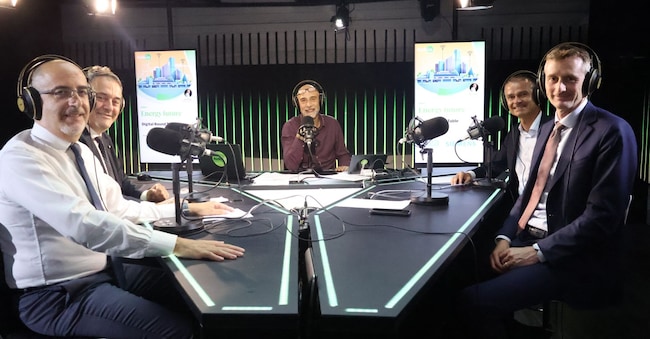
Gli ospiti da sinistra: Maurizio Delfanti: Professore di Sistemi Elettrici per l’Energia al Politecnico di Milano, Stefano Besseghini: Ricercatore del CNR, Ex Presidente di ARERA (Autorità di Regolazione per Energia Reti e Ambiente), Maurizio Melis: giornalista Radio 24 e conduttore del programma Smart City, Marco Rastelli: Head of Electrification & Automation Siemens Italia, Lorenzo Giussani: Direttore Strategy and Growth Gruppo A2A

5' min read

Translated by AI
Versione italiana

5' min read

Translated by AI
Versione italiana

We are experiencing the second major energy crisis in just a few years, linked to the collapse of a key supply chain for natural gas and oil, in an increasingly uncertain and unpredictable international context, where Italia chronically suffers from the highest electricity prices in Europe and a dependence on natural gas that is unmatched in any other manufacturing nation.

A situation that has brought the debate on the country’s energy future back into the spotlight, with discussions centring on the green transition, a return to nuclear power and new energy landscapes.

Loading...

What solutions can we put in place, if not to solve the problems tomorrow, then at least to ensure we are not just as vulnerable to the next crisis in two, three or five years’ time?

Can energy security and sustainability coexist with affordable energy costs?

Is there a contradiction between the energy transition process designed to tackle the climate crisis and what we need to do to ensure the country has a secure energy supply at affordable prices?

These are the key questions that experts from the worlds of academia, research and business were asked to address during the Digital Round Table: Energy Future, broadcast on Radio 24 and on Sole24Ore.com: Stefano Besseghini, CNR researcher and former president of ARERA; Maurizio Delfanti, Professor of Energy Systems at the Politecnico di Milano; Valeria Termini, Full Professor of Political Economy at Roma Tre University, expert advisor to the CNEL for the Presidency of the Republic; Lorenzo Giussani, Director of Strategy and Growth at the A2A Group; and Marco Rastelli, Head of Electrification & Automation at Siemens, moderated by Maurizio Melis, co-host of Smart City on Radio 24.

The discussion among the guests revealed a number of points on which there was broad – if not complete – agreement, which are worth highlighting:

1. The conflict between the environment and the economy is over. The main key technologies of the energy transition (solar and wind power, storage systems and most energy efficiency solutions) are now economically competitive in peacetime and, even more so, in wartime, and provide a safeguard against international turmoil. The latest GSE auctions have demonstrated this, enabling the supply of electricity at competitive prices: €60–80/MWh compared to an average of €110/MWh and peaks of up to €300. These results, however, can only be achieved provided there is a significant focus on large utility-scale plants.

2. Renewable energy can help reduce the cost of electricity. This is achieved precisely through the aforementioned auctions, by means of which the GSE can procure energy outside the electricity exchange mechanism (dominated by the prices of electricity produced from natural gas), thereby achieving a ‘de facto decoupling’. Individual businesses can achieve a similar result by focusing on self-generation or through arrangements such as PPAs (Power Purchase Agreements).

3. Managing the unpredictability (intermittency) of non-dispatchable sources requires a significant upgrade to the electricity infrastructure, particularly the distribution network. But there are no magic solutions. Today we have mature and cost-effective technologies that allow us to manage this discontinuity at least until the share of unpredictable sources becomes dominant: around 70–80%, whereas currently only 20% of electricity is produced from such sources. In short, it may be true that we cannot do everything with renewables, but as things stand, that ‘risk’ does not exist.

4. Since wind and solar power are partially complementary (for example, wind is often more abundant in winter than in summer and is also present at night), a careful balance between the two sources can simplify their management and reduce the need for additional electrical infrastructure. Today, it is wind power generation that lags behind photovoltaic generation. It is therefore a priority to develop wind energy and, more generally, to diversify renewable sources as much as possible in order to benefit from their different generation profiles. Geothermal, biomass cogeneration and waste-to-energy can make a fundamental contribution in this regard, qualitative even before quantitative.

5. Electrification is the key factor in ensuring the success of the energy transition. Increasing electricity consumption at the expense of fossil fuels creates scope for new sources of electricity and alleviates critical issues, such as the risk of overloading the grid with intermittent sources and coming too close to the 70–80% threshold (see above), beyond which managing the variability requires solutions that are not yet mature (such as hydrogen).

6. Nuclear energy can offer undeniable advantages in terms of energy diversification and security, but its ability to have a positive impact on the price of electricity is currently a matter of speculation, given that there is no commercial supply of SMR (Small Modular Reactors) or AMR (Advanced Modular Reactors) anywhere in the world. Hence the need to see the cards of the ‘new nuclear’ (of course, whilst ensuring we are prepared) before envisaging large-scale adoption plans which, in any case, could not have a significant impact on the energy market until a quantifiable critical mass has been reached – in the case of SMRs, a few dozen reactors. It is unrealistic to expect this to happen within the next twenty years.

7. No energy transition plan can succeed without significant public and private investment in energy efficiency, starting with the construction sector.

8. Italia has limited hydrocarbon reserves, yet this potential is not being fully exploited, particularly in light of new extraction technologies that have enabled countries such as the United States and China to significantly increase their hydrocarbon production. Replacing imported hydrocarbons with domestic ones, even partially (at least for as long as there is a need), is not at odds with the energy transition and can help, if not to reduce energy prices, then at least to lessen the country’s energy vulnerability.

Even amidst the confusion that characterises the present and the uncertainty that defines the future – and despite the complexity of the issue – there are therefore some clear elements that suggest specific courses of action for businesses and the public sector at all levels, if not between now and 2050, at least for the next decade.

In other words, there is a way to gradually reduce, starting tomorrow, the cost of energy and the country’s exposure to the storms affecting the energy sector, and this involves, first and foremost, unblocking tens of GW (out of a total of over 300) of connection requests for new renewable energy plants and simplifying the entire authorisation process.

There is no time to lose. The country and industry cannot wait any longer.

Copyright reserved ©
Loading...

Brand connect

Loading...

Newsletter

Notizie e approfondimenti sugli avvenimenti politici, economici e finanziari.

Iscriviti