
The eruption of Mount Etna shows no sign of abating: flights arriving in Catania have been further reduced
The airport management company has announced that incoming flights are limited to five aircraft per hour until 2.00 pm. However, there are no restrictions on outgoing flights.

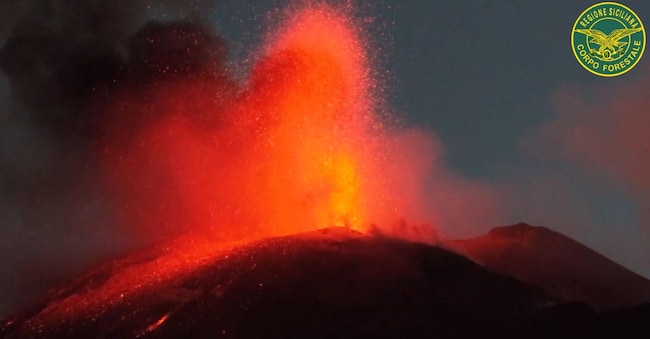
SAC, the company managing Catania Airport, has announced that, “due to the volcanic activity of Mount Etna and the resulting emission of volcanic ash into the atmosphere, the areas corresponding to sectors B1 and B2 have been closed”. Consequently, “incoming flights are limited to five aircraft per hour until 2.00 pm today, Monday 17 August. There are no restrictions on outbound flights”. SAC therefore urges passengers “to check the status of their flight with their airline before travelling to the airport”. Explosive activity at Etna’s Voragine crater therefore remains intense. Volcanic tremor, which indicates the energy present in the internal magma conduits, is on the rise and remains at very high levels.
The National Institute of Geophysics and Volcanology, Etna Observatory, in Catania, has in fact reported that “effusive activity continues from the vents at altitudes of 2,750 and 1,990 metres above sea level” and that “the most advanced edge of the lava flows is at an altitude of 1,395 metres, between Rocca delle Palombe and Rocca Musarra”. “Between 09:40 and 12:40 – as stated in the INGV bulletin issued on the evening of 16 August – a series of short-lived explosions occurred from the north-eastern crater, generating an ash plume that dispersed from the summit area towards the south-east. At 18:22, Strombolian activity resumed at the Voragine crater. Subsequently, from 18:45 onwards, ash emissions from the north-eastern crater intensified. From a seismic perspective, since late yesterday evening, the average amplitude of volcanic tremor has fluctuated widely between low and medium values, gradually increasing in amplitude. In the last few hours of today – continues the INGV statement issued on the evening of 16 August – the increase has been increasingly marked and, from around 18:00, the amplitude of the tremor has shifted from the range of medium values to high ones. The source centres of the tremor are located between the North-East and Voragine craters, at an altitude of between 2,800 and 3,000 metres above sea level.”

