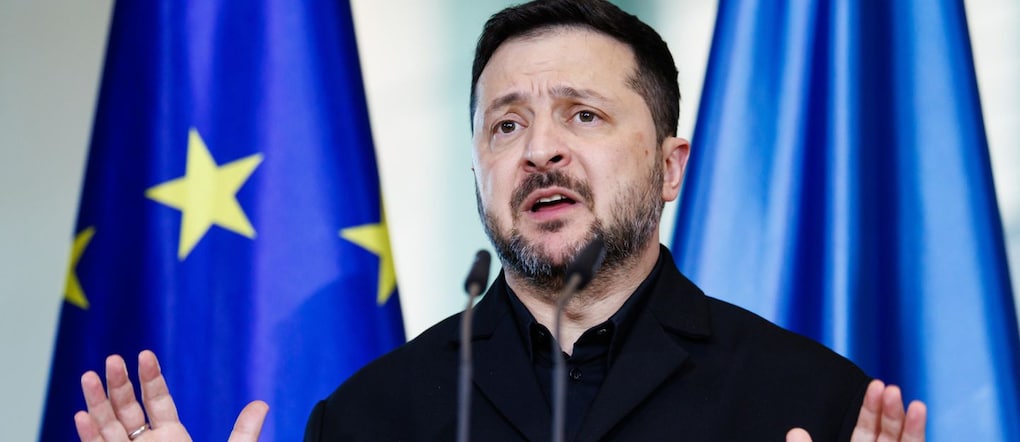
Il presidente ucraino Volodymyr Zelensky gesticola durante una conferenza stampa alla Cancelleria di Berlino, in Germania, il 3 novembre 2026. Il cancelliere tedesco Friedrich Merz e il presidente ucraino Volodymyr Zelensky si sono incontrati per colloqui bilaterali.  EPA/CLEMENS BILAN EPA

05 November 2026

Kiev, the mayor: ‘Water and electricity supplies are at risk of collapsing’

In an interview with the German television channel ZDF, Ukrainian President Zelensky expressed the hope that the outcome of the US mid-term elections would help to increase American aid to Ukraine and step up the pressure on Vladimir Putin to bring the war to an end

Translated by AI
Versione italiana
Aggiungi Il Sole 24 Ore
ai preferiti su Google

5 November 2026Pinned update

Zelensky hopes for a turning point: ‘More aid and pressure on Putin’

Ukrainian President Volodymyr Zelensky has flown to Spain, to Madrid, where the 30th Ibero-American Summit was held, for a flurry of meetings with Latin American leaders; at the same time, however, he has returned to the outcome of the US elections, which could have a significant impact on the future of negotiations with Russia. Zelensky is saying openly what Europe is whispering: a Democratic victory will help to increase US aid and step up the pressure on Putin. “We have bipartisan support,” he said in an interview with the German broadcaster. “I am also grateful to the Republicans, but the Democrats are very clear about their support for Ukraine and the provision of aid. There is talk of re-establishing ties between the US and Europe, which have weakened somewhat in recent years: without these ties, it is very difficult to stand up to Putin.” Looking back, it is now striking how much Zelensky distanced himself from Donald Trump in the weeks leading up to the election, whilst at the same time cultivating relations with Congress – in a sense, he gambled on the result that eventually emerged from the ballot box. “He made his presence felt as much as possible in the US; that much is very clear,” commented a European official. Whether he will be able to capitalise on this, however, remains to be seen. Meanwhile, at NATO headquarters, talks between negotiators have continued – still at a technical level – ahead of next week’s US-Russia-Ukraine trilateral meeting in Abu Dhabi. Representatives from the E3 (London, Paris, Berlin), the EU, the United States, Ukraine and NATO took stock of the situation, focusing in particular on the security guarantees to be given to Kyiv as part of the negotiation process (Zelenskyy has been insisting for months that these must be approved by the US Congress, and now, in the wake of the ‘blue tsunami’, this seems a less far-fetched demand). Yet another tranche of funding, this time amounting to 4.3 billion, disbursed by the European Commission to support Ukraine in its fight against Russia, demonstrates just how crucial the EU has become. And all this must be reflected in the balance of power in the negotiations. In Madrid, Zelensky also met the President of the European Council, Portugal’s António Costa, to discuss Ukraine’s European integration process ‘in detail’. The Commission has just approved the annual enlargement package in which, whilst praising the reforms adopted by Kyiv in the midst of a war, it noted that Moldova might ultimately make faster progress, given that Ukraine is struggling with the rule of law and the full implementation of anti-corruption laws. “We discussed our new ideas that could really speed up the process; Antonio will discuss them with Ursula,” Zelensky assured. “Of course,” he added, “we also discussed preparations for the trilateral meeting in Abu Dhabi and our priorities. I briefed Antonio on yesterday’s conversation with the American side. Ukraine has always maintained that Europe must be present at the negotiating table: when it comes to security guarantees and Ukraine’s economic recovery, these issues cannot be discussed without European representatives.” Costa agrees.

Loading...

5 November 2026

Bomb threats on flights; investigations launched in Rome and Milan. An email claims: ‘This is just the beginning’

Persone all'aeroporto di Fiumicino, dopo che un aereo della Finnair proveniente da Helsinki è stato scortato in sicurezza fino all'atterraggio previsto a Roma da jet dell'Aeronautica Militare italiana, a seguito di minacce di attentati che hanno costretto diversi aerei di linea a effettuare atterraggi non programmati in tutta Europa, a Fiumicino, vicino a Roma, Italia, il 5 novembre 2026. REUTERS/Remo Casilli REUTERS

Following the Milan Public Prosecutor’s Office, the Rome Public Prosecutor’s Office has also launched an investigation into the bomb threats that have affected several flights in recent days, including at Fiumicino Airport. The case opened at Piazzale Clodio is being pursued on the grounds of causing a false alarm, currently against persons unknown. Specialists from the Polaria unit are working on the case, with investigations also being carried out by the Postal Police, who have in the last few hours sent reports to the various relevant public prosecutors’ offices.

Previously, the Milan Public Prosecutor’s Office, headed by Marcello Viola, had opened an investigation – currently with no suspected offence or suspects – after receiving the first two reports from Polaria regarding the emails about false bomb threats on yesterday’s flights. These reports concern Malpensa Airport and also Linate Airport.
5 November 2026

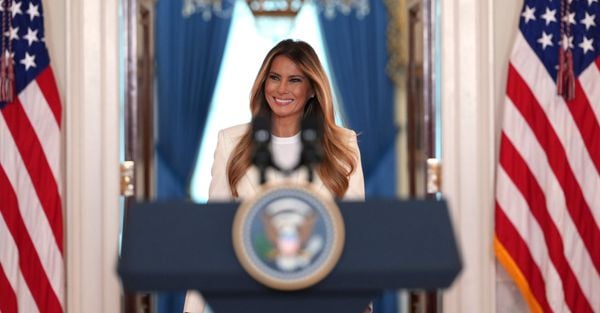
Ukraine: Melania Trump calls for a ‘lasting’ ceasefire

5 November 2026

Sanchez: ‘Putin wants to undermine the foundations of the European project’

“Vladimir Putin wants to undermine the foundations of the European project, call into question the European security architecture and redraw borders.” This was stated by the Spanish Prime Minister, Pedro Sánchez, speaking at the plenary session of the 30th Ibero-American Summit in Madrid, in the presence of the Ukrainian President, Volodymyr Zelensky. “Ukraine’s fate is also closely linked to that of the European project,” said Sánchez, explaining the reasons behind Madrid’s and the European Union’s support for Kyiv against the Russian invasion. “In this situation, there is an aggressor, Russia, and a victim, Ukraine,” the Spanish Prime Minister noted, calling on Ibero-American countries to maintain “a position consistent” with the principles of the declaration adopted at the summit. The Madrid Declaration, signed by the 22 member countries of the Ibero-American community, reaffirms, amongst other things, respect for international law, the peaceful resolution of conflicts and the United Nations Charter. “Failing to support Ukraine would mean opening the door to the law of the strongest,” warned Sánchez, stressing that any country present at the summit “could find itself in the same situation tomorrow”. The Prime Minister thanked Zelensky for attending the meeting and assured him that Spain’s support – as one of the leading contributors – for Kyiv “is across the board, transcending ideologies” and that the Spanish people “are very clear about which side of history they are on”.

5 November 2026

Zelensky: ‘Russia is starting to send deported Ukrainian children to the front line’

Russia is reported to have begun sending Ukrainian children – who were deported to Russian territories following the 2022 invasion – to the front line. This was denounced by the Ukrainian President, Volodymyr Zelensky, speaking today before the leaders at the 30th Ibero-American Summit in Madrid. “Russia has started conscripting some of these children into the army – children who were stolen from us and who have now grown up. It is perverse and must stop,” he explained, referring to tens of thousands of abducted minors. “The war continues only because one person, Putin, refuses to give the order to stop it,” added Zelensky, arguing that Ukrainian prisoners and the deported minors could return home if the Russian president so decided.

In his address, the Ukrainian president called on Latin American countries for urgent aid to “keep the Ukrainian energy system operational”, as it is the target of Russian attacks. “I ask you to get in touch with your companies and manufacturers to secure supplies for Ukraine as soon as possible,” appealed Zelensky, who highlighted the urgent need for transformers, cables, generators and electrical equipment.

The head of the government in Kyiv specifically mentioned potential supplies from Brazil, Mexico, Argentina, Colombia, Chile and Spain. “We need equipment that is compatible with our electricity grid, and we need it quickly,” he concluded. Following the summit, Zelensky will travel to the Zarzuela Palace for a meeting with King Felipe VI and, subsequently, to the Moncloa Palace for a bilateral meeting with Spanish Prime Minister Pedro Sánchez.

5 November 2026

Poland: six arrests over Russian espionage and arms smuggling in Kaliningrad

Poland’s Internal Security Agency (ABW) has arrested six people accused of being members of an organised criminal group acting against Poland’s interests on behalf of Russia. The news was announced today by the coordinator of the special services. Tomasz Siemoniak wrote on social media that those arrested, aged between 25 and 52, include five Polish citizens and one Russian woman. A court has ordered four of them to be remanded in custody on charges of espionage, whilst non-custodial restrictive measures have been imposed on the other two. “The evidence gathered indicates that the individuals in question were carrying out activities on behalf of the Russian special services and were involved in actions aimed at bolstering the military potential of the Russian Federation,” said Siemoniak. He added that, according to investigators, the group had illegally supplied Russia with large quantities of materials for military use, intended for the manufacture of ammunition and weapons.

5 November 2026

Russian negotiator: ‘Putin gave direct instructions for the ceasefire in Oleshky’

The Russian presidential envoy for economic cooperation and chairman of the Russian Direct Investment Fund, Kirill Dmitriev, has stated that Russian President Vladimir Putin personally issued the necessary instructions to ensure the success of the ceasefire in the town of Oleshky, which was in force from 27 October to 1 November. This has been reported by Russian news agencies.

5 November 2026

Moscow: ‘We are ready to cooperate with the Vatican on humanitarian matters’

Russia appreciates the Vatican’s willingness to facilitate the resolution of humanitarian issues that have arisen during the conflict in Ukraine and is ready for further cooperation in this area, said Russian Foreign Ministry spokeswoman Maria Zakharova. “We are open to further cooperation with the Vatican on humanitarian matters, particularly with regard to family reunification, the search for those missing during the conflict, the exchange of prisoners and, of course, the resolution of other situations arising in the conflict zone,” said Zakharova, as quoted by TASS. “We are grateful to the Vatican for its consistent approach to peacekeeping in the Ukrainian conflict and for its involvement in resolving humanitarian issues in the context of the special military operation,” the diplomat noted. She also emphasised that “the Russian President gave a positive assessment of the bilateral dialogue during his telephone conversation with the Pope on 16 October this year”.

5 November 2026

Melania Trump: ‘I hope the truce in Oleshky will inspire a broader peace’

“I hope the truce in Oleshky will inspire a broader peace.” First Lady Melania Trump said this at the White House whilst speaking about the ceasefire in Ukraine that she helped to negotiate. “Russia and Ukraine have agreed to work with me as their sole mediator,” added Donald Trump’s wife.

La first lady Melania Trump arriva per intervenire durante un incontro con rappresentanti russi e ucraini nel Grand Foyer della Casa Bianca, giovedì 5 novembre 2026, a Washington. (Foto AP/Alex Brandon) Associated Press/ LaPresse Solo Italia e Spagna

5 November 2026

Zelensky meets Costa; ‘Europe must be at the negotiating table’

“A fruitful meeting with the President of the European Council, Antonio Costa. As always, we are working closely with the European Union on all important issues.” Ukrainian President Volodymyr Zelenskyy wrote this on X. “We discussed Ukraine’s European integration process in detail. We are working to conclude all negotiation groups by the end of this year and, next year, to move on to closing the negotiation chapters and continue to make rapid progress towards our accession. We discussed our new ideas that could really speed up the process. We agreed that Antonio will discuss them with Ursula,” he added. “Of course, we also discussed preparations for the trilateral meeting in Abu Dhabi and our priorities. I briefed Antonio on yesterday’s conversation with the American side. Ukraine has always maintained that Europe must be present at the negotiating table. When it comes to security guarantees and Ukraine’s economic recovery, these issues cannot be discussed without European representatives. And Antonio supports our position. Thank you for all your support!”

5 November 2026

Ukraine: Crosetto to appear before COPASIR on Tuesday at 3 pm

The hearing of the Minister of Defence, Guido Crosetto, before COPASIR will take place on Tuesday 10 November at 3.00 pm.

5 November 2026

Russia: propagandist Borodin wants to ban pizza

In a Telegram post reported by the French newspaper *Le Parisien*, the pro-Kremlin Russian propagandist Vitaly Borodin criticised pizza, describing it as “Western soft power in a cardboard box”, and suggested replacing it with traditional Russian dishes.

The activist, lamenting the growing popularity of pizza in the diets of young Russians, urged Russian universities and schools to remove pizza from canteen menus, calling on educational institutions to place greater emphasis on Russian specialities, giving them priority over dishes of foreign origin.

In support of his claim, he argued that young Russians are no longer familiar with their country’s traditional dishes, going so far as to accuse them of being “unable to name a single Russian dish”.

5 November 2026

EU sources: ‘It would be difficult to open a discussion on the special envoy for Ukraine at this stage’

“It will be difficult to raise this issue now.” This is according to a European diplomatic source, commenting on the letter sent by Giorgia Meloni to President Antonio Costa regarding the need to appoint a European envoy for the peace negotiations in Ukraine as soon as possible. “There is already an agreement between the offices of Costa and Ursula von der Leyen; they are taking part in the discussions alongside the E3. When and if there is a need to take this to the leaders’ level, we shall see, but at the moment there is fairly broad consensus: representing Europe at the table will be the President of the European Council and the President of the Commission,” the source added. In short, there will be no backtracking by the E3, not least because, given that France and Germany are part of the EU, they could in theory step back, whilst London could not be represented by Costa and von der Leyen. Among the 27 Member States, however, there are also differences in preferences regarding the two presidents. “We believe there is already an envoy, not only when it comes to Russia and Ukraine but for the whole world, and this is even enshrined in the Treaty: it is the President of the European Council,” points out a diplomat from an Eastern European country. “If it proves necessary for a European leader to be present at the negotiating table, it must be von der Leyen,” retorts another source from a different Eastern European country. “In any case, these are pointless discussions,” they add. “Putin doesn’t want to negotiate with the Europeans; he’s happy with what he’s managed to achieve with the Americans. This is all about Italian domestic politics in the run-up to the elections.” However, there are also those who praise Meloni’s move. “The timing of the request is good; she knows how to play the European game: neither too early nor too late in relation to the European Council’s schedule; there is enough time to think things through”, assures a fourth diplomatic source. “That said, we are comfortable with the current format: the E3 supported by the Commission and the Council”. “This isn’t the first time Meloni has put forward this request; she clearly feels that Italia isn’t sufficiently represented,” concludes a fifth diplomatic source. With one caveat: “If it were a joint request from Zelensky and Meloni, that would be one thing, but that is not the case.”

5 November 2026

Ukraine: Meloni writes to Costa: ‘It is unacceptable for the EU to be in disarray; we need a single voice’

Manuela Perroneby Manuela Perrone

Il presidente ucraino Volodymyr Zelenskiy incontra il primo ministro italiano Giorgia Meloni a Palazzo Chigi, a Roma, in Italia.  (REUTERS/Remo Casilli/Foto d’archivio)

A Europe that continues to ‘proceed in a disorganised manner’ on Ukraine is ‘unacceptable’: ‘We are simply serving the interests of those who want this war to continue’. Giorgia Meloni has lost her patience. After months of calling for a single negotiator for Kyiv – someone capable of sitting at the negotiating table with a unified voice and a clear mandate to represent the EU – the Italian Prime Minister has put pen to paper and written to the President of the European Council, Antonio Costa.

The call is clear: put an end to ‘initiatives that follow one another in quick succession and overlap’, because ‘it will not help us, neither with our partners nor with those we need to convince to stop a senseless aggression’ (Vladimir Putin, whom he does not name). And to address the issue at the informal European Council meeting in Dublin scheduled for 13 November, with a view to reaching a final decision at the summit of Heads of State and Government in December.

5 November 2026

Email containing a threat regarding flights, signed by a Russian extremist cell

“The explosion will take place in 60 minutes. Today your sky will be red”: this is how the email containing bomb threats, sent to Italian airports and signed by the ‘Combattenti dello Stato maschile’, concludes. This signature refers to the Russian ultra-nationalist and misogynistic movement ‘Muzhskoye Gosudarstvo’, already known to international authorities, founded by Vladislav Pozdnyakov and banned in Russia. “We, the Fighters for the Male State, will make our mark on history with our actions today. Your feminist regime will remember this forever,” the email reads.

5 November 2026

Zelensky meets Portuguese president in Madrid: ‘We need help to protect lives’

Support for Ukraine’s energy system and the possibility of launching “joint arms production”. These were the topics addressed by Ukrainian President Volodymyr Zelenskyy during a meeting in Madrid with Portuguese President António José Seguro, on the sidelines of the 30th Ibero-American Summit. Zelensky himself reported this in a post on X. “We discussed with the President how Portugal can support our energy system and help protect lives in Ukraine. We also spoke about opportunities for joint arms production. We have high hopes for further steps to provide support,” writes the Ukrainian president. In the post, Zelensky thanked Seguro for his condolences following the Russian attack on a school in Komyshvakha, where, prior to the massacre, the local population had been receiving humanitarian aid. “The search and rescue operation is now in its fourth day. So far, 43 fatalities have been confirmed. My condolences to their families and loved ones,” wrote the Ukrainian president, noting that “Dozens of other people may still be trapped under the rubble”. “One of the people reported missing has been found today,” he added. In his message, the Ukrainian president emphasised: “Every day, Russia attacks our towns and communities with drones and missiles. Our energy sector has suffered extensive damage and it is very difficult to restore everything,” he concluded.

5 November 2026

Klitschko: ‘Strategic infrastructure at risk of collapse’

Without air defence systems, defensive structures will be unable to protect strategic infrastructure, the mayor of Kyiv, Vitali Klitschko, warned today, after the city has been facing difficulties with its water supply and ongoing power cuts. “Their stable operation and even their very survival are at serious risk,” stated the mayor of the Ukrainian capital.

“I will mention the most important point, the one on which all experts and specialists agree. With such a high intensity of devastating attacks by the enemy, if strategic infrastructure is not protected by air defence systems, its restoration, stable operation and even its very survival are at serious risk. When several missiles or a swarm of drones strike simultaneously, no protective structure is capable of withstanding them,” said Klitschko, according to the Ukrainian news agency Ukrinform.

5 November 2026

Putin: ‘Training programmes are needed for troops on the front line’

Vladimir Putin has instructed the government to draw up specific training programmes for those military personnel involved in the special operation in Ukraine who do not currently have a university education. “There are many young people on the front line who have not completed their university studies. We must also create the necessary conditions for them to realise their potential in civilian service,” Putin said during a government meeting on education.

5 November 2026

Zelensky: death toll from Russian air raid in Zaporizhzhia rises to 43

The death toll from the Russian attack on Komyshuvakha, in the Zaporizhzhia region, has risen to 43, and dozens more may still be buried under the rubble, Ukrainian President Volodymyr Zelensky said today, after meeting Portuguese President António José Seguro in Madrid.

“Search and rescue operations have been underway for four days. At present, 43 people are known to have died. My condolences go to their families and loved ones. Dozens more people may still be buried under the rubble. One person who was believed to be missing was found alive today,” Zelensky said today.

5 November 2026

Ukraine: Russian attack in the Kyiv region sparks a fire; firefighters are on the scene

5 November 2026

Von der Leyen to the Visegrad Group: ‘Support for Kyiv – you have a key role to play in its accession’

“In the beautiful city of Trenčín, the European Capital of Culture, I delivered three key messages at the Visegrád Group summit. We are committed to enlargement as a geostrategic necessity. It gives Europe greater influence and greater prosperity. The Visegrád Group countries are proof of its success. High energy prices are at the top of our agenda. We are working to reduce them by accelerating the transition to clean energy, diversifying supply sources and pooling demand.” EU Commission President Ursula von der Leyen wrote this on X. As for her third message, von der Leyen emphasises: “Ukraine must negotiate peace from a position of strength. Continued military support is essential, including through the successful ‘Czech Ammunition Initiative’.” “The Visegrád Group,” she concludes, “will also play a key role in Ukraine’s future integration into our Union.”

5 November 2026

Meloni to Costa: it is imperative that Europe speaks with one voice on Ukraine

‘In light of the latest developments, I am compelled to return to an issue I have raised on several occasions in the European Council. I am referring to the need for Europe to speak with one voice on the Ukrainian question. This is a need that can no longer be put off.’ Thus begins a letter sent by Prime Minister Giorgia Meloni to the President of the European Council, Antonio Costa. According to Meloni, the succession of interventions in various formats and with different compositions is making Europeans ‘lack credibility in handling one of the most complicated issues facing our nations’. And I am convinced that we all realise how, by projecting the image of a Europe that is in disarray, we are merely serving the interests of those who want this war to continue. And I think – she emphasises – that this is unacceptable, given that human lives and the future of our security are at stake.’

GIORGIA MELONI PRESIDENTE DEL CONSIGLIO

5 November 2026

Zelensky meets King Felipe, Sánchez, Costa and Latin American leaders in Madrid

Following his surprise arrival in Madrid yesterday, Ukrainian President Volodymyr Zelensky is set to hold a series of diplomatic meetings today with leading Spanish, European and Latin American officials, on the sidelines of the 30th Ibero-American Summit. After his meeting with Felipe VI at the Zarzuela Palace, Zelensky will attend a meeting at 3.45 pm in the Royal Collections Gallery – the venue for the summit – with Prime Minister Pedro Sánchez, the President of the European Council, António Costa, the Vice-President of the European Commission, Teresa Ribera, and several Latin American leaders, according to the Moncloa. The Ukrainian President also has bilateral talks scheduled with some of the ten heads of state and government from the Ibero-American community present in Madrid, and meetings are also planned with the UN Secretary-General, Antonio Guterres. A bilateral meeting with Sánchez is scheduled for 7.15 pm at the Moncloa Palace, to reaffirm Spain’s support for Kyiv. The Ukrainian president’s visit aims to strengthen dialogue with the Latin American region, where views on the Russian invasion remain divided, and coincides with preparations for a new round of trilateral talks between Ukraine, the United States and Russia, scheduled for 10 and 11 November in Abu Dhabi.

5 November 2026

Summit of the Visegrad Group presidents in Slovakia with von der Leyen

The President of the European Commission, Ursula von der Leyen, will attend the summit of the presidents of the Visegrad Group countries (V4: Poland, Hungary, the Czech Republic and Slovakia) in Trencin, Slovakia, today. The main topics of the summit are support for Ukraine in the face of the Russian invasion, the enlargement of the European Union and energy security. Last night, an initial meeting took place between the presidents of the individual V4 countries – Peter Pellegrini, Petr Pavel, Karol Nawrocki and Andras Baka – and the governors of the central banks of all four countries. According to the website Aktualne.cz, the discussion focused on the slowdown in the Visegrad Group’s economic convergence with the EU average, common economic challenges and the development prospects for the Central European region. This year, Slovakia holds the presidency of the Visegrad Group, and EU enlargement is one of its priorities. Next year, the summit will be hosted by the Czech Republic, which will take over the presidency in July. The Visegrad Group was established in 1991 in Visegrad, Hungary, with the aim of supporting the integration of Central European countries into Euro-Atlantic structures.

5 November 2026

The EU is providing 4.36 billion to Kyiv for financial support and defence

“Whilst Russia continues its relentless attacks, Ukraine is about to face its fifth winter at war. And whilst efforts to achieve a just and lasting peace for Ukraine continue, so too does the EU’s unconditional support. Today we are disbursing a package of €4.36 billion in support of Ukraine.” This was announced on X by the President of the Commission, Ursula von der Leyen. The funding comprises €3.7 billion relating to the second tranche of macro-financial assistance (MFA) agreed for 2026 and €658 million under the ‘defence’ component of the loan.

5 November 2026

Kremlin: ‘Allegations of involvement in attacks on supermarkets are unfounded’

Russian presidential spokesperson Dmitry Peskov has described as ‘absurd’ the allegations that groups of pro-Russian hackers were behind the recent cyber-attacks on supermarket refrigeration systems in some European countries. “‘These are absurd claims. As always, they are baseless and unsubstantiated,’ said Peskov, as quoted by TASS. ‘And these unfounded accusations against our country, alleging involvement in all this, are, unfortunately, becoming a persistent trend in European countries,’ emphasised the Kremlin spokesperson.

5 November 2026

Zelensky: I hope the outcome of the mid-term elections will mean more aid for Kyiv

President Volodymyr Zelensky, in an interview with the German broadcaster ZDF, expressed the hope that the outcome of the US mid-term elections – with a Democratic victory – will help to increase US aid to Ukraine and step up the pressure on Vladimir Putin to end the war. ‘We have bipartisan support,’ he said, ‘and I am also grateful to the Republicans, but the Democrats are very clear about their support for Ukraine and the provision of aid. There is talk of re-establishing ties between the US and Europe, which have weakened somewhat in recent years. Without these ties, it is very difficult to stand up to Putin.”

Brand connect

Loading...

Newsletter

Notizie e approfondimenti sugli avvenimenti politici, economici e finanziari.

Iscriviti