The Strategy

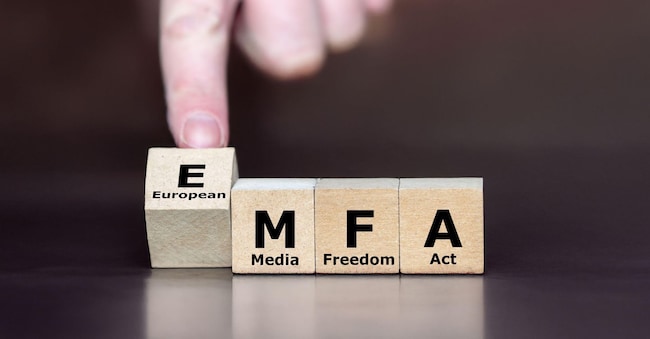
As of today the European Media Freedom Act applies, here is how the EU aims to defend information

"Now the real work begins," recalled Vice-President of the Eurochamber Sabine Veheyen, who chairs the Parliament's working group in charge of examining the implementation of the law. Work that consists in "ensuring that each Member State implements Emfa fully and faithfully".

by Andrea Carli

5' min read

5' min read

The EU clampdown to force member states to protect the independence of the media, starting with a stop to any form of interference in editorial decisions. Entering into force on 7 May 2024, from today, Friday 8 August, the European Media Freedom Act (Emfa) fully applies. This is the European Media Freedom Regulation (2024/1083) that establishes a common framework for media services within the internal market.

"Now the real work begins," recalled Vice-President of the Eurochamber Sabine Veheyen, who chairs the Parliament's working group in charge of examining the implementation of the law. Work that consists of 'ensuring that each Member State implements Emfa fully and faithfully. Media freedom is non-negotiable: it is the backbone of our democracy'.

Loading...

An independent body composed of national media authorities has been established, which replaces the former ERGA (the European Regulators Group for Audiovisual Media Services) as of February and is responsible for ensuring the uniform application of EMFA in the EU.

Objective: to protect pluralism and media independence in the EU

The European regulation on media freedom establishes a new set of rules to protect media pluralism and independence in the EU, thanks to which media - public and private - can operate more easily across borders in the internal market, without undue pressure and in the context of the digital transformation of the media space. In particular, the regulation obliges Member States to protect the independence of the media and prohibits any form of interference in editorial decisions.

Here, in summary, are the main points of the EU strategy.

Journalists' Labour Protection

.

The authorities are prohibited from using arrests, fines, searches, intrusive surveillance software installed on electronic devices and other coercive methods to pressure journalists and editors and force them to reveal their sources. The European Parliament introduced, during negotiations with the Council, severe limitations on the use of spy software, which will only be permitted on a case-by-case basis and after authorisation by a judicial authority within the framework of investigations into serious crimes punishable by imprisonment. Even in these circumstances, however, the persons concerned will have to be informed after the surveillance has taken place and will then be able to challenge it in court.

Public media editorial independence

.

In order to prevent public media from being instrumentalised for political purposes, their managers and board members are to be selected for a sufficiently long term on the basis of transparent and non-discriminatory procedures. Dismissal before the end of the contract will only be allowed if professional requirements are not met. Funding for public media must be sustainable and predictable and follow transparent and objective procedures.

Transparency of ownership

.

In order to allow the public to know who controls individual media and what interests may lie behind the ownership, all newspapers, from the largest to the smallest, will be required to publish information on their owners in a national database and indicate whether they are directly or indirectly owned by the state.

Fair Distribution of State Advertising

.

The media must also report on the funds they receive from state advertising and state financial support, even if these come from third countries. The criteria for allocating these funds to media or online platforms must be public, proportionate and non-discriminatory. Finally, information on state advertising expenditure, including the total annual amount and the amount per newspaper, will also have to be published.

Protecting media freedom from big platforms

MEPs introduced a mechanism to prevent very large online platforms, such as Facebook, X or Instagram, from arbitrarily restricting or removing independent media content. After distinguishing independent media from non-independent sources, platforms wishing to take such measures will have to inform those concerned, giving them 24 hours to respond. Only after this time has elapsed will platforms be able to decide to restrict or remove content that does not comply with their conditions. The media can appeal to an out-of-court dispute resolution body and seek the opinion of the European Media Services Board, a committee of national regulators provided for in the new law.

Metsola: 'Media Freedom Act, historic law in force'

"Today," wrote Eurochamber President Roberta Metsola on X, "the European law on media freedom enters into force. We are proud of the key role played by the European Parliament in the realisation of this historic law that strengthens democracy. In Europe and throughout the world, journalists must be protected and free to do their work without fear, threats or interference'.

In Italy, the clash between the centre-right and the opposition over RAI reform

In Italy, the application of the new EU rules has not escaped the political confrontation between majority and opposition. The centre-left parliamentarians, together with associations fighting for respect for freedom of the press, accuse the government of wanting to occupy public television and point out that doing so will bring Italy under European infringement proceedings, unloading a sort of 'Telemeloni Tax' on citizens. At the centre of the dispute is the reform proposal drawn up by the centre-right in the Senate's Public Works Committee, destined - according to the majority's plan - to continue its course in Palazzo Madama when work resumes after the summer break with the aim of being approved by the end of the year. The text contains the release from the government of the appointment of the RAI board of directors with the election of six members, in addition to the employee representative, by Parliament. The vote can be by absolute majority from the third ballot onwards, including for the ratification of the president. Other points include a maximum cut in the licence fee, in exceptional cases, of no more than 5% of the previous year's amount. The contents are strongly contested by the opposition, according to which the reform 'centralises power in the head of the government, generating financial instability that translates into a real TeleMeloni Tax imposed on citizens who will have to pay the costs of EU infringement'.

Rai, Pd: Media Freedom Act in force but Meloni does not give up control

"Tomorrow (Friday 8 August, ed.) the Media Freedom Act becomes fully applicable throughout the European Union. A long-awaited regulation to strengthen press freedom, media independence and democracy in Europe. But Italy is not in compliance. The Meloni government had 15 months and chose to do nothing. It has not reformed the governance of RAI, which remains firmly controlled by the government majority, and has not addressed the Paragon scandal, the case of espionage with military spyware against Italian journalists'. Thus Sandro Ruotolo, Head of Information in the PD secretariat and Member of the EMFA Monitoring Group in the European Parliament.

Rai, centre-right: no infringement, lies left

The majority's reaction comes close. "Only lies," assures the centre-right, claiming that, in the light of direct verifications carried out in Brussels, the procedure will not take place, because "there are no prerequisites". "Nothing new under the sun," replied the centre-right MPs of the Vigilanza, "and with these oppositions it could only be so. There will be no infringement proceedings for violation of the Media Freedom Act, unlike the falsehoods that the members of the oppositions in the Vigilance put into circulation. We know this on the basis of direct verifications made at the EU and which confirm that there will be no proceedings against Italy. Moreover, there would not have been any. There has never been and there is no TeleMeloni in RAI, indeed the company has never known a season of pluralism like now'..

Copyright reserved ©
Loading...

Brand connect

Loading...

Newsletter

Notizie e approfondimenti sugli avvenimenti politici, economici e finanziari.

Iscriviti