
Free Trade Agreement between the European Union and Indonesia
The pact testifies to Europe's effort to diversify its trading partners in a protectionist context
From our correspondent Beda Romano
2' min read
2' min read
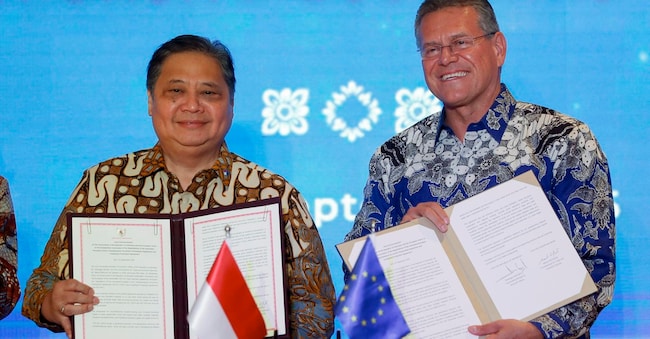
BRUSSELS - The European Commission and Indonesia have just signed a free trade agreement after years of negotiations. A sudden acceleration has come in recent months since President Donald Trump, animated by a protectionist spirit, arrived at the White House. The knot between the parties was in particular the environmental issue. Thanks to the agreement, 80% of Indonesian exports to Europe will not be taxed.
"The European Union and Indonesia are sending a strong message to the world thatwe are united in our commitment to open, rules-based and mutually beneficial international trade," said Maroš Šefčovič, the Trade Commissioner. "Our agreement creates new opportunities for businesses and farmers" and "also guarantees us a stable and predictable supply of essential raw materials," added European Commission President Ursula von der Leyen.
The European Union is Indonesia's fifth largest trading partner, with USD 30.1 billion (EUR 25.6 billion) of trade in 2024. The deal should make it easier for European companies to sell to a country of 280 million inhabitants. Each year European exporters will save up to EUR 600 million in Indonesian tariffs, the European Commission pointed out. The EU, in return, opens up new perspectives for Indonesian sectors such as textiles and footwear.
The trade agreement now to be ratified by the parties symbolises once again the European attempt to diversify its foreign trade in the wake of American protectionism. In recent months, Brussels signed an agreement with Mercosur (Brazil, Paraguay, Argentina and Uruguay). At the same time, diversifying has proved difficult from a political point of view, as demonstrated by the hiccups in the trade negotiations with India, a country close to Russia and at war with Ukraine.


