
The events in Milan? According to Crosetto, they are the result of hybrid warfare
The minister spoke at the second Defence Procurement Forum. The tools are ‘TikTok, social media and YouTube’. Chief of the Defence Staff Portolano: ‘Defence procurement is not merely an administrative process’

Key points
Hybrid warfare, as recent events in Milan have shown, is also waged in the streets. And the channels through which these messages are conveyed are social media. Who is fanning the flames of the protests?
“The events in Milan and elsewhere in Italy are profoundly different from those experienced in other eras and are the result of what I call a ‘hybrid war’ that someone is waging in our nations by resorting to unconventional tools such as TikTok, social media, YouTube, without the West realising it or reacting in any way.” So said Defence Minister Guido Crosetto.
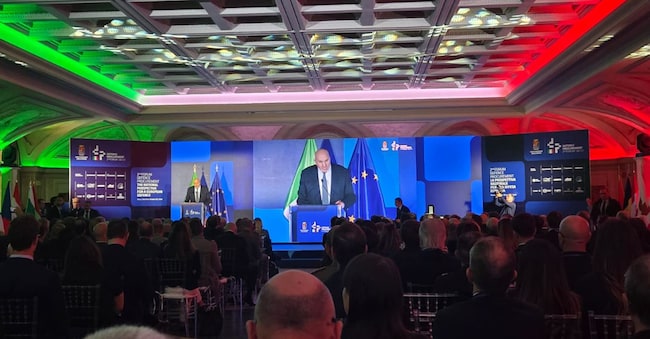
The Defence Minister spoke on Tuesday 20 October at the second Defence Procurement Forum. The event, which took place at Villa Miani, was organised by the Defence Staff with the aim of presenting the book “Defence procurement. The National Perspective for a European Defence’ (Rubbettino Editore). Also attending the meeting were the Chief of the Defence Staff, General Luciano Portolano, the Head of Cabinet to the European Commissioner for Defence and Space, Simonas Šatūnas, the Minister for Universities and Research Anna Maria Bernini, and the National Director of Armaments, Rear Admiral Giacinto Ottaviani. Following the institutional segment, key figures from the defence industry were involved in the afternoon session. From Lorenzo Mariani, CEO of Leonardo, to Alessandro Ercolani, CEO of Rheinmetall; from Biagio Mazzotta, Chairman of Fincantieri, to Domitilla Benigni, CEO of Elt Group.
‘If three out of ten young people took part in those demonstrations,’ Crosetto emphasised, ‘we’re not talking about “maranza”, about second-generation Italians, if six out of ten agree with them, it is because in recent years they have been subjected to a form of counter-education somewhere – not from their family or school – which has instilled in them values, ambitions, a worldview and points of reference that are at odds with the society in which we live and with democratic principles.”
Crosetto: ‘We are fighting a hybrid war that none of us has ever fought before’
Crosetto has no doubts. And he makes this clear. ‘We are fighting a hybrid war that none of us has ever fought before and which we are enduring. My greatest concern today is the ability of certain nations – having used algorithms to study the minds of our young people – to understand far better than any of us in this room how to influence them. Because,’ he added, ‘when you’ve been dealing with content that captures people’s interest, and with the reactions to that content, and you’ve been collecting data for years and years, observing those reactions, and with artificial intelligence you have the ability to analyse them – perhaps even enhancing your analytical capabilities through quantum technologies – you possess an extremely powerful weapon: that of instilling in people’s minds ways of thinking that they believe to be their own but which stem from highly sophisticated manipulation; and when I see things like what happened in Milan, my concern grows. ‘It is time,’ Crosetto urged, ‘for these issues to be addressed from an industrial and technological perspective as well, because they require solutions just as much as a missile defence system, an anti-drone network, or a nation’s naval, land or air capabilities do. ‘These capabilities do not strike physical targets but strike at something much deeper.’


