Digital Round Table

The evolution of heat pumps: from efficient technology to a source of flexibility for households and businesses

by Maurizio Melis, presenter of *Smart City* on Radio 24

Aggiungi Il Sole 24 Ore
ai preferiti su Google
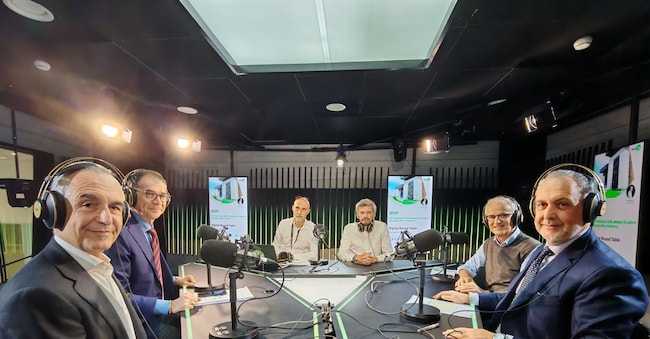
Nello scatto a partire dall’ospite seduto in basso a sx e spostandosi in senso orario ci sono:  Mario Motta - Ordinario di Fisica Tecnica Ambientale presso il Dipartimento di Energia del Politecnico di Milano; Maurizio Marchesini - Presidente di Assoclima; Maurizio Melis - giornalista di Radio 24 e conduttore del programma “Smart City”; Giuseppe Latour - giornalista de Il Sole 24 Ore; Riccardo Bani - Presidente di ARSE (Associazione Riscaldamento Senza Emissioni); Massimiliano Pierini - Managing Director RX Italy.

4' min read

Translated by AI
Versione italiana

4' min read

Translated by AI
Versione italiana

A thriving sector, recording double-digit market growth, particularly in the residential segment, and one in which, for once, Europe and Italia are taking the lion’s share of the industrial supply chain, with over 60 per cent of components produced domestically. This is the picture painted by Maurizio Marchesini, President of Assoclima, who opened the Digital Round Table ‘The evolution of heat pumps: renewable energy”, which Radio 24 dedicated to the world of heat pumps – a technology that is increasingly establishing itself as a key solution far beyond the simple replacement of gas heating systems.

The debate has highlighted this point very clearly, one of which there is little awareness even within the sector itself: originally developed decades ago as a technology to improve energy efficiency, heat pumps are now increasingly emerging as a key player in the energy transition, thanks to the contribution they can make to the process of electrification and, perhaps even more surprisingly, to the challenge of flexibility.

Loading...

The first point to highlight is that the technical limitations which, until a few years ago, plagued heat pumps – rendering them incapable of providing all the heat required when weather conditions became particularly harsh – have now been overcome. Today, as ARSE Chairman Riccardo Bani explained, these kinds of problems have been completely overcome, and alongside the technical capability to cope with harsh climates, the efficiency of these technologies has also improved.

A second finding to emerge from the round-table discussion – which represents a more recent development – is the possibility of using heat pumps in the civil and residential sectors (from homes to offices to commercial premises) as a means of managing flexibility in electricity demand. A study by the Politecnico di Milano and ENEA has shown that a well-insulated building fitted with a heat pump can be used in the same way as a thermal battery simply by overheating it (or over-cooling it in summer) by a degree or two during the middle of the day, when electricity is potentially available at a low cost or when it is self-generated via a photovoltaic system. According to Roberto Armani, an expert in building physics and consultant at the Politecnico di Milano, and co-author of the study, by applying this technique it is possible to shift up to 80 per cent of a home’s consumption peaks, concentrating them during the hours of maximum solar energy availability, without resorting to the far more expensive electrochemical batteries: this represents enormous potential for flexibility, which will gradually take shape as public and private buildings are refurbished in line with modern standards of comfort and energy efficiency.

It should be made clear that many of these solutions require an advanced use of heat pumps, which we, however, continue to use as if they were boilers. In short, we need to introduce intelligence into the system, and the world of appliance manufacturers is well aware of this. Massimiliano Pierini, Managing Director of RX Italia – a company that organises some of the most important trade fairs dedicated to the world of heat pumps – has indicated that this is a very prominent theme in the launch strategies that companies in the sector are developing ahead of upcoming events.

Daniele Forni, Technical Director of FIRE, emphasised, however, that this requires specific skills on the part of installers and designers – skills that are sufficiently widespread in the industrial sector but far less so in the residential sector, where small-scale tradespeople rarely possess them or are even aware of these possibilities, thereby failing to offer a service of great value to the user.

A third point that emerged from the discussion – and which was strongly emphasised by TEON’s CEO, Ferdinando Pozzani – is the still poorly understood potential of heat pumps in the industrial sector, where waste heat is often present and can be harnessed by heat pumps to generate high-temperature heat at very low cost; and where, in industrial processes requiring both heat and cooling (such as in the food sector), heat pump technology – when properly applied – enables both to be obtained for the price of one. At a time when the energy crisis is hitting particularly hard, this type of solution should be vigorously promoted so that it is adopted as widely as possible.

Whilst the outlook offers numerous opportunities, the framework of support measures and incentives for the sector remains weak, albeit one that is rapidly evolving. As Giuseppe Latour, a columnist for *Il Sole 24 Ore*, has pointed out, we are awaiting a review of the tax deductions for these technologies and the relaunch and strengthening of the Conto Termico 3.0 scheme. Furthermore, we are also awaiting the launch of the FER termico mechanism, which allows heat to be procured through long-term contracts, which are typically very cost-effective. The availability of additional resources stemming from Europe’s flexibility on energy policy should provide the impetus for these measures.

On the other hand, the ratio between the price of electricity and gas has a structurally negative impact. Mario Motta, Professor of Environmental Technical Physics at the Politecnico di Milano, explained that where this ratio is below 2, heat pumps thrive, whilst where it approaches 3, as in Italia, the payback periods that heat pumps can guarantee compared to boilers are extended, making the investment less attractive. It is a problem that affects all electrification processes. It should be addressed, and certain tools do exist, even though the lack of depth in the public debate on energy seems to ignore them. In addition to the possibility – which perhaps requires too much courage – of shifting some of the costs currently borne by energy bills onto general taxation, reducing the price of electricity is possible thanks to renewable sources, which are now significantly cheaper than fossil fuels, provided that these are brought to market correctly, relying on long-term contracts such as those provided for by mechanisms like FerX, on which Italia – or, more precisely, the current government – is, however, three years behind the originally scheduled deadline.

The Digital Round Table “The evolution of heat pumps: renewable energy” can be listened to again on the Radio 24 website (radio24.it)

Copyright reserved ©
Loading...
Loading...

Brand connect

Loading...

Newsletter

Notizie e approfondimenti sugli avvenimenti politici, economici e finanziari.

Iscriviti