
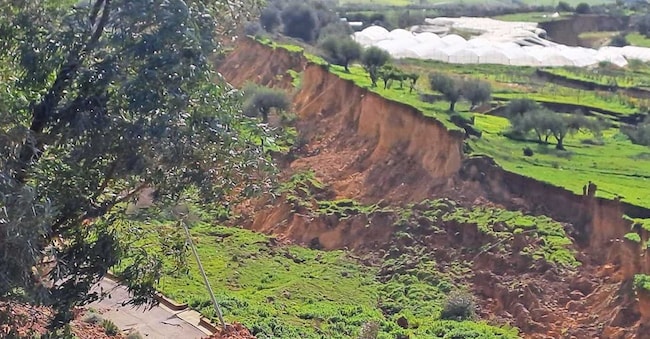
The expert: 'We are the European country of landslides. In Niscemi the largest in Italia, it has exceeded the Tessina landslide'
Erasmo D'Angelis, president of the Earth and Water Agenda Foundation, proposes with economist Mauro Grassi a 'civil prevention' plan worth 435 billion over 15 years
Key points
"Niscemi has become the largest landslide in Italia, surpassing the Tessina landslide in the Alps. A disaster foretold. We must become aware that we are the European country of landslides: out of the approximately 750 thousand recorded throughout the Union, as many as 620,808 are within our borders. In the last century we have had 17 thousand major ones, with 5,939 deaths, and we have spent an average of 1.2 billion annually. We cannot continue to chase emergencies'. Erasmo D'Angelis, one of Italy's foremost experts on hydrogeological instability, former undersecretary for Infrastructure in the Letta government and head of the mission structure Italia Sicura in the Renzi and Gentiloni executives, has no doubts: "In terms of fragility, Italia is unique in the world. We need to adopt a programme for securing the territory that equals, in terms of financial courage and political cohesion, Fanfani's Marshall Plan and House Plan".
A 'National Civil Prevention Plan'
D'Angelis and the economist Mauro Grassi, respectively president and director of the Ewa Foundation (Earth and Water Agenda), have already outlined and detailed it in the volume "Fuori dalle emergenze" (Out of emergencies), to be published by Il Mulino on 13 February, with a preface by Francesco Rutelli. The "National Plan for Civil Prevention and Strengthening of the National Water System" that they propose, over a 15-year time horizon, would require an investment of about 435 billion euros, with an additional volume of resources compared to those already committed of about 300 billion on average today. A journey at the rate of EUR 29 billion per year. More than the entire budget law for 2026.
The cost of emergencies has now risen to 12 billion annually
"But it is not science fiction," D'Angelis argues, "if we work to bring together public and private resources, calling on the business and insurance worlds and resorting to European structural funds and the EIB. We must consider the urgency. Today the emergency is not the exception, but the rule'. In the book, the two authors recall the consolidated estimates according to which, including the costs incurred by citizens and private organisations to meet basic needs in crises, the total cost of natural emergencies in Italia reaches an average of 12 billion a year. A figure that does not include the value of human lives lost, long-term health costs for the injured and disabled, productivity losses, depreciation of real estate and the reputational effects and perception of insecurity of places and relevant parts of the country. In the case of earthquakes alone, an average annual volume of damage is estimated at about 4 billion a year, to which must be added another 4 billion a year for instability (landslides, floods, coastal erosion), about 1 billion for fires, at least 2.5 billion for drought and about 500 million for other events. Climate change, as shown by Niscemi overwhelmed by Cyclone Harry, then acts as a structural multiplier of risk and expenditure.
Expenditure for prevention stopped at 8.8 billion annually
With expenditure earmarked for prevention and the integrated water service currently standing at 8.8 billion a year, of which 5 billion is spent on SSI investment, 2 billion on earthquake prevention and just 1.8 billion on water and fire prevention, there is a structural difference of around 20 billion that leaves the country's system defenceless and generates growing damage that is increasingly covered with extraordinary resources mobilised after each calamitous event.
Rising to 20 billion is not mission impossible
But an additional 20 billion for prevention would not be 'out of scale' from a financial point of view, according to D'Angelis and Grassi, because - they explain - data on capital expenditure by the public administration show that in the last two decades Italy has sustained average investments of around 60 billion euro a year, equal to about 4% of GDP, while between 2020 and 2024 these levels have more than doubled, exceeding 140 billion a year, thanks to Pnrr and Superbonus. So this would be "a totally plausible share compared to recent levels of public investment. In macroeconomic terms, we are talking about allocating about 0.9% of the current GDP to territorial safety, which is destined to fall, with GDP growth over the next fifteen years, to 0.7% in 2041'.


