
The Extraordinary World of Dalí in Milan
‘Dalí and Fashion’, an exhibition celebrating the multifaceted identity of the master of Surrealism and his relationship with style, opens at the Royal Palace

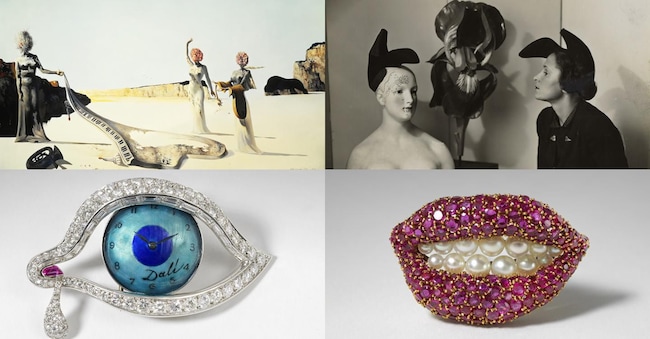
A previously unseen side of Dalí – certainly glamorous, but also so much more. In the Milan exhibition, the boundary between fashion and art dissolves, giving way to a dimension that embodies the whole of Dalí: the man, the artist, his moods and passions, and his theatrical side. The Catalan artist skilfully employed the medium of fashion, as well as disguise and performance. The use of surrogate bodies was a prerogative he refused to relinquish, complemented by his fascination with glass, which he used as “both a display case and a showcase”.
Indeed, even before he officially embarked on his couture career, his works – dating back to the mid-1920s – revealed a fascination with sartorial objects, busts, shoes and mannequins.
Mannequins
In his famous 1927 essay on Saint Sebastian, he puts forward a modern concept which is more relevant than ever when applied to fashion: the duality between motionless mannequins and living mannequins. Dalí himself, in fact, becomes a mannequin and an expression of his complex identity, whether in his public appearances and performances or even simply through his presence at social events.
The exhibition at Palazzo Reale, organised in collaboration with the Fundació Gala-Salvador Dalí and curated by Laura Bartolomé and Judith Clark – a fashion historian and lecturer at the University of the Arts London – is a rich, meticulously curated exhibition, an elegant and captivating tribute to Dalí’s complex and multifaceted creative world.
The exhibition opens with a quotation from his 1942 autobiography *My Secret Life*, in which he recalls how, as a child at primary school, he alone wore “…a sailor-style smock with large golden epaulettes and stars on his cap”, and that he alone smelled of “a marvellous scent” and had “little silver buttons lined up on his well-polished shoes”.

