
The Fed leaves interest rates on hold but is divided: three votes against

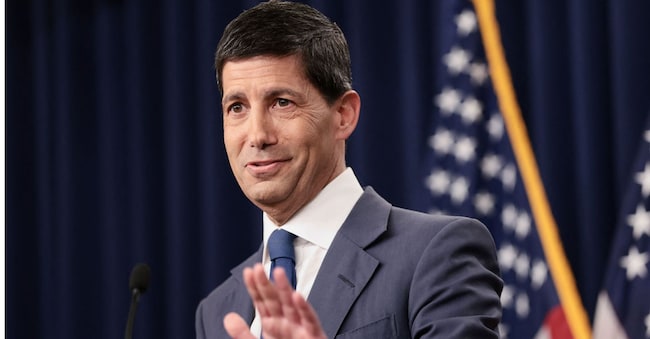
Rates held steady. The Federal Reserve has confirmed the Fed Funds target range at 3.50%–3.75%, in line with expectations. However, unlike in July, the decision was not unanimous: of the 12 governors with voting rights (out of a total of 19), three would have preferred a 25-basis-point rise to 3.75–4 per cent: Beth Hammack, President of the Cleveland Fed; Neel Kashkari, President of the Minneapolis Fed; and Lorie Logan, President of the Dallas Fed.
The three governors had also voted, at least in part, against the decision of April 2026: whilst approving the decision to keep rates on hold (still at 3.50–3.75 per cent), they did not agree with the inclusion in the statement of a signal regarding a future easing of rates. On that occasion, and as part of a strategy aimed at gradually reducing the official cost of borrowing, the statement referred to the ‘magnitude’ and ‘timing of further adjustments’ to the Fed Funds rate. However, whilst Hammack had also opposed a rate cut (to 4.25–4.50 per cent) in December 2024 – suggesting a ‘hawkish’ stance on her part – Kashkari’s earlier and more distant dissenting votes (in 2017 and 2020) – suggesting he is a pragmatist – were in favour of a more expansionary stance.
Unchanged from June, the assessment of the US economy in the statement released after the meeting – now rather terse following the changes introduced by the new chairman, Kevin Warsh – reads: ‘Economic activity is expanding at a sustained pace, despite high uncertainty, due in part to the conflict in the Middle East,’ explained the US central bank. ‘Productivity growth and capital investment are robust. Employment growth has kept pace with that of the labour force, and the unemployment rate has remained virtually unchanged.” “Inflation,” the statement went on to reiterate, “remains elevated relative to the Committee’s 2 per cent target, reflecting in part supply-side shocks that have led to price increases in certain sectors, including the energy sector.”
Preceded by a reputation as a ‘dove’ – if only because he was chosen by Donald Trump, who has long been calling for lower interest rates – Warsh felt it necessary to point out straight away at the press conference that ‘there is no “soft” inflation target. There is no more permissive implicit target. Not as long as this Committee is responsible for monetary policy. There is only one target, and that is 2 per cent’. This clarification was perhaps made necessary by the fact that – as the Chairman himself acknowledged – ‘nominal and real yields are significantly higher across the entire Treasury yield curve. In fact, some of the rises in market interest rates recorded between meetings are among the most significant of the last two decades, falling roughly within the top decile’.
However, Warsh does not view this decoupling of yields from the Fed’s ‘guidance’ as a negative: ‘The markets’ attention has focused on actual data and developments in the real economy. Prices have reacted in real time to new information, and the scaling back of forward guidance (the Fed’s guidance on possible future moves, ed.) may have played a part.” According to the chairman, the markets are focusing on the data rather than on the Fed’s moves, and “this is a change for the better, and we are only at the beginning”. The markets are reacting to the fact that “capital investment and productivity are robust; labour markets are strong and stable. Even the bond market – the Treasury market – seems to be indicating the same thing’. ‘I believe,’ Warsh added, ‘that, in essence, they are saying that this Committee is taking responsibility for the problem (inflation having been above target for 63 months, ed. ), has the credibility needed to resolve it and believes, as I do, that we will succeed’. The markets, he went on to say, “are acting in unison to keep us on our toes and, in the period between meetings, have brought about a tightening of financial conditions. This has reassured us that we have the tools and the capacity needed to achieve the desired outcome.”


