
Anselm Kiefer's female ancestral universe in Ravello
The exhibition "Women of Antiquity" can be visited at Villa Rufolo until 2 September
3' min read
3' min read
The Ravello Foundation, in collaboration with the Lia Rumma Gallery, presents "The Women of Antiquity" by Anselm Kiefer, an exhibition at Villa Rufolo until 2 September 2025 as part of the Ravello Festival 2025.
After Elektra, which saw Kiefer sign the sets and costumes for Strauss' opera at the Teatro San Carlo in 2003, a production that won him the Abbiati prize, the artist continues his research into the tragic and epic feminine dimension, crossing myths to share the representation of his imagination. The iconoclastic element in Kiefer's aesthetics is a revealed emblem of identity.
The female ancestral universe in Anselm Kiefer's work is one of the conceptual and visual fulcrums of his artistic production. Female figures are represented as powerful archetypes, suspended between myth, history, spirituality and ruin, in a constant dialogue between individual and collective memory. They are not mere portraits or celebrations, but symbolic and ritual presences, capable of embodying generative, destructive and initiatory forces.
Figures between myth and history
Kiefer draws on a wide cultural repertoire - from Greek mythology to biblical tradition, from Roman history to Nordic roots - to construct a female pantheon that moves outside chronological time. Women such as Demeter, Jezebel, Saint Mary and Arria Major become emblematic of symbolic passages: fertility, rebellion, sacrifice, purity, death and rebirth.
Fragmented Bodies and Memory Materials
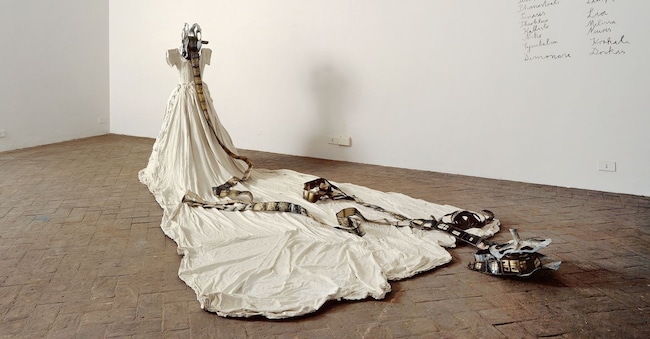
.Kiefer's women do not have a recognisable face: their bodies are mutilated, absent or transfigured, often reduced to clothes stiffened in plaster, lead coils, barbed wire, books, ash leaves or withered branches. This emptying of concrete identity opens up space for a symbolic, universal identity. They are living relics, witnesses of a non-linear memory, where personal history dissolves into collective myth.

