
The Fiap-Confapi alliance brings logistics to the Ministry for Made in Italy. A new strategic focus for competitiveness
Minister Urso: “Logistics is essential for strengthening manufacturing, attracting investment and enhancing the country’s role in Europe and the world”

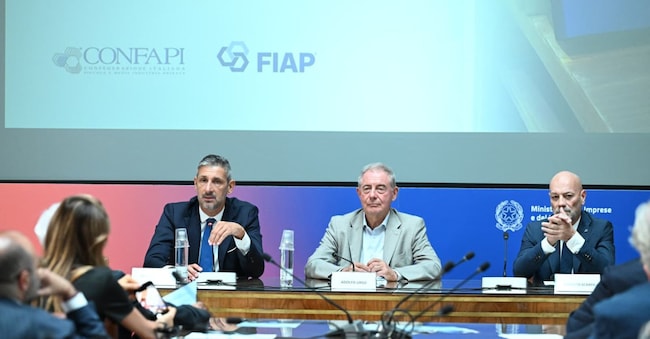
Logistics and freight transport as strategic levers for the competitiveness of the Italian manufacturing sector – no longer merely a support service for businesses, but a structural component of the country’s industrial policy. This is the central message of the conference ‘Made in Italy 2030 White Paper: Manufacturing and Integrated Logistics for a New Industrial Strategy’, organised by Confapi and Fiap at the Ministry of Enterprise and Made in Italy, in the presence of Minister Adolfo Urso.
Confapi President Cristian Camisa and Fiap President Roberto Scarpa discussed the challenges facing the manufacturing sector, and the crucial role that logistics – a sector undergoing major transformation – plays in addressing them. The occasion also served to formalise Fiap’s membership of Confapi, marking a strategic partnership extending across all production sectors: with around 2,000 member companies and over 80,000 employees, FIAP is the leading trade association for freight transport and logistics, and its membership brings the total number of SMEs represented by Confapi to 118,000, accounting for a total of 1.3 million employees.
“Logistics is a strategic hub for the entire industrial system, particularly for Italia, which, due to its geographical position, is a natural maritime, aviation and energy hub in the Mediterranean,” said Urso, noting that integrated and efficient logistics “is essential for strengthening manufacturing, attracting investment and enhancing the country’s role in European and global value chains”. The White Paper, the minister added, is the result of extensive consultation with stakeholders in the production sector and sets out the framework for the reforms currently underway, ranging from industrial and energy policies to fiscal and competition policies, right through to the tools for technological transition.
“Manufacturing and logistics are two inseparable components of the competitiveness of ‘Made in Italy’,” said Camisa, emphasising that only a shared vision will enable the production system to tackle the challenges it faces in both domestic and international markets. For Scarpa, the decision to pursue a joint approach with Confapi stems from a shared focus on ‘the competitiveness and strength of Italian businesses’. Fiap’s General Secretary, Alessandro Peron, framed the initiative within the context of changing distribution models, where logistics is playing an increasingly significant role in the end consumer’s choice: “Strong logistics can make Italia stronger.”
From an analytical perspective, the contributions from the academics who spoke provided substance to this position. According to Carlo Alberto Carnevale Maffè (SDA Bocconi), logistics “is no longer merely transport but an infrastructure that is both critical and strategic: critical because it underpins value chains under stress, and strategic because it is one of the major producers of real-world data”. Damiano Frosi (Milan Polytechnic), on the other hand, focused on the issue of digitalisation: whilst logistics is now a strategic function for 95 per cent of businesses – a figure that rises to 97 per cent among large companies – there remains a marked gap in the tools available, with just 10 per cent of SMEs equipped with a transport management system, compared with 37 per cent of large companies.


