
The anti-Putin film that is popular in Russia
Based on the novel by Bulgakov, it is an anti-militarist and anti-dictatorship work that was very successful in Moscow
4' min read
Key points
- Bulgakov's free interpretation
- Woland's arrival turns everything upside down
- The excellent actors
- The Kremlin's anger
4' min read
The Master and Margarita arrived in Italy quietly. A passage at the Bari Film Festival, a few courageous cinemas waiting for it and then, little by little, the surge of theatres and audiences by word of mouth. Whether it is a masterpiece or not - and in certain respects it is (Michael Lockshin's direction, Maxim Zhukov's photography, Galya Solodovnikova and Ulyana Polyanskaya's costumes) -, the film is remarkable in many respects. First of all, it has the strength to impose itself without a pervasive publicity battage on an unequal and distant audience in terms of age and interests. An audience that is half adult and refined, attracted by the title - the adaptation of Bulgakov's masterpiece - and by the elegance of the old Hollywood atmosphere. For the other half, young and eager to identify with the genres that nourished their childhood: fantasy, harrypottery, magic, superheroics. Elements that for the âgée spectator are rather kitschy, but nevertheless tolerable in the philological satanic context.
The Free Interpretation of Bulgakov
.The story is a free interpretation by screenwriter Roman Kantor, who put his hand on a transposition legendarily considered 'cursed'. Lockshin has won the bet by producing a blockbuster that takes the 'sacred' text in stride, but without completely disengaging from it, interweaving the plot with the life of Bulgakov, who never got to see his book published. The story takes place in 1930s Moscow, under a dictator, Stalin, who is neither seen nor ever named. The staging of a massive play about Pilate is stopped the day before its debut, accused of being condescending towards the figure of Christ, incompatible with Soviet 'state atheism'. The author of the play, the Master, is expelled from the Writers' Union and saved from certain death, during a parade, by an enigmatic, beautiful and sad woman, Margaret. The two are swept away by an irrepressible passion that forces them to hide because she is married. What is immediately apparent is the architectural similarity between the Moscow of Denis Lischenko's set design and certain art deco palaces in New York: two twin metropolises that would have drawn a completely opposite vital outcome from building megalomania.
Woland's arrival overturns everything
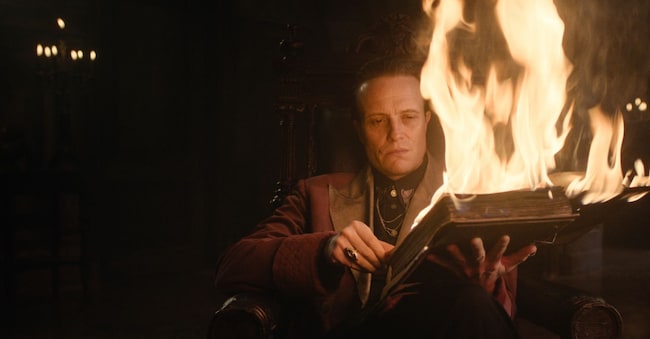
.Into this beautiful and constantly changing city comes Woland, an enigmatic and elegant German gentleman, accompanied by cheerful and crazy servants. Woland is the devil, in whose presence everything is turned upside down, especially the lives of those who deny his existence. In the world where hypocrisy triumphs, Satan seems to be the avenger of the humiliated and offended rather than the incarnation of Evil: he persecutes the communist leaders who impose austerity on the people and lock themselves in luxury flats drinking champagne, he tempts and corrupts comrades and companions with the frivolity of fashionable clothes. With him on the city and on the Moscova a witch runs amok, bursting into the luxury houses, destroying them, pink from the profound pain that seized her in the prison-psychiatric hospital where non-aligned intellectuals end up and where even the Maestro is plunged into a feverish state, amidst stings and hallucinations. Here and towards the end is the 'zone' of greatest suffering for the old cinephile who encounters the contemporary horror film, which is however tempered by the beauty of the rationalist interiors. But does Woland exist or is it an illusion? The writer, aka the Master, will never know, and neither will the viewer. Of the book, one recognises the cat, cinematically rather clumsy, but faithful to the idea that stems from the literary text, as well as Pontius Pilate's migraine and the beheading of the boyar of state Berlioz.
The excellent actors
.All scenes that vividly render the pages, thanks also to the great quality of the actors. Above all, Evgeniy Tsyganov (the Master), August Diehl (Woland), Yulia Snigir (Margaret), Pontius Pilate (Claes Bang). The American-born director, the son of a scientist born in America to Russian Jewish parents who fled the pogrom, went to live in the USSR in 1986, when his father left his research post in Houston and asked for political asylum in the Soviet Union. Perfectly bilingual and an interpreter of both mentalities, he was able to make a commercial but anti-militarist film at the time when Putin launched his attack on Kiev, even verbally expressing his solidarity with Ukraine. In every frame The Master and Margarita conveys the rejection of war, totalitarianism and censorship.
The anger of the Kremlin
When it won the Russian box office with more than 3.7 million viewers, queues outside the cinemas and applause during the screening, Putin wondered why the hell (it has to be said) the state-supported Russian Cinema Fund had financed a large part of the $17 million budget - one of the largest ever allocated in the country - for a film that was heavily detrimental to his political line. The pro-Kremlin media went on the attack against Lockshin, accusing him of discrediting the Russian army, branding him a terrorist, and hitting him with thousands of posts generated by online trolls. Lockshin must have been well pleased to have taken the opposite route to his father, retracing his grandparents' path with a safe residence in Los Angeles. He is also helped by the phrase repeated several times in the film, taken from Goethe's Faust: 'I am part of that force that wants eternally evil and works eternally good', as his film also thanks to Putin continues to attract audiences even in the summer stampede.


