
Italy's first ecological data centre is inside a Trentino cave
Storing photos, emails and content consumes a lot of energy, so it is the challenge of the future. In San Romedio, an old dolomite mine becomes the heart of a double transition: digital and ecological.
4' min read
4' min read
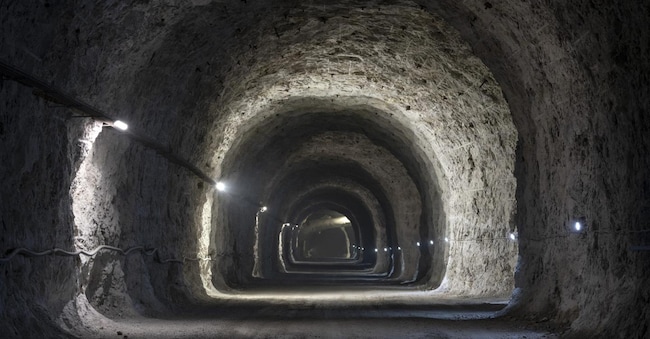
In the San Romedio mine in Trentino, dolomite, one of the basic ingredients of the old economy, was extracted. It is used for cement, concrete, as a raw material for the steel industry and to make natural hydraulic lime. It sounds almost like a handover, therefore, that in the spaces emptied by the dolomite mining, Italy's first ecological data centre is being built, the Trentino Data Mine, a project that in fact achieves two transitions at once, digital and ecological.
This public-private joint venture in the belly of the mountain is coordinated by the University of Trento and is also financed through PNRR funds. In all, it is 50 million euros, to tackle one of the blind spots of the new economy: the fact that digitalisation is also a carbon bomb, the emissions to run the new technologies are those of large industrial sectors that are much more exposed, such as steel or cement. If it were a nation, the digital economy would be the fourth largest emitter of CO2 in the world, just below India. The sector has already doubled aviation as an impact on global warming, today we are between 4 and 7 per cent depending on the metric. This includes everything from hardware to cryptocurrency production, but a key piece of the problem is what Trentino Data Mine is trying to solve: data centres.
The servers that hold our data are one of the most difficult infrastructures to make sustainable. As Giovanna Sissa, a lecturer at the University of Genoa and an expert on the intersection of digital and sustainability, explains, 'the reason is the curse of continuity at all costs. Servers can never stop working, for any reason, because we need email, social content, photos all the time. This drives manufacturers to make systems redundant, infrastructures are oversized to anticipate tra co peaks and respond to three categorical imperatives: to make sure we have access to everything, all the time, instantly. Being 'everything, everywhere, all the time', to quote the Hollywood movie about the metaverse, makes data centres gigantic machines hungry for space, power and water.
The first goal of designing a data centre in a mine is energy savings. The digital economy alone consumes 1 per cent of global electricity, but will double that share within two years. In Italy, according to data from the Politecnico di Milano, the tech infrastructure consumes as much electricity as the entire textile industry and twice as much as the pharmaceutical industry.
Everyone looks to Ireland's parable as an example: becoming a landing place for Facebook and Google has brought it economic growth, but also an explosion in energy consumption: today, servers have to use one fifth of all domestic electricity to run. This is why more and more data centres around the world are being built where there are natural cooling sources, because almost half of the consumption (43 per cent) is to prevent the infrastructure from heating up too much. This is exactly the rationale for which the Trentino Data Mine will be built in the old dolomite mine, at a fixed temperature of 12 degrees, surrounded by hundreds of metres of living rock, in spaces already used as natural refrigerators for storing apples. The energy consumed will come from renewable sources, which abound in Trentino thanks to the presence of hydroelectric power plants.

