
The La Scala premiere with the opera closest to us in time

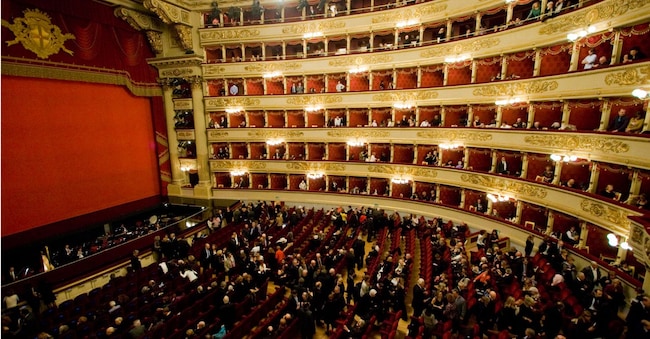
No one has noticed until now, but Shostakovic's 'Lady' is the youngest in the history of all glorious 7 December: the closest we have come. She is among the operas staged for the opening of the season since the Sant'Ambrogio at La Scala has existed. Um, sure, young is a bit of a loose term. Because you are 91 years old. Yet - if we have done the maths right - it wins the crown of the most 'contemporary' title in the age race of Milanese theatre openings. In 1951, the first anticipation of the patron saint's day, which was the customary 26 December on Boxing Day, with Victor de Sabata on the podium and a leading lady by the name of Maria Callas (she still signed herself Meneghini), Verdi's "I vespri siciliani" was performed. Almost a novelty, recovered from oblivion. Then, from then on, more or less this line was always maintained: predominance of 19th century cornerstones, a lot of Verdi, some Wagner. With the exceptions of Abbado rediscovering the Russian 'Boris' and Muti opening the doors to the 18th century, between 'Zauberflöte' and Gluck, and the rare neoclassical Spontini, known only as a pizzeria. Until now, the record for closeness to our present was held closely by Puccini's "Turandot", 1924, and Bizet's "Carmen", 1925. To beat them today comes her, 'A Lady Macbeth from the District of Mcensk', 1934.
The talk of age, of when an opera was born and how far away it is from us may seem flippant, at a time when the chronicles would instead take us to other topics, such as the presence of VIPs in the hall, like Mahmood, or the absence of the Head of State, too bad, we will miss him. Topics certainly worth reflecting on. But little tangential compared to the intrinsic and permanent value, indeed perhaps the real theme to give meaning to 7 December at La Scala. The Milanese theatre's season opener is in fact the only one that is still so widely talked about, and not only in Italy, in the world. To demonstrate that - by centred construction, step by step, Sant'Ambrogio after Sant'Ambrogio - here people have continued to believe in the symbolic gesture of a date. Of a title. Of an evening. Betting from time to time on the weight of the conductor, the lead singer, the director, or the whole team.
Well, so far it has not been noticed that the real and most important feature of Dimitri Shostakovic's 'Lady Macbeth of the District of Mcsensk', due to debut in a few hours and broadcast live on Rai1 and Rai Radio3, linked worldwide thanks to ARTE, RSI, NHK, Medici TV, with Sara Jakubiak in the title role, Riccardo Chailly on the podium and Vasily Barkhatov directing, lies in the merit of having moved the time bar a little further: of the distance between us and the opera we hear. The theme is fundamental, at a time when we believe in the need for a present for theatre in music. Of course, some might reiterate that sometimes Monteverdi, going right back to his origins, speaks to us in a more contemporary way than what was written a short distance away. And yet the vibrant and unexpected success at La Scala of two world premieres in the season that has just ended, "Il nome della rosa" by Francesco Filidei and "Anna A." by Silvia Colasanti, stands to show that perhaps the time has come, we need it: to build a 7 December on a new opera. Let it become the youngest ever in the list of Sant'Ambrogios. To give a different meaning to this beautiful term, 'inaugurate', so precious and full of glances towards the future. A gamble? No. Rather a return to the ancient (back to the ancient and it will be progress, said Verdi). In 1778, the Teresian Teatro alla Scala, freshly built by Piermarini, opened with Salieri's 'L'Europa riconosciuta'. That was the custom then. But here, perhaps this time we will treasure it, choose Mozart.

