Opinions

The Five Europes Facing the Chinese Factory

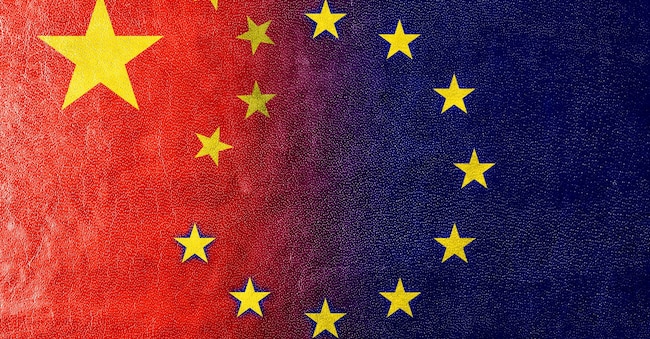
 (Adobe Stock)

3' min read

Translated by AI
Versione italiana

3' min read

Translated by AI
Versione italiana

In 2025, the European Union and the United Kingdom — or EU+ — each contributed their share to a new record trade deficit with China, pushing the total above €400 billion.

On the industrial front, the EU+ recorded a fall in employment of around 150,000 workers alongside real growth of 1.4 per cent, which, on closer inspection, was driven by Ireland and countries in Eastern Europe.

Loading...

It is therefore difficult to establish a direct link between developments in EU and UK industry and the trade deficit with China.

An analysis of the five largest EU+ economies makes it possible to identify their vulnerabilities to the world’s ‘great factory’.

Germany’s industrial sector, with output down 1 per cent in 2025 and more than 140,000 jobs lost, illustrates the shift in its relationship with Beijing: China has gone from being an export market to a competitor in the very sectors on which Germany built its surplus. The trade deficit is now taking its toll on Europe’s largest industrial base and threatening the automotive, machinery, chemicals, components and electrical technology sectors.

The stability of industrial employment and output in Italy masks the vulnerability of a fragmented manufacturing system built on supply chains, industrial clusters, components, chemicals, machinery, metals and intermediate goods. Here, the risk is not that of losing the top of the pyramid, as in Germany, but that of seeing many of its middle tiers gradually eroded.

EUROPE AND CHINESE FACTOR

Loading...

The United Kingdom may be outside the EU, but it is facing the same Chinese shock: employment has fallen by 40,000, whilst higher productivity has led to the first modest rebound in output since 2021. Brexit changed the negotiating table and the rules, but it did not create productive capacity, and the surplus in services does not alter the structure of globalisation.

France is suffering less because its productive structure in strategic sectors — aerospace, defence, pharmaceuticals, luxury goods and energy — enjoys greater protection from a state that acts as a stabiliser. A decline of just over 15,000 jobs has been accompanied by marginal growth in output.

Spain is the counterexample: its trade deficit with China is substantial, but this has not led to industrial decline. Domestic demand, investment, more favourable energy conditions, European funds and high-value-added sectors have provided a buffer; the more limited overlap between Chinese imports and the labour-intensive core of domestic industry has done the rest, creating more than 110,000 additional jobs and generating growth of over 1 per cent.

Relations with China are not simply a matter of tariffs. The issue is who produces, using what energy, within which supply chains, with which technologies and with what kind of state backing them. Trade defence does not create productive capacity and, without industrial policy, becomes a bulwark with no hinterland.

Loading...

The point is to understand where China acts as a complementary supplier, where it is a direct competitor, and where it has become an indispensable part of the infrastructure underpinning European production. Germany, Italy, the United Kingdom, France and Spain each tell a different version of the same story: some see the very heart of their manufacturing sector at risk, others the depth of their supply chains; some compensate through services, others protect themselves through strategic sectors, whilst others withstand the pressure thanks to the domestic economic cycle.

London may remain outside the Union, but in its relations with the world’s major economic powers it continues to share the continent’s fate.

When it comes to relations with Beijing, the choice remains the same: to become an industrial system once again, underpinned by a common strategy and shared debt, or to remain, as it is today, a wealthy market for other countries’ products.

Copyright reserved ©
Loading...

Brand connect

Loading...

Newsletter

Notizie e approfondimenti sugli avvenimenti politici, economici e finanziari.

Iscriviti