
The fjord of suspicion and discord
Cristian Mungiu’s film depicts the ideological clash between a deeply religious Romanian family and the small Norwegian community where they go to live

Key points
Fjord by Cristian Mungiu is hitting Italian cinemas with the boldness of retaining its original title, even though it could easily be translated. It can do so because it is underpinned by a rock-solid screenplay, over which the confident direction glides. It is this direction that demands a restrained performance from two actors with huge media appeal, Sebastian Stan and Renate Reinsve. Both are equally adept at navigating auteur and mainstream projects: Stan, from the Marvel Cinematic Universe to Gossip Girl to The Apprentice – The Rise of Trump (in the role of ‘Donald’) and Reinsve from the Oscar-winning Sentimental Value to Backrooms. Against this backdrop of restraint, Tudor Panduru’s cinematography blends seamlessly, never capitalising on the magnificence of the Scandinavian locations. On the contrary, it shrouds them in shadows, mirroring the film’s narrative.
The plot
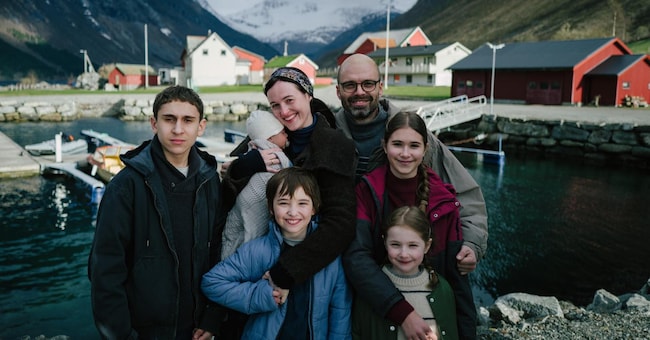
Winner of the Cannes Film Festival, Fjord, depicts the ideological clash between a deeply religious Romanian Evangelical family, the Gheorghius, and the small Norwegian community that lines the fjord of the film’s title. The father, Mihai (Stan), is Romanian and was recruited by a fellow believer to work as an IT specialist in a role far below his qualifications as an engineer. This highlights the financial hardship from which the Gheorghiu family hails. The mother, Lisbet (Reinsve), is a nurse, born and brought up in Norway: for her, this is a homecoming. The film, therefore, tells a story of immigration sui generis that also involves the couple’s five children, who are subjected to a strict upbringing—at times even involving measured corporal punishment (spanking)—and are forbidden from participating in the globalised world, such as accessing the internet. The Gheorghiu family’s behaviour causes considerable friction within the community, which is accustomed to upholding the codes of (apparent) maximum openness towards diversity and respect for multiculturalism.
The Ambivalence of the Community and the Family
That is why, in the fjord, they do not celebrate Christmas but the winter festival, honouring the Sami people – whose culture, incidentally, the Norwegians destroyed and whose traditions they suppressed centuries ago. They are less open-minded towards the Gheorghiu family, whose happiness and harmony they view with suspicion, and they observe a severe restriction on their children’s freedom of behaviour and sexual orientation. They regard this as psychological abuse, a clear sign of physical abuse: tolerating it could lead to the corruption of the community’s values. Consequently, when the PE teacher at school discovers some bruises on the neck of Elia (Vanessa Ceban), the eldest daughter, the standard procedure is triggered, involving social services.In the Gheorghiu family’s eyes, however, what stands out are the glaring shortcomings in affection within Norwegian society, which is rigidly politically correct, and Stan, in particular, is wary of a certain freedom enjoyed by teenagers – especially the friendship between Elsa and the neighbours’ daughter, Noora (Henrikke Lund-Olsen).
The director’s perspective
The Georghiu family are old-fashioned, patriarchal and out of step with the times; indeed, Mungiu adopts their point of view. But what scope do Norwegian rules allow for genuine humanity?, the director seems to ask. Mungiu had already explored the suffocating atmosphere of a small community in *i* *Wild Animals* , but from the perspective of someone witnessing the arrival of foreign workers in a Transylvanian town. He had also explored the family dynamic in the intensely powerful – and, in this writer’s view, as yet unsurpassed – A Father, a Daughter, which dealt with Romanian bureaucracy and corruption. In 4 Months, 3 Weeks and 2 Days, he again addressed the theme of freedom, but this time through the lens of clandestine abortion. That film was a punch in the gut: it brought to the big screen the surgical harshness of a cinema reminiscent of Ágota Kristóf’s writing. Throughout his filmography, Mungiu has prepared us for a brutally ruthless dissection of the human soul, and this time – not only through the setting and lighting – with a style that owes much to Scandinavian atmospheres.
Scandinavian atmospheres
Fjord is reminiscent of Thomas Vinterberg’s *The Suspect*, in which an enigmatic Mads Mikkelsen, a primary school teacher, is accused of sexual abuse by a young girl: the shadow of doubt will never lift from him. In Mungiu’s film, the water of the fjord reflects the majesty of the mountains, yet is so dense and murky as to create a sense of disorientation. It is no coincidence that Mungiu also wants to keep his actors on their toes: he brings Stan back to his native language, following his success in the United States, and Reinsve back to his native Norway, despite his international career. Mungiu, as well as directing the film (as always), also writes it: he seems to want to follow the story to the letter, yet he skilfully reveals clues and hints without giving away the ending, creating suspense and a psychological and ideological puzzle.


