
The Forest of Light and Darkness by Mercè Rodoreda
An exhibition at the Cccb in Barcelona reconstructs the literary imagination of the great Catalan author only recently rediscovered by critics

"A novel is made with a lot of intuition, a certain amount of imponderability, with agonies and resurrections of the soul, exaltations, disappointments, reserves of involuntary memory... it's all alchemy," wrote Mercè Rodoreda (1908 - 1983), now considered by many to be the most important Catalan writer of the last century, in the prologue to one of her masterpieces, perhaps her most ambitious novel: Shattered Mirror (translation by Giuseppe Tavani, La nuova frontiera, pp., 312, euro 17.50).
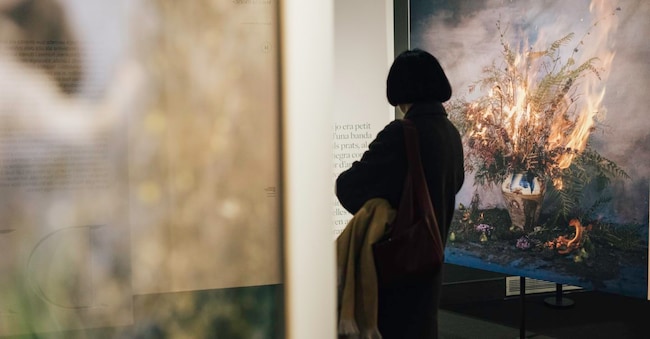
Reconstructing the author's literary imagination, that confusing accumulation of experiences, ideas, memories, sensations and illuminations that seeded her writing, is what critic and essayist Neus Penalba, curator of an original exhibition dedicated to her, 'Rodoreda, un bosque' (a forest), currently underway at the Cccb, Barcelona's Centre for Contemporary Culture. Located in the old city, in a monastery that became an orphanage at the beginning of the 19th century and was then abandoned during the civil war, it was renovated on the return of democracy, thirty years later, to create a large museum space where ancient and modern coexist harmoniously. A multidisciplinary centre that, as its director, Judith Carrera, explains, "does not have its own permanent collection, but hosts exhibitions, festivals, meetings concerts, screenings, courses (for example a critical thinking programme for teenagers) aimed at promoting education and culture and stimulating debate. With its 300 speakers each year, the Cccb is an ecosystem that supports democracy with quality public debate'.
In this historical period, it therefore seemed important to Carrera to dedicate an exhibition to Rodoreda 'with his novels that delve into the ambivalence of human experience, where beauty and horror, innocence and infamy, childhood and the macabre, the realistic and the fantastic can go hand in hand. With his life in opposition to Francoism, and with his work, where war, even if it is not explicitly present, always is. With the devastation it brings, with the silence. An author rediscovered by a new generation of artists and filmmakers who find in her a way to interpret the present, to speak of the return of fascism and conflict, but also of the Anthropocene, with her work on the fusion of human beings and nature' (the desire to transform herself into a tree, a flower, a fish, an amphibian, or into the wind or flowing water, according to the curator, would be a way of representing the exile to which she was forced).
'Innocence is a winter dress' wrote William Blake (here translated by Ungaretti). And yet, it is precisely innocence, the naivety of so many of the author's characters, that has long been used to stigmatise her work, to relegate Rodoreda to the cliché of a sentimental, mawkish writer: 'a writer for women', to use provocatively an expression that some still employ with disdain. Aware of the criticism that was unfairly levelled at her, Rodoreda said of the innocence of her characters: 'I am a person like any other, endowed with multiple personalities, and perhaps the most marked is a kind of innocence that makes me feel at ease in the world in which I have to live. Out of a desire to write with certain characteristics, I have cultivated for many years now - and this is innocence - a kind of purity - which after all must mean the same thing - with as little falsification as possible'.
"Innocence" - with "desire", "so much war", "houses and streets", "metamorphosis" and "soul" - is one of the thematic sections around which the exhibition revolves, which aims to free this master of chiaroscuro from labels and highlight the formal and thematic contemporaneity of her work. Four hundred works of visual art, installations, original documents and audiovisuals dialogue her work with that of artists such as Remedios Varo, Pina Bausch, Marc Chagall, Leonora Carrington, Goya, Picasso, Suzanne Valadon, Ramon Casas, Fina Miralles, Joan Ponç, Tura Sanglas, Dora Maar, Toni Catany, Man Ray and Laia Abril, and with works commissioned especially for the exhibition by Cabosanroque, Mar Arza, Carlota Subirós, Èlia Llach and Oriol Vilapuig.


