
The four lives of Schiffini, one hundred years of VIP kitchens
In 1925, in La Spezia, it was a ship furnishings workshop. Then it was the global luxury product. After two bankruptcies, it passed to the Scic group

3' min read
Key points
- In the 1950s he was among the first to propose modular modules
- The boom with the collaboration with Vico Magistretti
- Four changes of hands and finally the relaunch with the Scic group
3' min read
One hundred years in four stages. With ups and downs that brought Schiffini first to the top of the world - the most prestigious and coveted kitchen brand, albeit a niche one. Then to double bankruptcy, after funambulistic changes of hands. Finally to rebirth as the brand of a larger, more structured group.
Schiffini's beginnings are very original, as they will be for the next hundred years. Enrico Schiffini founded a workshop in La Spezia (the factory was in the port) to supply furniture for the ships of the Military Arsenal and for large vessels. Furniture and, later, kitchens. Which became, in the 1950s, the company's product. Which in the meantime had moved to Ceparana, a hamlet of Bolano, a small town in the province of La Spezia.
The stylistic and functional heritage of ships will be the hallmark of Schiffini kitchens. Since the 1950s, thanks to the intuition of Giuseppe, Enrico's son, the La Spezia-based brand was one of the very few manufacturers to offer modular kitchens on the market. Very rational, linear elements, almost as if the need to exploit all spaces had been transferred from ship furnishings to kitchens. The use of high quality materials, from steel to aluminium, not very common in those years, and robustness made Schiffini the kitchen of quality and style par excellence.
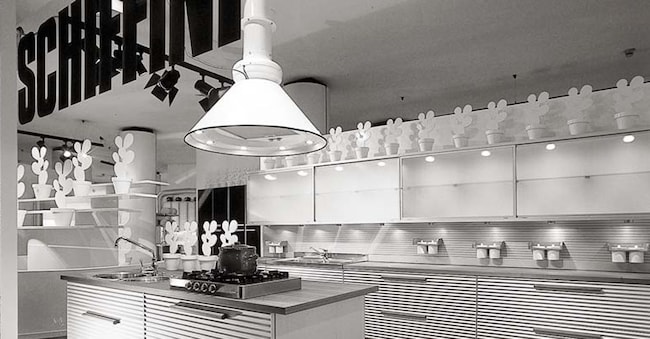
But the leap forward came with the collaboration with Vico Magistretti that began in 1966. In 1970 the Milanese architect designed Schiffini's new headquarters (he would later also design the company's Milan showroom), but above all the most iconic products of the La Spezia brand and the kitchen world in general. From 1966 to 1990 Magistretti created the Timo, Campiglia, Dama, Arnia, Cucina 35 and Tellaro kitchens for Schiffini. But above all Cina and Cinqueterre, the two iconic products of Schiffini and the entire kitchen segment. Cina, from 1986, with its large hoods and concealed handles, is a pioneer product, which will be presented again at the Salone this year. Cinqueterre, made entirely of aluminium, even in corrugated workmanship, represents a true revolution for the entire sector. Still today, updated in 2024, it is one of the brand's workhorses.
The years of the union with Magistretti are those of the company's consecration. The Schiffini kitchen is a must-have for the haute bourgeoisie and the starsystem all over the world. Thanks to contract and made-to-measure projects, the brand is growing all over the world, from the United States to the Middle East. Exports account for about half of the turnover, which is close to EUR 30 million.


