
The Frecciarossa in Germany: first trains from summer 2027
The FS Group is expanding across Europe with services between Rome, Milan and Munich. From 2028, Trenitalia aims to offer up to ten daily services between the two countries

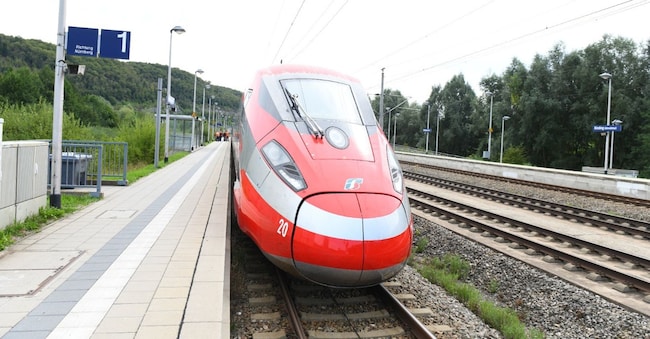
Following France and Spain, the Frecciarossa is set to arrive in Germany too. Test runs have in fact begun in Germany and Austria for the flagship train of the Trenitalia fleet (part of the Ferrovie dello Stato group). The company’s aim is to launch services between Milan and Munich and between Rome and Munich in the summer of 2027. The project is being carried out in collaboration with the German railway operator Deutsche Bahn and the Austrian railway operator ÖBB. But let’s take it one step at a time.
Germany is becoming a strategic target for Italian high-speed rail companies: Trenitalia and Italo. Whilst their timelines and approaches differ, both operators have their sights set on expanding into the German market. In recent weeks, it was Italo’s turn to announce a deal with the manufacturer Siemens, worth around €3 billion, for the purchase of 26 trains destined for the German high-speed rail market. Italo’s aim is to compete with Deutsche Bahn on domestic routes. The first services are expected to begin in mid-2028 (50 daily services).
It is now Trenitalia’s turn to reveal further details on its Germany plan, with the start of the first tests required as part of the high-speed train’s international type-approval process. Services between Milan and Munich and between Rome and Munich are scheduled to begin in the summer of 2027. The test runs are taking place on the German Berlin–Munich–Kufstein railway network. In Austria, the Frecciarossa is currently running test services between Kufstein and the Brenner Pass and between Salzburg and Vienna.
Gianpiero Strisciuglio, Chief Executive of the FS Group, says: “The start of test runs in Germany and Austria marks a step towards the realisation of a project that confirms our ambition to make the train the go-to mode of transport for European mobility. Thanks to our collaboration with Deutsche Bahn and ÖBB, we are moving towards the development of a high-speed European metro network. The Frecciarossa continues its path of international growth, taking the FS Group’s technological and industrial excellence abroad and contributing to the expansion of an increasingly integrated European rail network.” The agreement between Trenitalia and Deutsche Bahn will also enable the sharing of technical expertise to ensure that trains can adapt to different power supply and signalling systems. Training programmes for German and Austrian train crews have also been launched.
FS’s service schedule includes four daily services on the Milan–Munich and Rome–Munich routes. On the Milan–Munich route, with a journey time of around six and a half hours, the main stops along the way will be at Brescia, Verona, Rovereto, Trento, Bolzano and Innsbruck. As for the Rome–Munich route, with a journey time of around eight and a half hours, the main stops will be at Florence, Bologna, Verona, Rovereto, Trento, Bolzano and Innsbruck. From December 2028, the full service will consist of ten daily connections between Italia and Germany, covering the routes between Milan, Rome and Munich, with a possible extension to Naples and Berlin. The new services will also have an impact on rail links with other countries, as they will meet the demand for travel to other destinations, such as Frankfurt and Kraków (Poland).


