2026 World Cup

And so France turned its failures into the strongest national football team in the world

Following the crisis of the 1990s, France has built an unrivalled football ecosystem, and Paris has become the Silicon Valley of football. On 14 July, they face Spain in their third consecutive World Cup final

7' min read

Translated by AI
Versione italiana

7' min read

Translated by AI
Versione italiana

There is a paradox that characterises French football, one that probably no other major European nation experiences with the same intensity. The stronger, more global and more dominant the French national team becomes in terms of producing talent, the more the French league struggles to find a sustainable business model.

On the one hand, there are Les Bleus: set to face Spain in Dallas on 14 July – the day marking the storming of the Bastille – in their bid to reach a third consecutive World Cup final, a side characterised by exceptional consistency and boasting the most valuable squad on the planet. On the other hand, there is Ligue 1, which in recent years has been overwhelmed by the collapse of the deal with Mediapro, the subsequent reduction in the value of TV rights and difficulties in its relationship with DAZN – a sign that the domestic league is struggling to capitalise on the extraordinary technical talent it produces.

Loading...

It is only an apparent contradiction. Because France’s success stems precisely from a system that now generates far more value outside its borders than within them.

The lesson of the humiliations of the 1990s

To understand the superiority of the French model, we need to go back to its roots. In the late 1980s, France faded from the forefront of top-flight football. Following Platini’s golden era, Les Bleus failed to qualify for Italia ’90 and then for the 1994 World Cup in the United States. Two traumatic failures that called the entire footballing system into question.

The answer does not lie in a generation of phenomena, but in industrial reform.

The French Football Federation is investing heavily in training, regional recruitment, the expansion of its federal technical centres and, above all, the Clairefontaine model, which is set to become the symbol of elite talent development in French football.

This gives rise to a long-term vision that views talent not as a random variable, but as the result of a process that needs to be organised and developed.

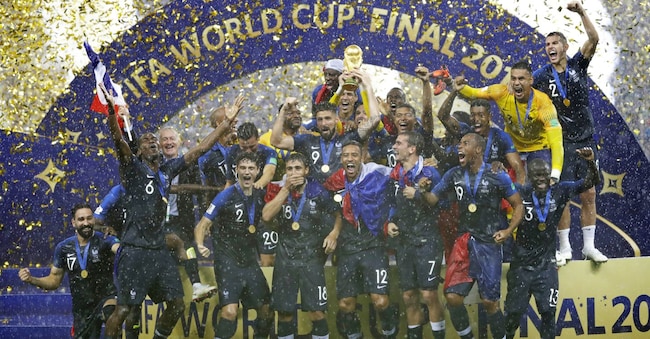
The results speak for themselves: the 1998 World Cup, Euro 2000, the 2018 World Cup, a place in the 2022 World Cup final, and an almost constant presence in international semi-finals over the last twenty years.

France as a global exporter of talent

However, the true measure of French strength is not victories. It is the flow of players. According to the CIES Football Observatory, France is currently the world’s second-largest exporter of professional footballers, surpassed only by Brazil. There are 1,275 French players in the world’s 135 leading professional leagues, compared with 1,455 Brazilians, whilst Argentina is third with 1,016.

The European comparison is even more telling: Spain, another extraordinary producer of talent, fields around half as many players abroad as France does. If we look at the phenomenon through the eyes of an economist, France has become the leading European hub for the football talent industry. Just as Germany exports machinery or Italia exports design.

Ninety-nine French players at the World Cup

The 2026 World Cup provides a perfect snapshot of this phenomenon. In fact, there are 99 players born in France taking part in the tournament – the highest number in the world. Not all of them are playing for Les Bleus. Quite the contrary. Dozens of them are representing Algeria, Morocco, Senegal, Haiti, the Democratic Republic of the Congo and many other national teams.

This figure tells two stories. The first concerns the extraordinary ability of French youth academies to produce professional footballers. The second concerns the multicultural nature of French society, which enables the sporting system to draw on a broad and diverse pool of talent.

In fact, France does not merely provide players for its own national team. It supplies a significant proportion of the international football scene.

Paris, the Silicon Valley of football

If France were a factory, its main industrial hub would be Paris. According to demographic analyses of the 2026 World Cup, the Île-de-France region alone accounts for 4.3 per cent of all 1,248 footballers taking part in the World Cup.

No other urban region in the world boasts such a concentration of talent.

Mbappé, Dembélé, Saliba, Maignan, Barcola, Zaïre-Emery and dozens of other professional players are the product of a unique ecosystem in which population density, multiculturalism, sporting infrastructure and social competition generate a competitive advantage that is difficult to replicate.

Paris is to football what Silicon Valley is to technology: a constant accelerator of human capital.

The world’s richest national team

It is therefore no surprise that France is now the national team with the highest economic value. Market valuations put the value of Les Bleus at over 1.5 billion euros, ahead of England and Spain.

But the most striking statistic concerns the depth of the squad. According to some analyses published during the World Cup, a squad made up exclusively of French players not selected by Deschamps would be valued at around 418 million euros, higher than that of many of the national teams taking part in the tournament. In other words, France has a second national team which, in terms of economic value, would already be an international powerhouse.

The great paradox of Ligue 1

And this is where the contradiction lies. Whilst the national team continues to thrive, the league is going through a structural crisis, linked mainly to television rights.

The turning point for the worse came in 2018, when the Ligue de Football Professionnel awarded Mediapro the main audiovisual rights package for the four-year period 2020–2024, effectively creating a sort of joint venture with the Spanish company. The Spanish operator undertook to pay around 780 million euros a year to acquire the rights to 80 per cent of the matches, helping to push the total value of Ligue 1’s domestic rights above one billion euros per season (around 1.15 billion including the other packages awarded to Canal+ and beIN Sports). For French football, this seemed to mark its definitive entry into the club of Europe’s major leagues in terms of television revenue.

The revolution, however, quickly backfired. A few months after the contract came into force, amid the impact of the pandemic and the difficulties faced by the new Téléfoot channel’s business model, Mediapro suspended the payments due to the League and requested a renegotiation of the agreement. By the end of 2020, a mutually agreed settlement was reached: the broadcaster withdrew from the French league, paying compensation of around 100 million euros, but leaving a revenue stream unfulfilled that was supposed to have guaranteed over 3 billion euros over the entire contract period. For French clubs, this was an unprecedented financial shock, triggering a state of emergency and forcing many clubs to review their budgets, investments and wage policies.

To prevent the system from collapsing, the LFP subsequently awarded the broadcasting rights for the majority of matches to Amazon Prime Video, which secured the main rights for around 250 million euros a year – less than a third of what Mediapro had promised. The difference is enormous and highlights the fragility of the French television market. Whilst the Premier League continues to grow and La Liga maintains a far greater ability to generate revenue, Ligue 1 is becoming increasingly reliant on transfer profits and the sale of home-grown talent.

The subsequent award of rights for the 2024–2029 cycle was supposed to mark a fresh start. In reality, it confirmed the product’s structural difficulties. The agreement signed with DAZN, worth around 400 million euros per season for the majority of matches, came after a tender process in which no bids met the League’s expectations; it had initially aimed to reach close to 800 million euros per year. Commercially too, the results fell short of forecasts: subscriber numbers remained well below the targets set, whilst piracy and the fragmentation of the market continued to erode value.

This led to the most radical decision, which was conceived in 2025 and implemented for the following season: the creation of a Ligue 1-owned channel, controlled directly by the League and designed to broadcast the league without the involvement of a traditional broadcaster. The aim is to regain control of the entire value chain — distribution, user data, commercial revenue generation and pricing — by following models already tried and tested in other sports and in certain international markets.

It is a decision that carries significant risks, as it shifts the commercial risk of acquiring and retaining subscribers onto the League. But it is also the logical consequence of a decade in which French football has discovered that it is a superpower when it comes to producing players, whilst failing to become one in the marketing of its television product.

Ligue 1 has thus become a league for developing talent rather than a destination in its own right, apart from the ‘Qatari’ enclave of PSG, which is nonetheless capable of nurturing home-grown talent and, amongst other achievements, winning the last two Champions League titles. The best players come through, develop their skills and then move on to the Premier League, La Liga, the Bundesliga or Serie A. From this perspective, the success of the French national team and the league’s commercial weakness are two sides of the same coin.

The semi-final against Spain

Now Spain stand in the Bleus’ way once again. Another semi-final, on 14 July in Dallas. Another clash between the continent’s two great footballing powerhouses. And once again, Lamine Yamal, who has already proved decisive in the Euro 2024 and Nations League 2025 fixtures. But regardless of the result, France go into this match with one certainty.

He built the most efficient talent development system in Europe. The two failed attempts to qualify for the 1990 and 1994 World Cups were a sporting trauma. Today, they almost seem like the founding moment of a much more profound transformation. Since then, France has stopped thinking like a national team and has begun to think like an industry, feeding into the global football talent pipeline.

Copyright reserved ©
Loading...

Brand connect

Loading...

Newsletter

Notizie e approfondimenti sugli avvenimenti politici, economici e finanziari.

Iscriviti

Tutto mercato WEB