
The bathroom of the future designed with sinuous shapes and soft colours
From service space to wellness and self-care concept, the room also becomes an area of technological experimentation and innovation

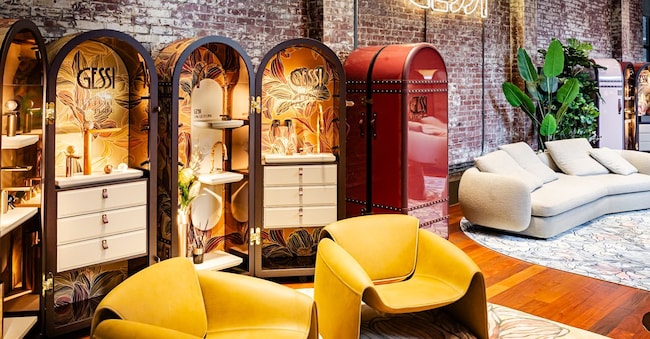
Quality, aesthetic research and technological innovation have so far rewarded the Italian bathroom manufacturers who present themselves at the appointment with Milan Design Week strong with a 2025 still growing, but aware of the geopolitical instability that invites caution.
"In 2025, the bathroom furnishing system recorded a production turnover of 4.3 billion euros, up 1.5% on 2024," says Elia Vismara, president of Assobagno. "The positive trend is mainly sustained by the domestic market, which - as the FederlegnoArredo Study Centre attests - is growing by 2.2%, while exports remain substantially stable, touching 1.7 billion euros. Europe is confirmed as the great reference basin, led by Germany and France with approximately 250 million in export turnover. "Contract is a segment that is gaining importance," continues Vismara, "and the bathroom is becoming an aspirational area where companies can experiment and offer high-end solutions. Well-being does not only lie in the technological complexity of the product, but also in the perception of living in a custom-designed space'.
Agrees Giulio Cappellini, since 2004 art director of Flaminia, the excellence of ceramic design in Italia, with a turnover of 25 million in 2025. "Over the last few decades," he explains, "there has been an epoch-making change in the bathroom environment, which has gone from being a service room to being a room for well-being. There is greater attention to furnishings, coverings, sanitary ware, perhaps coloured to give a different tone to the bathroom". Always a keen observer of trends, Cappellini sees for the bathroom, but for our homes in general, a need for softer, more rounded shapes and, above all, less sharp colours and textures than in the past. "Given what is happening in the world, we want softer environments, a more muted colour palette, which harks back to nature, to the earth". The new Hasu collection of washbasins designed by Giulio Iacchetti for Flaminia goes in this direction. "They are round, ovoid washbasins, both countertop and freestanding, which reflect this trend in their shapes and colours and also have the right scale for bathrooms that are now smaller than in the past".
Innovation guides the strategic choices of Antonio Lupi, the Tuscan company that in 2025 exceeded 44 million in turnover with a growth of 7 % on the previous year. "The strategic guidelines remain clear: invest in research and experimentation, develop collaborations, explore new project areas, and strengthen the technological presence," says Andrea Lupi, CEO of the company that became part of the Laufen group last summer. 'In complex international contexts,' he continues, 'it is essential to continue investing without slowing down on the path undertaken. This approach is reflected in the company's participation in the Salone Internazionale del Bagno with a stand full of new products, from Carsico, Paolo Ulian's marble washbasin-sculpture, to Carlo Colombo's Slide bathtub. Alongside these and other projects, there is the evolution of Lineadacqua, a washbasin with integrated spout in the wall by Giorgio Rava with Sensor technology, a technological update that eliminates all visible control elements.
Agape does not focus on isolated launches, but on evolutions that arise from relationships and visions shared over time. "During Design Week," says CEO Emanuele Benedini, "in the Via Statuto showroom we will present a project (a bathtub and a washbasin, ed.) developed with David Chipperfield, a figure we have followed and appreciated for the quality of his work. From an initial meeting, a dialogue was born that has developed over time and now results in a shared project, developed also thanks to the relationship with our partner Cesare Roversi". "For us," Benedini continues, "the difference is made by the partners: it is essential to work with qualified interlocutors, who know our range well and are able to represent it competently within complete interventions". For Agape, whose strongest markets include the United States and Australia, growth today comes above all from the residential and hôtellerie sectors, with positive signs in Italia, Spain and the South of France, and an initial response from investments in Scandinavian countries.
Brand connect


Newsletter RealEstate+
La newsletter premium dedicata al mondo del mercato immobiliare con inchieste esclusive, notizie, analisi ed approfondimenti
Abbonati