
'The future is in biodiversity and research has a crucial role to play'
Luigi Fiorentino, President of the National Biodiversity Future Centre, explains the importance of the new single health paradigm at the centre of a conference at the Expo in Osaka, emphasises the key role of synergy between businesses, universities and citizens, and takes stock of the Centre almost three years after its launch

7' min read
7' min read
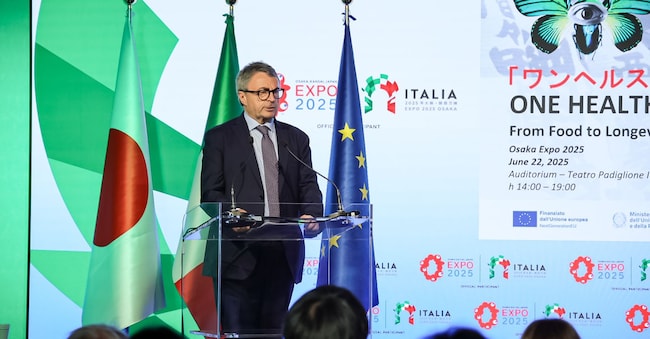
"The concept of One Health is closely connected to the issue of the environment and sustainability: we cannot think of protecting human health and the health of all living organisms without at the same time taking care of the conservation of ecosystems and the quality of natural resources. It is important, therefore, to proceed steadily with our research activities, while also continuing the intense 'cultural awareness' campaign we started on these issues with our project so that there is a collective commitment to safeguarding nature'. This was spoken by Luigi Fiorentino, President of Nbfc, the National Biodiversity Centre, just back from the conference at the Expo in Osaka dedicated to the theme of 'one health'. 'For Nbfc,' he adds, 'our presence at Expo, for which I am very grateful to Commissioner Vattani, had a very important meaning because it allowed us to be at the world's most important 'diplomacy and communication' event. Moreover, in that context we had the opportunity to consolidate a relationship, already initiated by one of our important partners, La Sapienza University, with Kansai Medical University.
How to make biodiversity a strategic investment for human well-being? Is public research sufficient?
The synergy between the public and private sectors is indispensable today. According to the World Economic Forum, about 50 per cent of global GDP - or USD 44 trillion - is directly dependent on biodiversity. Yet the Global Biodiversity Framework approved at COP15 (Kunming-Montreal) estimates that at least USD 200 billion per year is needed to preserve it. It is clear, therefore, that the only possible way forward is a true integration between the public and private sectors, a strong collaboration while respecting each other's roles. Creating new sustainable production chains and concrete economic opportunities is what will allow us not only to meet international targets, but also to guarantee a liveable future for all and, above all, to clearly affirm that biodiversity must also be seen as an engine for the economy and not only in terms of conservation and management costs.
What actions has the Nbfc taken on this issue and what are its future plans?
The entry of the private sector into the field of biodiversity is also linked to the concept of One Health. Underlying this is a simple but powerful principle: improving the health of all living organisms necessarily involves protecting natural resources and habitats, of which there are over one hundred in Italy. The efforts of the scientific community, including those carried out by Nbfc, are aimed at building better living conditions for human beings. These objectives, however, must be addressed today by taking into consideration the health of the planet together with that of human beings, with an assessment of the reciprocal impacts. With this approach, not only can we use research to improve action on the land and natural resources, but we can also create a social, scientific and political humus that can consider the wellbeing of all living organisms and that of ecosystems in an integrated way. The research and innovation proposals we are pursuing ask fundamental questions: how can we assess the state of health of the environment and the living beings that populate it? What actions can be taken to preserve and even restore biodiversity, instead of compromising it? We have published a report dedicated precisely to the restoration of nature that focuses not only on science but also on the role of man, of the citizen as an actor in the restoration process from a participatory perspective.


