Products

The PC of the future? For Nvidia it will be like R2-D2 but the incongnity is geopolitical

by Luca Tremolada

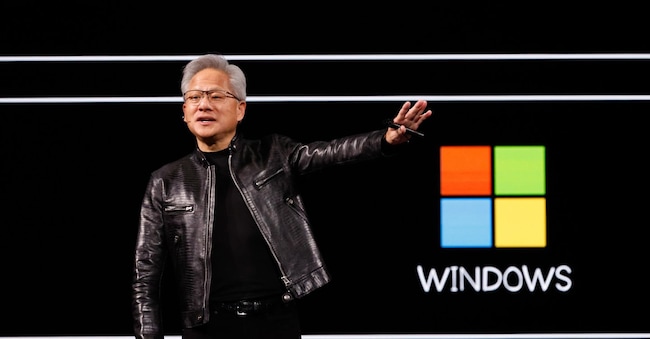
epa13008185 NVIDIA CEO Jensen Huang announces a Windows partnership during his keynote speech as part of the COMPUTEX 2026 AI exhibition in Taipei, Taiwan, 01 June 2026. Jensan Huang officially announced NVIDIA’s new products and various AI integration.  EPA/RITCHIE B. TONGO EPA

3' min read

Translated by AI
Versione italiana

3' min read

Translated by AI
Versione italiana

I can absolutely imagine that one day there will be an AI supercomputer in every home. And it will run all your agents and all your assistants, doing all sorts of things for you all the time." We are in Taipei, at Nvidia's GTC, almost at the end of Jensen Huang's very long keynote. According to the Nvidia boss, the computer of the future will surpass the traditional concept of a PC: 'Over time, it will become much more like R2-D2 or C-3PO for you than a PC'.

We still don't know much about the new laptops with the RTX Spark chip made with Microsoft. Jensen Huang enjoys rock-star fame here. The CEO of the $5 trillion chip manufacturer, born in the southern Taiwanese city of Tainan, chose Computex to announce that he will also enter the personal computer market.

Loading...

According to him, PCs today are like phones when smartphones came along: an evolving species. They will control the home and govern, locally and through the cloud, thousands of intelligent agents.

Its Arm architecture machine promises to consume little but have superior computing power. The goal is to offer Windows machines that not only focus on energy efficiency (as Qualcomm does), but also offer world-class graphics performance, native support for the Cuda ecosystem, and acceleration for local artificial intelligence and gaming. A bit like the holy grail in the age of artificial intelligence.

A new competitor joins Amd, Intel and Apple in the chip market. Future laptops with Nvidia chips aim to compete directly with Apple Silicon processors and the traditional x86 architecture controlled by Intel and Amd.

The company did not provide details on performance compared to competing solutions already on the market or coming in the next few months. Comparisons will be announced closer to the commercial launch of the new devices. Nvidia also stated that it does not anticipate any availability issues related to the current pressure on the semiconductor supply chain.

Remember, however, that Microsoft launched its AI-branded Copilot PCs in 2024, but the products turned out to be a flop. And then there is the market. According to an IDC report, global deliveries will fall by 11.3 per cent for the year as a whole, and the slowdown will be even more pronounced in the fourth quarter, when the expected drop will reach 20 per cent compared to the same period in 2025.

The main unknown factor, however, concerns the development of market prices. Underlying IDC's forecasts is the persistent memory shortage, a situation that analysts do not expect to improve significantly before the end of 2027. The shortage of components continues to put pressure on price lists, with the risk of price increases and reduced availability of certain configurations. For manufacturers and consumers, the crux is not only how many devices will be sold, but at what price it will be possible to buy them in the coming quarters. And finally, there is geopolitics. Will Ai be able to make way for the consumer electronics market or will the race take all the capacity? As long as artificial intelligence is part of the proof of power, it is difficult to imagine a phase of 'adoption' and standardisation. When you run, you run and think of nothing else. At least here in the West.

Copyright reserved ©
Loading...

Brand connect

Loading...

Newsletter

Notizie e approfondimenti sugli avvenimenti politici, economici e finanziari.

Iscriviti